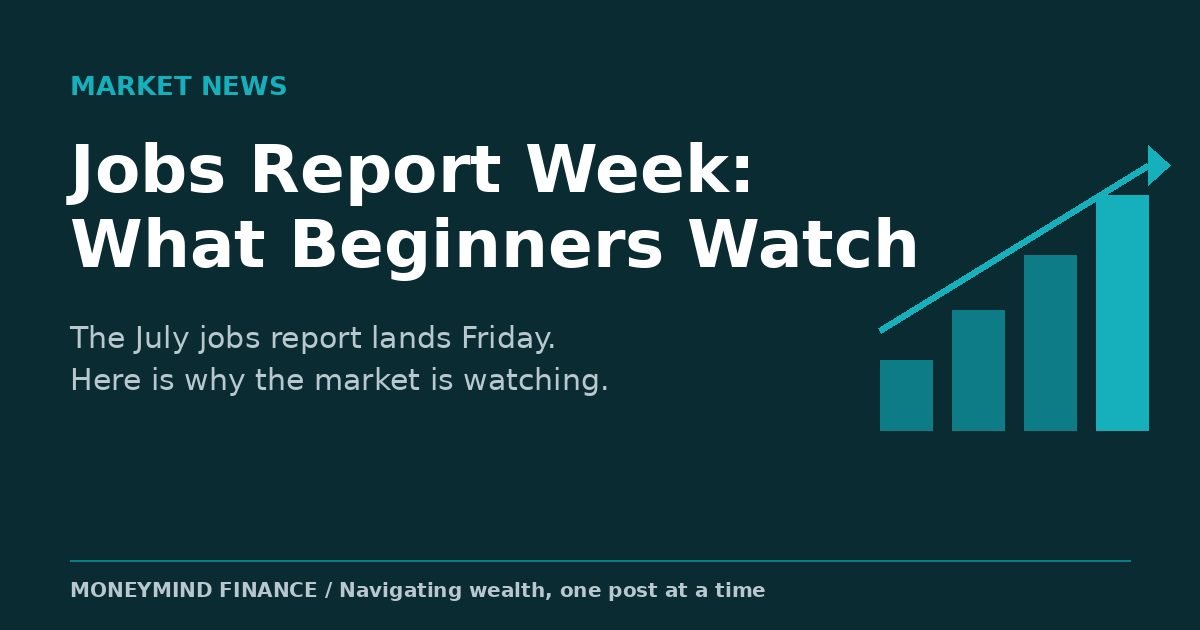
The July jobs report is the key event beginner investors should have circled this week, and it lands Friday. It's due Friday, August 7, at 8:30 a.m. Eastern. In plain English, the jobs report is the U.S. government's monthly scorecard for how many people are working, and the result can move the broader stock market within minutes of its released. This week it matters even more than usual, because it could actually help decide whether the Federal Reserve cuts interest rates in the month of September.
It also arrives in a packed week. This week brings earnings from major companies including Palantir, AMD and Eli Lilly, along with speeches from Fed officials following the central bank's decision to leave interest rates unchanged in late July. But the jobs report is the headline act. Here is what it is, why markets care so much, and the single figure a beginner investor should watch.
What the jobs report actually is
Once a month, the U.S. Bureau of Labor Statistics (a government agency that counts jobs and prices) publishes the Employment Situation report. Almost everyone just calls it the "jobs report." It has two headline pieces.
The first is nonfarm payrolls, often shortened to "NFP." This is simply the net number of jobs the economy added or lost last month, leaving out farm workers (their seasonal hiring would muddy the picture). If you hear that the economy "added 100,000 jobs," that is the payrolls number. The second is the unemployment rate, the share of people who want a job and are actively looking but do not have one yet.
Read: Intel Stock to Watch: 25% Revenue Jump, $11B...
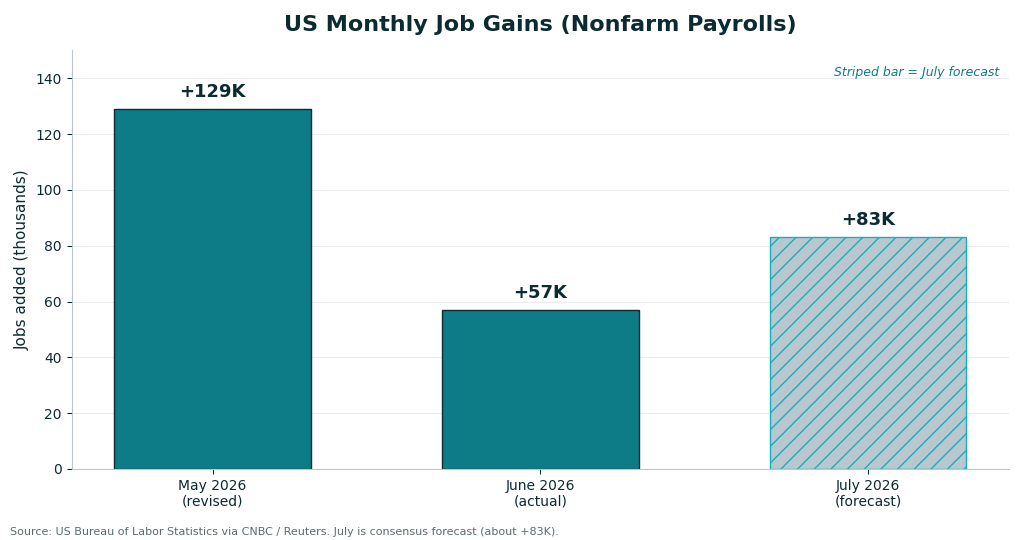
For context, the June report showed the economy added just 57,000 jobs, well short of what forecasters expected, while the unemployment rate held at 4.2%. Economists surveyed ahead of Friday's release expect roughly 83,000 jobs were added in July. The chart below shows how the last few months stack up.
Why the stock market cares so much this week
Here is the chain of logic that ties the jobs report to your investments. "The Fed" is the Federal Reserve, the U.S. central bank that sets a key interest rate. When it lowers that rate, borrowing gets cheaper for businesses and households, which tends to help the stock market. When it raises the rate, the opposite happens.
The Fed watches the job market closely. A cooling job market gives it a reason to cut rates to support the economy; a hot job market gives it a reason to keep rates high to hold down inflation (rising prices). The Fed left rates unchanged in late July, and its next decision comes on September 16. A softer jobs report on Friday would make a September rate cut look more likely, which investors generally cheer. A surprisingly strong report would push those hopes back.
That is why a single data point can move the market. It is not really about the number itself, but about what the number tells traders about the Fed's next move. Layer on a heavy week of company earnings, and you have plenty of reasons for prices to swing.
Read: Market Week Ahead: Fed Meeting and Big Tech Earnings
The Counter-Argument (And Why It's Serious)
Here is the strongest case against paying much attention at all: one jobs report is noisy. The headline payrolls figure is an estimate based on surveys, and it gets revised in later months, sometimes by tens of thousands of jobs. May's number, for example, was revised to about 129,000 after the fact. Critics argue that beginners who try to trade around the release usually just buy high, sell low, and pay fees for the privilege. The market can also react in a way that feels backwards, rising on "bad" news because it raises the odds of a rate cut.
That case is serious, and it is largely right about one thing: you should not trade on Friday's number. But understanding the report still matters. It sets the tone for the Fed, for interest rates on things like mortgages and savings accounts, and for the mood of the whole market over the following weeks. The healthy middle ground for a beginner is to follow the jobs report to understand the weather, not to time your next move. If you invest steadily over years, one month's headline should not change your plan.
Read: CPI Report Week: What Beginners Should Watch for the follow-up: the next inflation reading is the test of the rate-cut hopes this jobs report set off.
Read: Retail Earnings Week: What Beginners Should Watch for the next link in the chain: whether households are still spending as the job market cools.
The One Number to Watch
If you look at just one figure on Friday, make it the headline nonfarm payrolls number: how many jobs the economy added in July. Analysts have laid out rough goalposts. A gain well below 100,000 would fan worries that hiring is slowing and would strengthen the case for a September rate cut, something investors often welcome. A gain above roughly 150,000 would suggest the job market is still strong, giving the Fed less reason to cut and potentially cooling the market's enthusiasm.
Watch the direction and the surprise, not just the raw figure. A number far from the roughly 83,000 that forecasters expect is what tends to move prices, whether it lands higher or lower.
Read: Index Funds Explained: A Beginner's Guide
Update: since this was published the Fed has held rates at 3.5 to 3.75 percent, with three officials voting to raise them instead. Read: Jackson Hole Preview: 3 Fed Votes Say Hike, Not Cut.
Frequently asked questions
What time does the jobs report come out?
The July jobs report is scheduled for Friday, August 7, 2026, at 8:30 a.m. Eastern time, one hour before the U.S. stock market opens. That timing is why you often see stock futures jump or drop right after the release.
Is a strong jobs report good or bad for stocks?
It depends on the moment. Right now, with investors hoping for a rate cut, a very strong report can actually disappoint the market because it gives the Fed less reason to lower rates. In calmer times, strong hiring is simply read as a healthy economy. Context matters more than the label "strong" or "weak."
Should a beginner do anything before the report?
For most long-term investors, no. Trying to guess the number and trade around it is closer to gambling than investing. It is fine to read the report afterward to understand what is happening, but you do not need to change a well-diversified, long-term plan because of one month of data.
Why do the numbers get revised later?
The first release is an early estimate built from surveys that are not fully complete. As more employers report their data, the government updates the figure in the following months. That is why the first number is a snapshot, not the final word.
Read next: Rate Hike Odds Top 60% Before Friday’s CPI Report
Disclaimer: Content on this site is for informational and educational purposes only and does not constitute financial, investment, or trading advice. I am not a licensed financial advisor. Always conduct your own research and consult a licensed professional before making investment decisions.