The market week ahead is a big one for beginners to understand, because two of the most powerful forces in investing land at the same time: a Federal Reserve interest-rate decision on Wednesday and earnings reports from the four largest technology companies in the world. From July 27 to 31, 2026, Wall Street will hear from the Fed and from Microsoft, Meta, Amazon and Apple, and the reaction could set the tone for stocks into August. Here is what is happening, in plain English, and why it matters even if you are brand new to the market.
Stocks head into the week near record territory but a little jittery. The S&P 500 (a basket of 500 large U.S. companies that acts as a scoreboard for the whole market) finished Friday at about 7,412, essentially flat on the day and up roughly 8% so far in 2026. The Dow Jones Industrial Average closed near 51,947 and the Nasdaq Composite, which is packed with tech names, slipped about 0.6% to around 24,976. Disappointing results from Alphabet and Tesla the week before, plus rising oil prices, left investors cautious going in.
What is driving the market week ahead
Think of the market as a room full of people trying to guess how much companies will earn in the future and how expensive it will be to borrow money. This week hands them fresh clues on both. On the borrowing side, the Federal Reserve meets Tuesday and Wednesday. On the earnings side, four giant companies open their books. On top of that, the government releases its first estimate of second-quarter GDP (gross domestic product, the total value of everything the economy produced) and the PCE inflation report, which is the Fed's preferred way of measuring how fast prices are rising. When this much information arrives in a few days, prices can move quickly, so it helps to know what each piece means before it hits.
Read: What Happens When the Fed Raises Rates? A Beginner's Guide
The Fed decision: what "holding rates" actually means
The Fed (short for the Federal Reserve, America's central bank) sets a benchmark interest rate that ripples out to mortgages, car loans, credit cards and savings accounts. Right now that rate sits in a target range of 3.50% to 3.75%. The Fed announces its next decision on Wednesday, July 29, at 2 p.m. ET, followed by a press conference with Fed Chair Kevin Warsh at 2:30 p.m. ET.
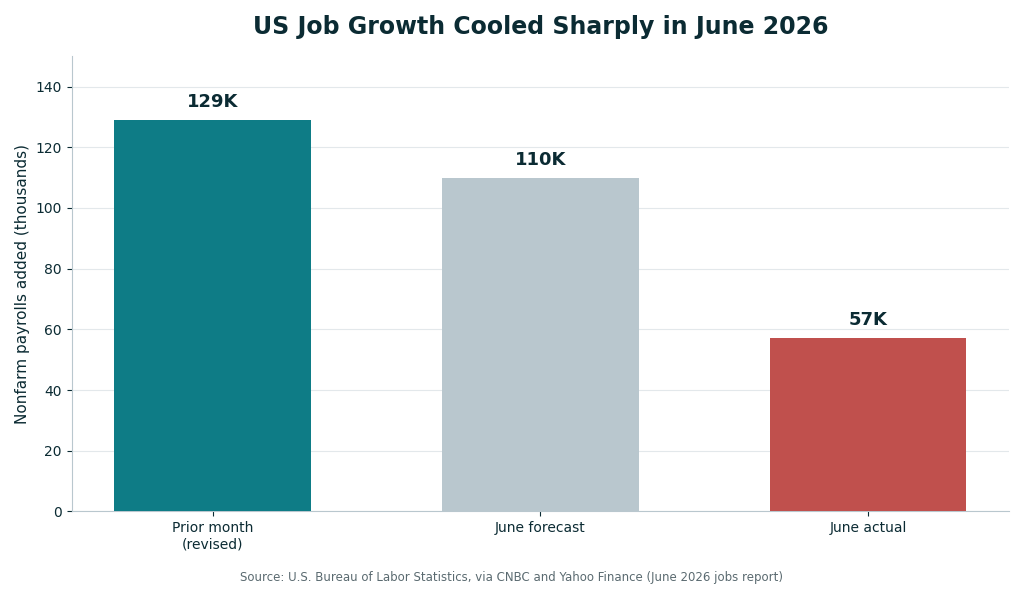
Most investors expect the Fed to "hold," meaning leave the rate exactly where it is. Here is the key idea for a beginner: markets usually care less about the decision itself and more about the tone. If Warsh sounds "hawkish" (worried about inflation and open to raising rates later), stocks can wobble. If he sounds "dovish" (relaxed about inflation and open to cutting), stocks often cheer. Lower rates tend to help stocks because borrowing is cheaper for companies and safer investments like savings accounts pay less, nudging money toward the market. One reason the Fed can afford to wait: hiring has cooled. The economy added just 57,000 jobs in June, well below the 110,000 forecast, as the chart below shows.
Big Tech earnings: why four companies can move the whole market
Every three months, public companies report "earnings", basically a report card showing how much money they made. A number investors watch closely is EPS, or earnings per share, which is the company's profit divided by the number of shares. Beating or missing what analysts expected can send a stock sharply up or down within minutes.
This week the reports come from the heavyweights: Microsoft and Meta on Wednesday, then Amazon and Apple on Thursday. These four have enormous "market caps" (market capitalization, the total value of all a company's shares), so they make up a large slice of the S&P 500. When a company that big moves, it tugs the whole index with it, like a few very heavy people shifting their weight on a see-saw. That is why even savers who never buy individual tech stocks feel the effect through index funds. Investors will listen for what these companies say about artificial intelligence spending, consumer demand and their outlook for the rest of the year.
Read: Index Funds Explained: A Beginner's Guide
Read: CPI Report Week: What Beginners Should Watch for how the next big inflation reading shapes the Fed's rate path.
Read: Retail Earnings Week: What Beginners Should Watch for how the big retailers report after Big Tech, and what they reveal about consumer spending.
The Counter-Argument (And Why It's Serious)
Here is the strongest opposing case: maybe none of this should matter to a long-term beginner at all. Plenty of seasoned investors argue that trying to trade around a Fed meeting or an earnings release is a losing game, because the professionals have already priced in the likely outcome. By the time you react to a headline, the move has often happened. In this view, obsessing over a single week just tempts you to buy high on excitement or sell low on fear.
That argument is serious and largely correct, and it is exactly why we are not suggesting you trade this week. But there is a balanced rebuttal. Watching weeks like this is still valuable as an education, not as a trading signal. Seeing how the market reacts to the Fed's tone, or to a big earnings surprise, teaches you how these forces work over time. And there is a practical angle: a hawkish Fed can keep savings and CD rates higher for longer, which affects the safe part of your money too. The goal is to understand the weather, not to gamble on tomorrow's forecast.
The One Number to Watch
If you follow just one number this week, make it the Fed's target rate range, currently 3.50% to 3.75%. Whether it stays put (the widely expected outcome) or the Fed hints at its next move in the press conference, that single range influences almost everything downstream: how much it costs to borrow, how much your savings account pays, and how investors value stocks. A beginner who simply notices where rates are and which direction the Fed is leaning understands more about the market than someone chasing every green and red flash on the screen.
Frequently Asked Questions
What time is the Fed decision this week?
The Federal Reserve is scheduled to announce its interest-rate decision on Wednesday, July 29, 2026, at 2 p.m. ET, with a press conference by Fed Chair Kevin Warsh at 2:30 p.m. ET.
Which big companies report earnings this week?
Microsoft and Meta report on Wednesday, and Amazon and Apple report on Thursday. Many other large firms also report, including Visa, Mastercard, Boeing, Exxon Mobil, Chevron and Starbucks.
Should a beginner buy or sell around these events?
This post is educational, not advice. Many long-term investors deliberately avoid reacting to single events because short-term moves are unpredictable. The healthier habit for most beginners is to watch, learn and stick to a plan rather than trade on headlines.
Why does the Fed's rate decision affect my savings account?
Banks tend to follow the Fed's benchmark rate. When that rate is higher, savings accounts and CDs often pay more interest; when it falls, those payouts usually shrink. So the Fed's decision touches your cash, not just the stock market.
Read next: Rate Hike Odds Top 60% Before Friday’s CPI Report
Disclaimer: Content on this site is for informational and educational purposes only and does not constitute financial, investment, or trading advice. I am not a licensed financial advisor. Always conduct your own research and consult a licensed professional before making investment decisions.