Index funds are one of the simplest ways for a beginner to start investing, and this guide explains exactly what they are and how they work in plain English. Instead of trying to pick individual winning stocks, an index fund lets you own a tiny slice of hundreds (sometimes thousands) of companies at once, all in a single purchase. That simple idea has made index funds hugely popular with new and experienced investors alike. Below, we will cover what an index fund actually is, why so many people use them, the strongest argument against relying on them, and the one number every beginner should watch.
What is an index fund?
An "index" is simply a list that measures a slice of the market. The S&P 500, for example, tracks about 500 of the largest companies listed in the United States. An index fund is an investment that tries to copy an index by holding the same companies in roughly the same proportions. So when you buy a share of an S&P 500 index fund, your money is spread across all 500 of those businesses at once.
This is called "passive" investing, because no one is actively trying to guess which stocks will beat the others. The fund just mirrors the index. That is different from an "actively managed" fund, where a professional manager picks and chooses investments in an attempt to beat the market (and usually charges more for the effort). Index funds come in two common wrappers: traditional mutual funds and ETFs (exchange-traded funds), which trade like a stock during the day. For a beginner, the key idea is the same: one purchase, instant diversification.
"Diversification" is just the old wisdom of not putting all your eggs in one basket. If one company in the index struggles, it is only a small part of the whole, so the damage to your overall investment is cushioned by the hundreds of others.
Why index funds are so popular with beginners
Three things make index funds especially friendly for people just starting out. First, they are low-cost. Because no expensive team of managers is picking stocks, index funds typically charge very small annual fees, which means more of your money stays invested and working for you. Second, they are simple: you do not need to analyze company earnings or read financial statements to get broad exposure to the market. Third, they harness time and compounding.
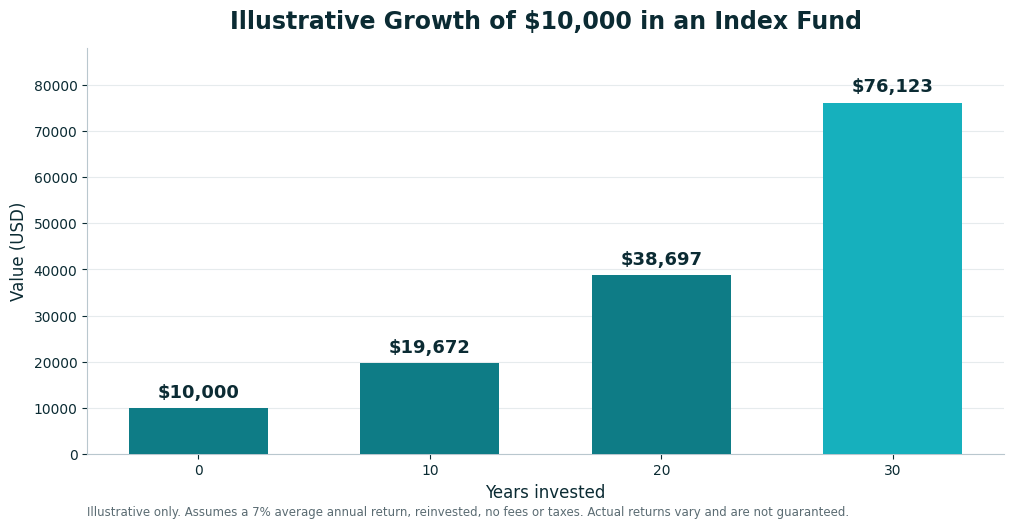
"Compound interest" (or compound growth) is when your gains start earning gains of their own. The chart below is an illustrative example: it assumes $10,000 grows at a 7% average annual return, reinvested, with no fees or taxes. Under those assumptions the balance would grow to roughly $76,000 over 30 years, without adding another dollar. Real returns are never this smooth and are not guaranteed, but the illustration shows why starting early matters so much.
If you are still deciding between index funds and buying individual companies, it helps to understand how to evaluate a single stock too. Read: How to Research a Stock Before Buying: A Beginner's 7-Step Checklist.
The Counter-Argument (And Why It's Serious)
Here is the strongest case against relying only on index funds, and it deserves honest attention. Because an index fund simply mirrors the market, you are guaranteed to never beat the market; you get the average, minus a small fee. When the whole market falls, your index fund falls right along with it, since it holds everything, including the losers. There is no manager stepping in to move you to safety. Index funds can also be more concentrated than they look: in a market-value-weighted index like the S&P 500, the largest companies make up an outsized share, so a handful of giant firms can drive much of your return.
The measured rebuttal: "average" market returns have historically been quite good over long periods, and decades of evidence show that most active managers fail to beat their index after fees. Falling with the market is the price of admission for long-term growth, and for an investor who keeps contributing and does not panic-sell, downturns can even be opportunities to buy at lower prices. The concentration risk is real, which is why some beginners choose a broader "total market" index fund. The takeaway is not that index funds are flawless, but that their trade-offs are well understood and manageable. Big promises of beating the market, by contrast, are where many beginners get burned. Read: Stocks That Could Explode: How to Spot Them Without Getting Burned.
The One Number to Watch
If you follow just one number with an index fund, make it the expense ratio. The expense ratio is the annual fee the fund charges, shown as a percentage of the money you have invested. A fund with a 0.03% expense ratio costs about $3 per year for every $10,000 invested; one at 0.75% costs about $75 for the same amount. That gap sounds tiny, but over decades those fees compound against you, quietly eating into your returns. All else equal, a lower expense ratio means more of the market's growth stays in your pocket, so it is the single most important cost number for a beginner to compare.
The account you hold an index fund inside matters as much as the fund itself, because it decides how the growth gets taxed. Read: Roth IRA Basics: A Beginner's Guide for 2026.
Frequently Asked Questions
Are index funds safe for beginners?
No investment is risk-free, and index funds can lose value when the market drops. But because they spread your money across many companies, they avoid the risk of a single stock wiping you out. Over long time horizons, broad index funds have historically been a popular, lower-cost way for beginners to invest. Your own situation and risk tolerance still matter.
What is the difference between an index fund and an ETF?
An index fund is defined by its strategy (tracking an index), while ETF describes how it is packaged and traded. Many ETFs are index funds that trade like stocks throughout the day, whereas traditional index mutual funds are priced once daily. For a long-term beginner, both can offer the same low-cost, diversified exposure.
How much money do I need to start?
It varies. Some index funds have minimum investments, while many ETFs can be bought for the price of a single share, and some platforms allow fractional shares. The more important habit is investing regularly over time rather than trying to time the market with one large lump sum.
Do index funds pay dividends?
Often, yes. If the companies inside the index pay dividends (a share of their profits), the fund typically passes that cash on to you, and many investors choose to automatically reinvest it to buy more shares, which adds to the compounding effect over time.
Read next: Market Week Ahead: Fed Meeting and Big Tech Earnings
Disclaimer: Content on this site is for informational and educational purposes only and does not constitute financial, investment, or trading advice. I am not a licensed financial advisor. Always conduct your own research and consult a licensed professional before making investment decisions.