Copper stocks have quietly become one of 2026's loudest trades, and Freeport-McMoRan is the name at the centre of it. The metal set an all-time high this month while Freeport's biggest mine was still recovering from an accident that halved its output. That combination, a shortage of supply meeting a company that is about to produce a lot more, is the whole story. This is a watch piece. There are no price targets here and nothing below is advice to buy or sell.
1. What Freeport Actually Does, in Plain English
Freeport-McMoRan (NYSE: FCX) digs copper out of the ground in Arizona, Peru, Chile and Indonesia, and sells it to the people who make wire, pipe, motors and transformers. It also produces gold and molybdenum, a metal used to harden steel, largely as by-products of the same rock.
Think of a bakery that mills its own flour. Freeport does not make the electrical cable in a data centre or the windings in an electric motor. It supplies the raw ingredient those things cannot be made without, and it earns whatever the market will pay for that ingredient on the day. That is the crucial difference between a miner and a manufacturer: Freeport has very little say over its selling price.
One asset matters more than the rest. Grasberg, in the Indonesian province of Papua, is one of the largest copper and gold deposits on earth. What happens there drives Freeport's results more than anything management does elsewhere.
2. Why Copper Stocks Are Getting Attention Right Now
Three dated things, and they compound each other.
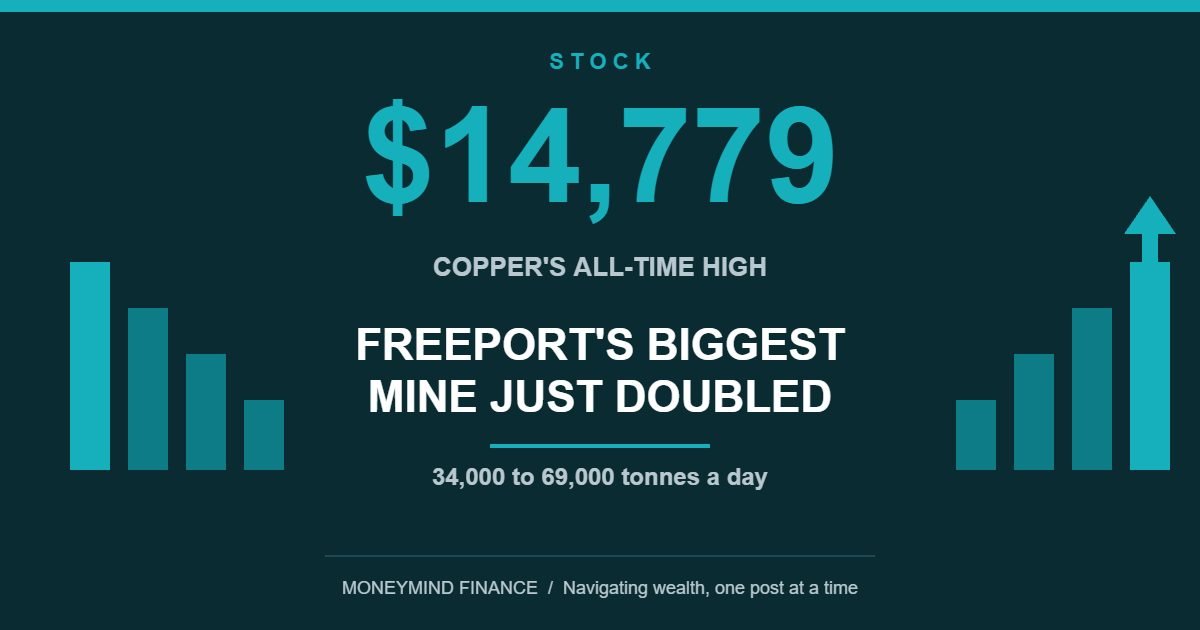
- Copper hit an all-time high on 8 September 2026. The benchmark three month contract on the London Metal Exchange reached $14,779 a tonne, a fourth straight session of gains, with analysts openly discussing $15,000, as Reuters reported that day.
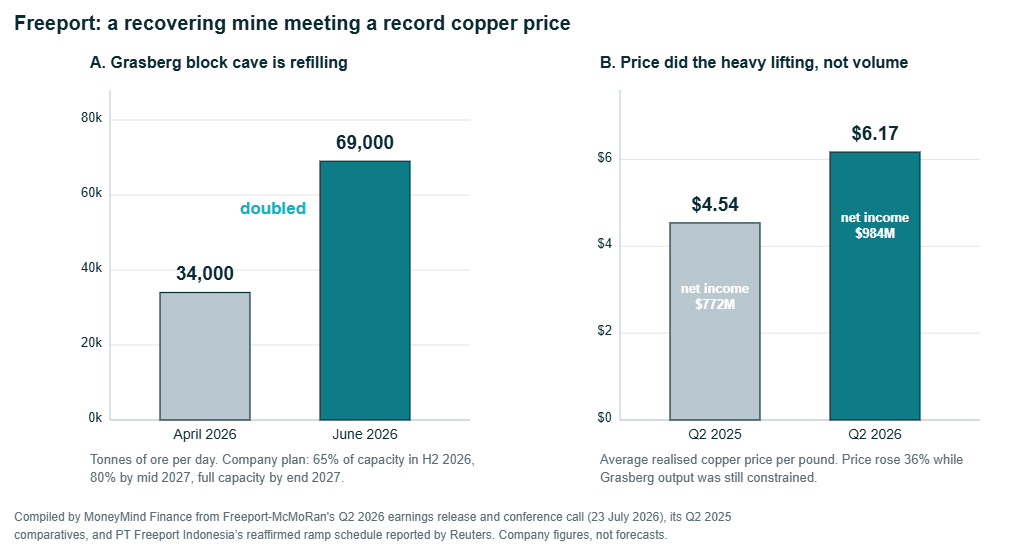
- Grasberg's output doubled in two months. Freeport's Q2 2026 results, published 23 July 2026, showed the block cave mine going from 34,000 tonnes of ore a day in April to 69,000 tonnes a day in June, recovering from a mud rush accident in September 2025.
- The copper is all in the wrong place. Washington has proposed a 15% tariff on imported refined copper from the start of 2027, rising to 30% in 2028, and has neither confirmed nor ruled it out. Traders have shipped metal to America ahead of a decision. Exchange stocks in London and Shanghai now total just over 300,000 tonnes between them, against a record 695,624 tonnes sitting in US COMEX warehouses.
Underneath the tariff noise is a demand story that will not go away: electricity grids, electric vehicles and the enormous power draw of new data centres. We looked at that same electricity demand from the other end of the supply chain last month. Read: AI Infrastructure Stocks: 3 Companies to Watch.
3. Revenue and Earnings, Explained Simply
From Freeport's second quarter 2026 results, for the three months to 30 June 2026:
- Revenue: $7,029 million. Operating income was $2,003 million and operating cash flow $2,048 million.
- Net income: $984 million, or $0.68 a share, up from $772 million a year earlier. Adjusted net income, which strips out one off items including charges from the Grasberg accident, was $1.1 billion, or $0.74 a share.
- Copper sales: 710 million pounds at an average realised price of $6.17 a pound, against $4.54 a pound in the same quarter of 2025.
- Unit net cash costs: $1.97 a pound. This is roughly what it costs Freeport to get one pound of copper to market after by-product credits from gold and molybdenum are deducted.
Put those last two together and you have the simplest picture of a miner's economics anyone needs. Freeport sold copper for $6.17 and it cost roughly $1.97 to produce. That gap is where the profit lives, and this year the gap widened not because costs fell but because the copper price rose 36%.
That is also the warning. A miner whose profit growth comes from price rather than volume is renting its earnings from the commodity market. When the price turns, the same arithmetic runs backwards.
The MoneyMind Stock Watch Score
We score every company we cover on the same six criteria, out of five each, for a total out of 30, so you can compare across posts. These scores are MoneyMind Finance's own judgement, not fact, not a rating and not a recommendation.
| Criterion | Freeport (FCX) | Southern Copper (SCCO) | Teck (TECK) |
|---|---|---|---|
| Revenue momentum | 4 | 5 | 3 |
| Profit quality | 3 | 5 | 1 |
| Balance sheet | 3 | 4 | 3 |
| Customer concentration | 4 | 4 | 4 |
| Valuation vs growth | 4 | 2 | 3 |
| Catalyst clarity | 5 | 3 | 4 |
| Total out of 30 | 23 | 23 | 18 |
- Freeport, 23 out of 30. The clearest catalyst calendar in the sector and the cheapest growth adjusted valuation of the three, held back by heavy capital spending and a balance sheet carrying net debt.
- Southern Copper, 23 out of 30. The same score by a completely different route: extraordinary profitability, with return on equity near 50%, offset by the most expensive valuation and the thinnest near term catalysts.
- Teck, 18 out of 30. A pending merger with Anglo American is a real catalyst, but return on equity of about 3% and a weak free cash flow position make the current business hard to score highly.
Download the full spreadsheet: the MoneyMind Finance copper stocks worksheet contains this scoring table with live SUM formulas, a mining margin calculator whose inputs you can change, a five year revenue sketch, and a source data block listing every figure in this article with its date and origin. It opens in Excel, Numbers or Google Sheets.
4. What Could Actually Drive Growth
Four specific mechanisms, not "electrification tailwinds".
- The Grasberg ramp itself. Freeport has guided to 65% of full capacity in the second half of 2026, 80% by mid 2027 and full capacity by the end of 2027. For the second half of this year it guided copper volumes up over 20% and gold up over 65% against the first half. More pounds at today's prices is the single biggest lever.
- Operating leverage. A mine's costs are mostly fixed: the same trucks, the same mill, the same crew. Doubling throughput spreads those costs over twice as many pounds, so unit costs fall as volume rises. That is why the cost per pound and the volume number move in opposite directions.
- Gold as a second engine. Grasberg produces gold alongside copper, and Freeport sold 192 thousand ounces in the second quarter. Gold revenue is deducted from copper costs as a by-product credit, so a strong gold price makes Freeport's copper look cheaper to produce without changing a thing underground.
- US smelting capacity. If Washington does impose tariffs on imported refined copper, companies producing and processing metal inside the United States gain a structural advantage over importers. Freeport's American mines sit on the right side of that line.
5. What Could Go Wrong
One mine, one country, one accident away. The September 2025 mud rush at Grasberg, an inrush of wet material into the underground workings, took the mine from full production to a fraction of it and Freeport is still climbing back more than a year later. The company itself has described the recovery as taking longer than expected. Any repeat resets the entire investment case, because no other Freeport asset can absorb the loss.
Processing is a bottleneck too, and it is already biting. PT Smelting's Gresik plant, 66% owned by Freeport Indonesia, has been shut since 8 August 2026 for furnace repairs, as MINING.com reported. It produces around 342,000 tonnes of cathode a year. Digging rock up is only useful if something can turn it into metal, and a mine with nowhere to send its concentrate is a warehouse.
The tariff cuts both ways. Record COMEX inventories exist because traders front ran a tariff that has not arrived. If Washington rules one out, that stockpile becomes surplus metal looking for a home, and the US premium that has flattered prices this year disappears. Morgan Stanley, which remains positive on copper for the rest of 2026, has said it is more cautious into 2027 for exactly this reason.
Cash is tighter than the profit suggests. Over the last twelve months Freeport generated $5.90 billion of operating cash flow but spent $4.14 billion on capital projects, leaving free cash flow of $1.76 billion on $25.87 billion of revenue. Mining is a business that eats its own earnings, and the ramp is not free.
6. The Valuation, Explained for Beginners
A price to earnings ratio, or P/E, is the share price divided by profit per share. It answers one question: how many years of current profit are you paying for?
As of 9 September 2026, using data sourced from S&P Global Market Intelligence, Freeport traded on a trailing P/E of about 38 and a forward P/E of about 22. Forward means based on the profit analysts expect next year, which is much higher because of the ramp. Enterprise value to EBITDA, a yardstick that includes debt, sat near 12. Return on equity was about 14.8% and the shares had risen 65% over 52 weeks.
Here is the nuance beginners usually miss. Freeport does not look expensive on forward earnings, and its PEG ratio, which divides the P/E by the expected growth rate, was about 0.61. A PEG below 1 normally reads as cheap. But that only holds if the growth arrives, and the growth depends on one mine in one country hitting a schedule it has already missed once. The low PEG is not a bargain, it is a bet on the ramp.
Cyclical companies are also the one place where a low P/E is a warning rather than a comfort. Miners look cheapest at the top of the cycle, when prices and profits are at their peak, and dearest at the bottom.
7. A Realistic Five Year Scenario for the Business
This projects the business, not the share price. No price targets and no forecast of where the stock goes. Three labelled arithmetic sketches with their assumptions stated, so you can disagree with the assumptions. Starting point: trailing twelve month revenue of $25.87 billion and an EBITDA margin near 37%.
- Cautious case. The Grasberg ramp slips again, copper gives back the tariff premium and averages nearer $12,000 a tonne, and smelter outages recur. Revenue growth of about 3% a year, EBITDA margin easing to the low 30s, revenue around $30.0 billion by 2031.
- Middle case. The ramp lands broadly on schedule, copper holds near current levels without going higher, and costs per pound fall as volume rises. Revenue growth of about 8% a year with the EBITDA margin holding near 37%, revenue around $38.0 billion by 2031.
- Stretch case. Grasberg reaches full capacity by the end of 2027, the structural deficit persists, and tariffs land in a way that favours US production. Revenue growth of about 12% a year, roughly the pace analysts currently forecast over three years, with the EBITDA margin in the low 40s, revenue around $45.6 billion by 2031.
All three are MoneyMind Finance's own illustrative arithmetic and nothing more. The worksheet lets you change the growth rate and margin and watch the revenue line move.
8. Who This May and May Not Suit
Speaking generally, and not about anyone's personal situation: this is a cyclical commodity business with a five year beta of about 1.40, meaning it has historically swung considerably harder than the wider market in both directions. The shares are up 65% in a year and trade well above their 200 day average of about $61, so anyone arriving now is arriving after a large move.
That profile tends to sit badly with money someone needs within a few years, or with anyone who would find a deep drawdown intolerable. The dividend of $0.60 a share, a yield near 0.8%, does little for an income investor. Anyone weighing this should think about their own time horizon and risk tolerance first, and speak to a licensed professional.
9. What to Watch, and the One Number That Matters
Four signposts:
- Freeport's third quarter results, due 22 October 2026.
- Whether the PT Smelting furnace repair finishes on schedule and the Manyar smelter runs reliably.
- The US tariff decision on refined copper, which is the single largest swing factor for the price.
- LME and Shanghai exchange inventories, which at just over 300,000 tonnes combined leave very little cushion.
The one number to watch: Grasberg's tonnes of ore per day, reported at the 22 October results. Everything else in this post is a story about a metal price nobody controls. That single figure is the part Freeport does control, and it decides whether the 65% of capacity target for the second half of 2026 is met. If it has stalled near 69,000 tonnes a day, the ramp is slipping again and the forward earnings that make the valuation look reasonable are the ones that move.
Interest rates also shape how the market prices cyclical, capital hungry businesses like this one. Read: Rate Hike Odds Top 60% Before Friday's CPI Report.
10. Copper Stocks FAQ
Why is the copper price at a record in 2026?
Three things at once. Mine supply has disappointed, with Chile stuck near 5.5 million tonnes a year against a 2018 peak of 5.831 million and the Democratic Republic of Congo banning concentrate exports. Demand from grids, electric vehicles and data centres keeps growing. And the prospect of US tariffs has pulled metal into American warehouses, draining stocks everywhere else.
What happened at Freeport's Grasberg mine?
In September 2025 a mud rush, an inrush of wet material into the underground block cave, forced production down sharply. Recovery has been gradual: 34,000 tonnes of ore a day in April 2026, 69,000 in June, with the company targeting full capacity by the end of 2027.
Is Freeport-McMoRan a copper stock or a gold stock?
Primarily copper, but the gold matters. Grasberg produces significant gold alongside copper, and Freeport sold 192 thousand ounces in the second quarter of 2026. Because gold revenue is credited against the cost of producing copper, a rising gold price lowers Freeport's reported cost per pound of copper.
Do copper stocks pay good dividends?
Generally not much, and not reliably. Freeport pays $0.60 a share, a yield of roughly 0.8%. Miners cut dividends when metal prices fall, which is precisely when an income investor would want them most, so this is not a sector to rely on for regular income.
Are copper stocks a good investment for beginners?
They are among the more volatile places to start. A copper miner's profits depend on a price it cannot influence, on mines that can flood or collapse, and on governments that can change tax and export rules overnight. The long term demand case is real, but the ride is rough. Anyone considering it should take advice from a licensed professional.
Disclaimer: Content on this site is for informational and educational purposes only and does not constitute financial, investment, or trading advice. I am not a licensed financial advisor. Always conduct your own research and consult a licensed professional before making investment decisions.