Your SAVE plan deadline is specific to your case, not a nationwide date, and for many borrowers, that deadline falls this month. The Department of Education says about 7.5 million people were enrolled in SAVE when a court order halted the program and loan servicers began sending exit notices on July 1, 2026. Each notice starts a 90-day clock that is specific to you. Let it run out, and a computer picks your repayment plan instead of you.
Why Your SAVE Plan Deadline Is Personal to You
A servicer is the private company that bills you for your federal student loans and processes your payments. You don't get to choose your plan, and that matters here, because the 90-day period begins when your servicer sends this notice, not to a single national cut off.
The sequence is simple. A federal court ended the SAVE plan on March 10, 2026. On March 27 the Department of Education began issuing guidance telling SAVE borrowers to move into a legal repayment plan. From July 1, servicers started sending the notices that begin the 90 day window. Edfinancial, one of the federal servicers, told its borrowers it would send those notices between July 1 and August 15, 2026.
Do the arithmetic and the earliest deadlines fall in the last week of September 2026, the latest around the middle of November. The only date that matters is the one printed on your own notice.
If you cannot find it, log in to your servicer account and check the message center, then check the email you used when you first borrowed. You do not have to wait for the notice either. You can call your servicer and switch today.
What Happens If You Do Nothing
Doing nothing is still a choice, and it has a specific outcome. Borrowers who have not moved by the end of their 90 days are automatically enrolled in one of two plans.
- The Standard Repayment Plan: a fixed monthly payment sized to clear your balance in 10 years.
- The new Tiered Standard Plan: a fixed payment over a term of 10, 15, 20 or 25 years, with the term set by how much you owe. Larger balances get longer terms and smaller monthly payments.
Notice what those two have in common. Neither looks at your income. The payment comes from your balance, so a month where your hours get cut does not change the bill. If you were paying nothing under SAVE, an auto enrolled payment could be the biggest new bill to hit your budget in years.
That is the real cost of missing the date. There is no penalty and no fee. You just end up in a plan you did not pick.
How the Repayment Assistance Plan Sets Your Payment
The Repayment Assistance Plan, usually shortened to RAP, is the new income based option and it opened on July 1, 2026. Income based means the bill comes from what you earn rather than what you owe.
RAP uses your adjusted gross income, or AGI. That is your income for the year after a short list of deductions, the figure on your tax return rather than the number on your payslip. RAP takes a percentage of your whole AGI and divides it by twelve.
The percentage climbs by one point for every extra $10,000 of income, according to the base payment percentage table published by servicer Edfinancial. It starts at 1% for an AGI just above $10,000 and stops at 10% once you pass $100,000, with a flat $120 a year below $10,000. Two adjustments then follow: subtract $50 for every dependent you claim on your tax return, and never pay less than $10 a month.
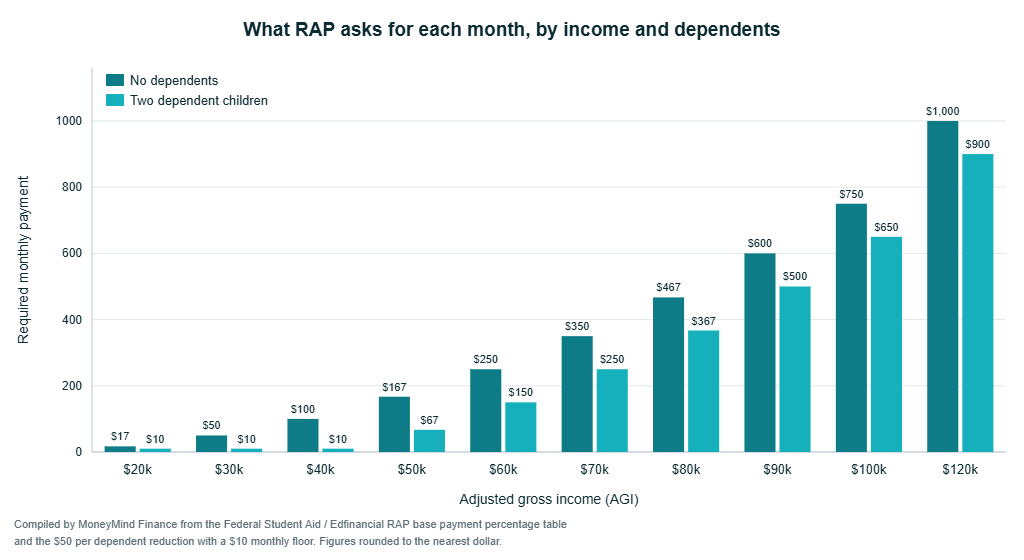
The dependent reduction does a lot of work at the lower end of that chart. A borrower earning $40,000 with two children pays the $10 floor, while the same earner with no children pays $100. Worth lining up against the rest of your family paperwork this year.
Read: Trump Account Rules: The $1,000 Is Not Automatic
Two features genuinely help. Any interest your payment does not cover is waived each month, so the balance cannot quietly grow behind you. And if your payment shaves less than $50 off the principal, the government tops it up so the principal falls by at least $50. The trade off sits at the finish line: anything still owing is forgiven after 30 years, and since January 1, 2026 that forgiven amount counts as taxable income.
The Counter-Argument (And Why It's Serious)
The case for RAP is stronger than the headlines suggest.
Under the older plans, a borrower with a very low payment could watch the balance climb year after year as unpaid interest stacked up. RAP ends that. The monthly interest waiver plus the $50 principal match mean a borrower who pays on time watches the number fall every month. The rules are also far easier to explain, and Public Service Loan Forgiveness still works the same way at 120 qualifying payments.
The rebuttal is about who pays, and for how long. RAP charges a percentage of every dollar you earn, while the older plans only counted income above a threshold, so lower earners generally pay more. The $0 bill is gone. And the forgiveness clock stretches to 30 years for everyone, against 20 or 25 years on the older plans, according to the plan comparison chart from the Institute for College Access and Success. Sixty extra payments is not a rounding error.
Both things are true at once. RAP is a better deal for a balance that was ballooning, and a worse deal for someone who was paying nothing and counting on relief at year 20.
The One Number to Watch
Watch your AGI against the nearest $10,000 line.
Because RAP moves in whole brackets, the boundaries behave like cliffs rather than slopes. An AGI of exactly $60,000 sits in the 5% band, so the payment is $250 a month. An AGI of $60,001 sits in the 6% band, so it is $300. One extra dollar of income costs $600 across the year.
This is why the account you save into matters. A traditional 401(k) or HSA contribution comes out before AGI is worked out, so it can pull you under a bracket line. A Roth IRA contribution does not, because that money is already taxed.
Read: Roth IRA Basics: A Beginner's Guide for 2026
None of that is a reason to save less. It is a reason to know which line you are standing near before you recertify your income.
Frequently Asked Questions
Can I still get a $0 student loan payment?
Not under RAP. The minimum is $10 a month, or $120 a year. Set up an automatic transfer so a missed $10 does not turn into a delinquency.
What if my notice never arrived?
Contact your servicer rather than waiting for mail. You can move into a legal plan at any time, and moving early means you are the one choosing.
Do RAP payments count toward Public Service Loan Forgiveness?
Yes. RAP payments count toward the 120 qualifying payments PSLF requires. The catch is that higher monthly payments leave a smaller balance to forgive at the end.
All my loans are from before July 2026. Do I have to move to RAP?
No. If all your loans predate July 1, 2026, you keep access to the other income based options and have until July 1, 2028 to make a final choice. The SAVE exit deadline still applies though, so you do need to pick something now.
Read: if extra shifts are part of your repayment plan, see why only part of your overtime pay is deductible.
Disclaimer: Content on this site is for informational and educational purposes only and does not constitute financial, investment, or trading advice. I am not a licensed financial advisor. Always conduct your own research and consult a licensed professional before making investment decisions.