
Trump Account Rules: The $1,000 Is Not Automatic
Trump Account Rules: The $1,000 Is Not Automatic
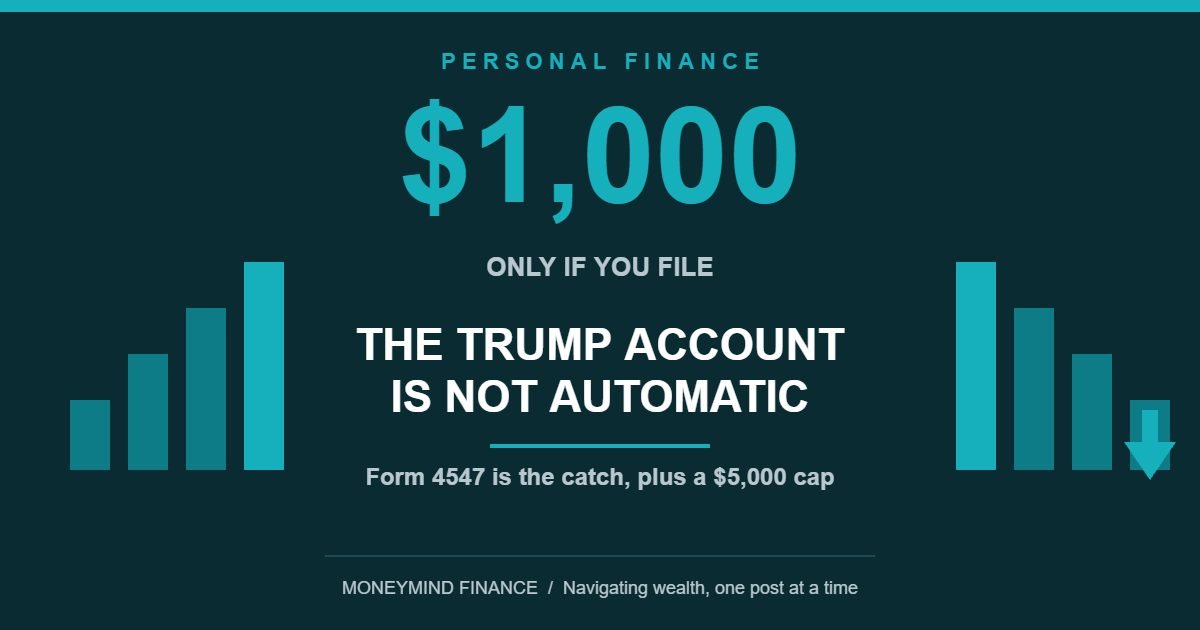
For new parents, the most important Trump account rules may be the details the headlines overlook. Here is the big one: the $1,000 the federal government has set aside for your newborn does not arrive automatically. Parents need to submit a form to claim.
Trump accounts available for contributions after July 4, 2026, and so many families still assume the money lands automatically once a birth certificate is issued. It does not. This guide explains who qualifies, how the money gets in, and the key detail about turning 18 that changes the way you should think about it.
Trump Account Rules: Who Actually Qualifies for the $1,000
A Trump account is a new type of traditional IRA (an individual retirement account, meaning a tax-sheltered pot of money meant for retirement) that can be opened for a child. A child with a Social Security number is eligible for one if the account is set up before the year they turn 18.
The one-time $1,000 government deposit is narrower. According to the proposed regulations Treasury and the IRS issued in March 2026, a child must meet all four of these tests:
- Be born in calendar year 2025, 2026, 2027 or 2028.
- Be a United States citizen.
- Have been issued a Social Security number.
- Have no prior pilot program election already processed by Treasury.
Then comes the step people miss. A parent or guardian who expects to claim the child as a dependent must actively elect the contribution using a new IRS form, Form 4547, Trump Account Election(s). No election, no $1,000. You can file it with a tax return or submit it through the official Trump Accounts portal at TrumpAccounts.gov.
The good news is that you have some breathing room. The claim can be made at any point during what Treasury calls the growth period, which runs from birth through December 31 of the year the child turns 17. The downside is that a deadline nearly two decades away can easily slip off a family's radar.
How Money Gets In: The $5,000 Cap, Explained
Once the account exists, four different types of contributor can put money in, and they are treated differently.
- You and your family. Cash only, after-tax, and not tax-deductible. This is the main way most accounts will grow.
- Employers. Up to $2,500 a year per employee, and that money is not counted as taxable income to the employee.
- Nonprofits and governments. Not subject to the annual cap, but they must give equal amounts to every eligible child in a defined group.
- Treasury. The one-time $1,000, which does not count against the annual cap.
Individual and employer contributions share a combined ceiling of $5,000 per year, adjusted for inflation after 2027. So a parent putting in $5,000 leaves no room for an employer that year, a detail worth checking if your workplace has pledged to contribute.
Charitable money is starting to show up too. The Michael and Susan Dell Foundation has pledged $6.25 billion toward $250 contributions for children, although published summaries of the program differ on exactly which children qualify, so treat the eligibility details there as unsettled.
One more constraint, and it is a sensible one: during the growth period the money must sit in a low-cost fund tracking a broad index of mostly United States shares, with no leverage and fees capped at 0.1%. You do not get to pick individual stocks for your toddler.
The Part Most Parents Miss: This Is a Retirement Account
This is where a lot of the excitement runs into the fine print. A Trump account is not a college fund and it is not a starter savings account.
No money can be withdrawn during the growth period at all, with the sole exception of the beneficiary's death. On January 1 of the year the child turns 18, the account simply converts into an ordinary traditional IRA. From that point the normal IRA rules apply, which means a 10% penalty on withdrawals before age 59 and a half unless the money goes to a narrow list of excepted purposes such as education or a first home, up to set limits.
The tax treatment matters as much as the lockup. Investment gains compound without being taxed each year, which is genuinely valuable, but they are taxed as ordinary income when eventually withdrawn. Ordinary income rates are the same rates that apply to wages, and they are usually higher than the long-term capital gains rates a plain taxable brokerage account would pay. As the Bipartisan Policy Center notes in its breakdown of the Treasury rule, a low-dividend fund held in an ordinary brokerage account could in some cases end up ahead.
If you want the version of this that gives tax-free withdrawals instead of tax-deferred ones, read our guide to Roth IRA basics for 2026.
The $1,000 Is a Seed, Not the Plan
It is worth being clear-eyed about what $1,000 does over 18 years. The table below assumes a 6% average annual return with monthly compounding, no fees and no taxes. It is an illustration, not a forecast, and real returns move around a lot and can be negative.
| What goes into the account | Estimated balance at age 18 |
|---|---|
| The $1,000 seed only | $2,937 |
| Seed plus $25 a month | $12,621 |
| Seed plus $50 a month | $22,304 |
| Seed plus $100 a month | $41,672 |
The government's $1,000 roughly triples. Your own $50 a month does more than seven times as much work. That is the honest framing: the seed is free money and worth claiming, but it is not a retirement plan for your child.
The Counter-Argument (And Why It's Serious)
The strongest case against funding a Trump account beyond the free $1,000 is a matter of sequence, and it deserves real weight.
Money in one of these accounts is locked for 18 years, then locked again by IRA penalty rules until roughly age 60. Meanwhile the same family may have no cash cushion, credit card balances at high rates, an unfunded 401(k) match, or nothing set aside for college. A 529 plan, by contrast, pays education costs directly and can roll up to $35,000 into a Roth IRA. Critics point out that a married couple with two children could reasonably fill more than $100,000 of other tax-advantaged accounts before a Trump account is the best home for the next dollar. On top of that, the rules are still proposed rather than final, and Treasury has said guidance on basis tracking and transfers is still to come.
The measured rebuttal: none of that argues against claiming the $1,000. That deposit costs you a form, not a dollar of your own money, and it buys 18 years of compounding you would not otherwise have. The sequencing critique is an argument about contribution number two onwards, not about the seed. Claim the free money, then put your own savings wherever it does the most good, which for most families starts with an emergency fund and a workplace retirement match.
The One Number to Watch
2028. That is the last birth year eligible for the one-time $1,000 contribution. Children born in 2025 through 2028 qualify; a child born in 2029 can still have a Trump account, but no federal seed money comes with it. If you have a child in that window, or one on the way, the action item is small and specific: file Form 4547 and get the deposit claimed.
Frequently Asked Questions
My baby was born in 2026. Do I get the $1,000 automatically?
No. Treasury only makes the deposit after a valid election has been filed by someone who expects to claim the child as a dependent. That election is Form 4547, filed with a tax return or through TrumpAccounts.gov.
Can I open a Trump account for a child born before 2025?
Yes. Any child with a Social Security number can have an account opened for them, provided it is set up before the calendar year they turn 18. What they cannot get is the $1,000 pilot contribution, which is limited to birth years 2025 through 2028.
Can the money be used for college?
Not freely. Nothing can be withdrawn before January 1 of the year the child turns 18. After that it follows traditional IRA rules, where qualified higher education expenses are one of the exceptions to the 10% early withdrawal penalty, but income tax is still due on the gains. A 529 plan is the purpose-built tool for education costs.
Is a Trump account better than a 529 plan?
They do different jobs, so "better" depends on the goal. A 529 is built for education and offers tax-free withdrawals for qualifying costs plus a Roth rollover option. A Trump account is built for retirement, locks money up far longer, and taxes gains as ordinary income. For most families the sensible order is to claim the free $1,000, then decide separately where new savings should go.
Read: the overtime break in the same law has its own trap, and we set out how the new overtime tax break actually works.
Disclaimer: Content on this site is for informational and educational purposes only and does not constitute financial, investment, or trading advice. I am not a licensed financial advisor. Always conduct your own research and consult a licensed professional before making investment decisions.
All Categories
Recent Posts

Meta and Tesla Earnings Wednesday: Nasdaq Fell 4.5%
JPMorgan Stock to Watch: $15.3B Profit, Buffer at 13.9%

Delta Stock to Watch: Fuel Up 75%, Profit Still Held
Tags

Navigating wealth, One post at a time