Most beginners meet the AI trade through one company, and it is usually the one making the chips everyone talks about. But spending on artificial intelligence flows through a much broader network of businesses. AI infrastructure stocks are the companies operating along that chain, from the semiconductors and networking equipment to the power, cooling, data centers and computing infrastructure needed to run AI systems.
This guide looks at three companies in that ecosystem, what each one actually does, where its growth could come from, and what beginners should keep an eye on. To be clear up front, this is a watchlist, and not a list of stocks to buy.
What "AI infrastructure stocks" actually means
Think about what has to exist before anyone can type a question into an AI assistant. Someone sells the specialized chips. Someone supplies the electricity and cooling that stop those chips melting inside warehouse-sized buildings. And someone rents the finished computing power out by the hour.
Those are three different businesses with three different risk profiles, and beginners often lump them together as "AI stocks." Separating them is the single most useful thing you can do when looking at this sector.
The scale of the spending is what makes the chain worth understanding. Amazon, Microsoft, Alphabet, Meta and Oracle are collectively expected to spend between $600 billion and $690 billion on capital expenditures in 2026, depending on the estimate. Capital expenditure, or capex, means money spent on physical assets: buildings, servers, equipment. When one company's capex budget is another company's revenue, you can see why the suppliers get interesting.
Three AI infrastructure stocks to watch, one from each layer
Broadcom (NASDAQ: AVGO), the silicon layer. Broadcom designs custom AI accelerators for a handful of very large customers, plus the networking chips that let thousands of processors talk to each other inside a data centre. In its second quarter, which ended May 3, 2026, the company reported total revenue of $22.19 billion, up 48% from a year earlier, and said AI semiconductor revenue alone was $10.8 billion, up 143%, according to Broadcom's own results announcement. Chief executive Hock Tan guided for AI chip revenue to reach $16.0 billion in the following quarter, growth of more than 200% year over year. What to watch: the next report, due September 2, and specifically whether that $16 billion guidance is met. Guidance this bold leaves no room for a miss.
Vertiv (NYSE: VRT), the physical layer. Vertiv makes the deeply unglamorous equipment that keeps data centres alive: power distribution, backup systems, and the liquid cooling that modern AI chips increasingly require. It is a useful reminder that AI has a physical footprint. In its second quarter of 2026 the company reported net sales of $3.27 billion, up 24% year over year, and raised its full-year outlook, in its results release of July 29, 2026. Adjusted earnings per share came in at $1.52, up 60%. What to watch: organic sales growth, which shows how much sales grew from the existing business alone. Vertiv reported 18% organic growth in the quarter against 24% total, and that gap tells you how much of the growth is genuinely new demand rather than acquisitions.
Oracle (NYSE: ORCL), the capacity layer. Oracle is a decades-old database company that has repositioned itself as a place to rent AI computing power. Its fourth-quarter results, reported June 10, 2026, showed cloud infrastructure revenue up 93% to $5.8 billion and total revenue up 21% to $19.2 billion, according to Oracle's results announcement. The headline figure, though, was remaining performance obligations of $638 billion, up 363%. What to watch: whether that backlog converts into actual revenue on schedule, and what it costs Oracle to build the capacity to deliver it.
One term worth defining there. Remaining performance obligations, or RPO, is the value of contracts a company has signed but not yet delivered. It is a promise of future revenue, not money in the bank, and promises can be renegotiated or delayed.
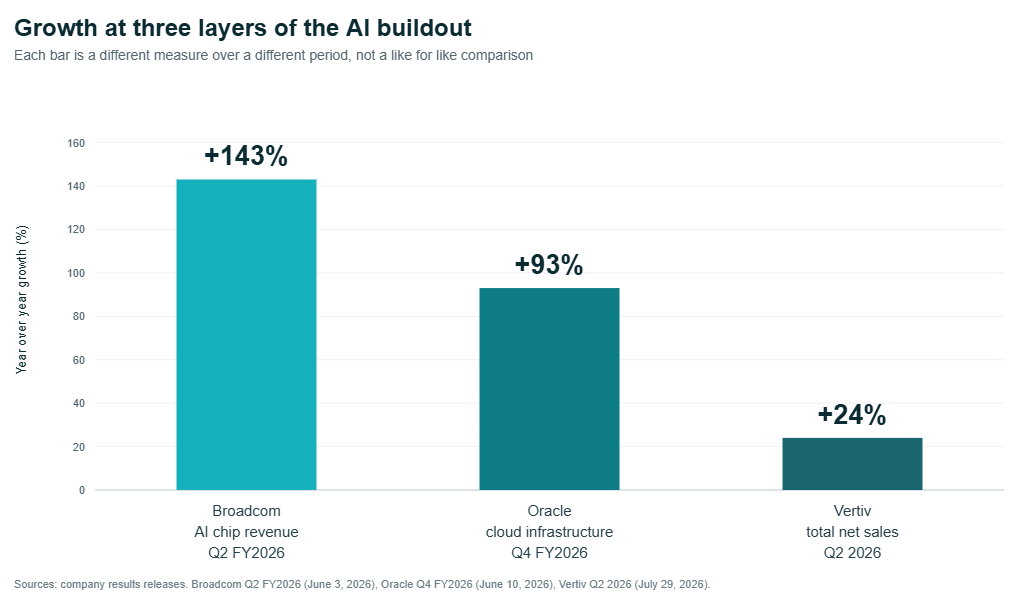
The shape of that chart is the lesson. The closer a business is to the AI chip itself, the faster it tends to grow and the more exposed it may be if demand cools. Vertiv's 24% looks modest beside Broadcom's 143%, but selling power and cooling is a steadier business than selling the chips.
If you want a process for looking at any of these properly rather than taking a blog post's word for it, Read: How to Research a Stock Before Buying: A Beginner's 7-Step Checklist.
Every layer of that buildout also needs metal. A data centre is thousands of tonnes of copper in cabling, busbars and transformers, which is why the AI trade shows up in the metals market too. Read: Copper Stocks: Freeport Up 65% as Grasberg Doubles Output
The Counter-Argument
Here is the strongest case against getting excited, and it deserves a proper hearing.
Every one of these businesses depends on a very small number of customers continuing to spend enormous sums. That $600 billion-plus of capex is not a law of nature; it is a decision a handful of executives make each year, and they can revise it. If AI products do not generate the profits investors currently assume, the first thing to be cut is next year's building programme, and the suppliers feel it immediately.
Concentration makes this sharper. A supplier whose growth depends on three or four buyers has little negotiating power if one of them pauses. And all three stocks have already risen a long way on this expectation, which means the good news is priced in and disappointment is expensive.
The measured rebuttal is that the spending is contracted rather than hypothetical, and it is being funded out of the enormous cash flows of profitable businesses, not borrowed on hope. Broadcom generated $10.26 billion of free cash flow in a single quarter. That is a different situation from the speculative building booms of previous cycles. Both things can be true at once: the demand is real today, and the price already assumes it continues.
The One Number to Watch
If you follow just one number across the AI infrastructure sector, make it hyperscaler capital expenditure guidance, what Amazon, Microsoft, Alphabet, Meta and Oracle say they plan to spend building out their computing and data-center infrastructure. You can find these figures in the company's quarterly earnings reports, investor presentations and quarterly earnings calls, and they can change as management adjusts its plans.
I find this useful because hyperscalers sit near the top of the AI infrastructure spending chain. When companies such as Microsoft, Amazon, Alphabet and Meta increase their infrastructure budgets, that spending can eventually create more demand for semiconductors, networking equipment, power systems, cooling technology and data-center capacity. The reverse is important too.
If spending plans flatten, get delayed or are reduced, companies throughout the supply chain can eventually feel the impact. That doesn't mean every supplier's revenue will immediately fall, but weaker spending expectations can change investor expectations well before the effect appears in a company's quarterly results. And this is why I would watch the buyers and not just the sellers.
A company can report an excellent quarter and still face a tougher outlook if its biggest customers begin slowing their infrastructure spending. On the other hand, rising capital expenditure plans can provide an important demand signal for companies supplying the technology and physical infrastructure required to build AI systems. The bigger lesson for beginners is very simple, don't just ask which AI company is growing fastest. Ask who is paying for the AI buildout, and whether those customers are still willing to increase their spending. .
And if picking individual companies in a fast-moving sector sounds like more risk than you want, that is a perfectly reasonable conclusion. Read: Index Funds Explained: A Beginner's Guide.
FAQ
Are AI infrastructure stocks safer than AI chip stocks?
Not necessarily. AI infrastructure stocks can carry significant risks just like AI chip stocks. Their performance depends on factors such as customer demand, capital spending, competition, valuations and the specific part of the AI supply chain they serve. Some may be less exposed to chip cycles, but that doesn't automatically make them safer investments.
What is a hyperscaler?
It is the industry term for the small group of companies running cloud computing at enormous scale, mainly Amazon, Microsoft, Alphabet, Meta and Oracle. They are the biggest buyers of AI hardware, which is why their spending plans matter so much to suppliers.
Why does a backlog figure like Oracle's not count as revenue?
Because the work has not been done yet. Accounting rules only let a company record revenue once it delivers the service. A backlog shows demand and gives useful visibility, but contracts can be delayed, renegotiated or cancelled before they turn into cash.
Should a beginner buy any of these three stocks?
This article is about understanding and watching these companies. I'm not telling you to buy them. Each has potential growth opportunities as well as significant risks. Before considering any investment, it's important to understand how the business makes money, its financial position, valuation and what could go wrong.
Disclaimer: Content on this site is for informational and educational purposes only and does not constitute financial, investment, or trading advice. I am not a licensed financial advisor. Always conduct your own research and consult a licensed professional before making investment decisions.