Rate hike odds pushed above 60 percent on Friday after the August jobs report came in roughly three times stronger than Wall Street expected. The Federal Reserve meets on 15 and 16 September, and only one more report can realistically change the outcome. It arrives at 8:30 a.m. Eastern on Friday morning.
This is a short trading week. Monday is Labor Day and the markets are closed, leaving four sessions with two of them dominated by inflation data. Here is what happened, why it matters, and the single figure worth circling on Friday.
What Sent Rate Hike Odds Above 60 Percent
Every month the Bureau of Labor Statistics publishes a count of nonfarm payrolls, simply the number of jobs on company and government payrolls, excluding farms. Economists surveyed by Dow Jones expected a gain of about 53,000 for August. The actual figure, published in the BLS Employment Situation report for August 2026, was 162,000.
The revisions mattered just as much. July had been reported as a loss of 23,000 jobs and was revised to a gain of 21,000. June went from 20,000 to 31,000. Together the two prior months were revised up by 55,000, so what looked like the start of a downturn now looks like a soft patch. Unemployment held at 4.1 percent, and average hourly earnings rose to $37.75, up 3.1 percent over the year.
Traders reacted within minutes. Pricing in fed funds futures, tracked publicly by CME Group's FedWatch tool, moved from roughly a coin flip to a clear lean toward a quarter point increase. Reported estimates on Friday ranged from about 60 percent to about 65 percent depending on the outlet, so treat the exact figure as a moving target.
Why Good Economic News Pushed Stocks Down
New investors are often confused when a strong economy sends share prices lower. The logic runs through interest rates. The federal funds rate is what banks charge each other for overnight loans, and the Fed sets a target range for it. Almost every other rate in the economy, from mortgages to credit cards, keys off that anchor. Raise it and borrowing gets dearer, future company profits are worth less in today's money, and safe government bonds start paying enough to compete with shares.
So a hot jobs report reads as evidence the economy can absorb higher rates. The S&P 500 slipped 0.4 percent on Friday to close at 7,718.60 while the 10 year Treasury yield climbed back toward 4.8 percent. Yields and bond prices move in opposite directions, so a rising yield means investors were selling bonds ahead of tighter policy.
Read: Jackson Hole Preview: 3 Fed Votes Say Hike, Not Cut
The Fed Was Already Three Votes From a Hike
This is the part many beginners miss. The Fed is not debating whether to cut. It is debating whether to raise. At the July meeting the committee left the target range at 3.50 percent to 3.75 percent, but the vote was not unanimous. According to the official FOMC minutes for 28 and 29 July 2026, Beth Hammack of Cleveland, Neel Kashkari of Minneapolis and Lorie Logan of Dallas all voted against holding. All three wanted a quarter point rise on the spot.
Chair Kevin Warsh argued that higher market interest rates had already tightened conditions, doing some of the Fed's work. That argument is weaker after a 162,000 print. The committee's quiet period also began on 5 September, so no official will discuss policy publicly this week. The data speaks alone.
The Week Ahead: PPI Thursday, CPI Friday
The calendar is thin until Thursday, then dense. Tuesday brings the NFIB small business survey and July consumer credit. Thursday at 8:30 a.m. Eastern the BLS publishes the Producer Price Index, which tracks the prices companies receive rather than the prices households pay, alongside weekly jobless claims. Friday at 8:30 a.m. brings the Consumer Price Index for August, then University of Michigan sentiment at 10 a.m.
For context, July headline CPI ran at 3.4 percent over the year and core CPI at 2.5 percent. Core CPI strips out food and energy, which swing violently and can disguise the underlying trend. Energy is why the gap is so wide: that index rose 14.7 percent in the twelve months to July.
As of 4 September the Cleveland Fed's nowcasting model was tracking August headline CPI at 3.38 percent annually and core at 0.20 percent monthly, per Kiplinger's economic calendar for 7 to 11 September. A nowcast is a running estimate built from partial data, not the official print, so it can miss.
The Counter-Argument
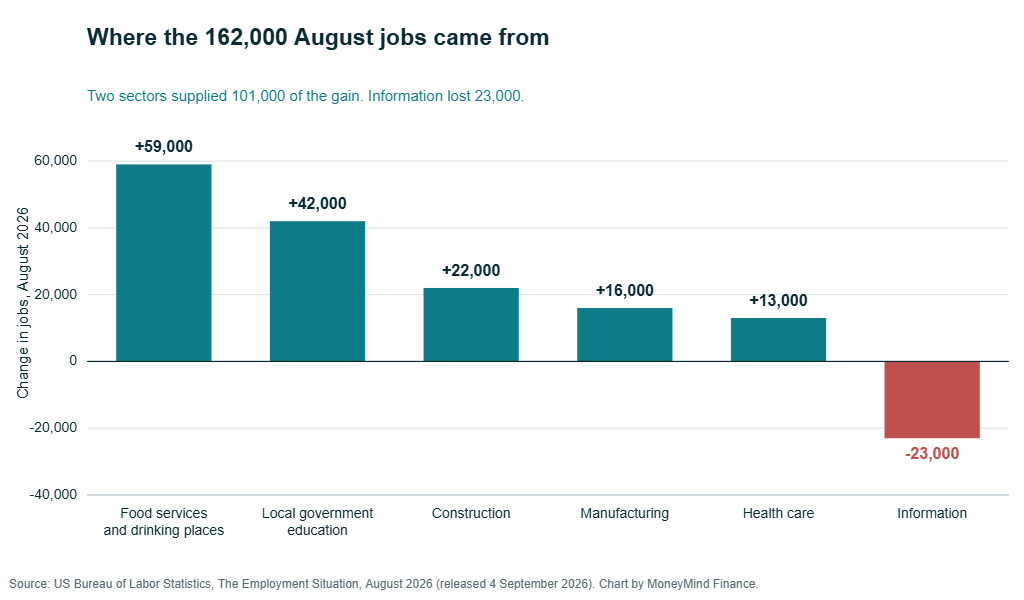
The case against hiking on 16 September starts with where the jobs came from. Food services and drinking places added 59,000 positions and local government education added 42,000. That is 101,000 of the 162,000 total, roughly 62 percent, from two sectors. Local government education was largely making up for a drop the previous month, so it may not repeat. Meanwhile the information industry shed 23,000 jobs. Breadth is thin.
The trend argument is weak too. The average monthly gain over the prior twelve months was just 31,000, so August ran at five times that pace and stays an outlier until a second month confirms it. Wage growth of 3.1 percent is also running below headline inflation of 3.4 percent, meaning the typical worker's pay is losing ground in real terms. That is not an overheating labour market.
The rebuttal is about credibility rather than this month's data. Inflation has sat above the Fed's 2 percent target for more than five years, and three voting members have already broken ranks to say waiting has a cost. Pass again after a strong jobs print and a firm inflation reading, and the Fed risks signalling that 2 percent is merely aspirational. Expectations of future inflation feed into actual inflation, which is why central banks guard that perception so carefully.
Read: Retail Earnings Week: What Beginners Should Watch
The One Number to Watch
Core CPI, month over month, Friday at 8:30 a.m. Eastern.
Not the annual rate, which moves slowly and is distorted by what happened a year ago. Not headline CPI, which energy prices drag around. The monthly core figure is the cleanest read on whether price pressure is building right now, and it is the number the committee carries into the room on 15 September.
A rough guide: 0.3 percent or higher makes it very hard for the Fed to justify waiting. A print at 0.2 percent, matching the nowcast, leaves the decision genuinely open. A print of 0.1 percent or lower hands the committee a reason to hold.
Frequently Asked Questions
Where do rate hike odds actually come from?
They are derived from fed funds futures, contracts whose value depends on what the federal funds rate averages in a given month. Because real money is at stake, the prices imply a probability, and CME Group publishes that calculation free. It is a market expectation, not a Fed forecast, and it can swing sharply in one morning.
What is the difference between headline and core CPI?
Headline CPI covers everything a typical household buys, including food and petrol. Core CPI removes food and energy because those categories jump around for reasons that have little to do with monetary policy. Headline is what you feel at the till. Core is what policymakers watch for the trend.
What would a hike mean for my own money?
Broadly, savers gain and borrowers pay more. Savings accounts, money market funds and newly issued bonds tend to follow the Fed upward, and so do credit card rates and new mortgage quotes. Existing fixed rate debt does not change. One quarter point move is small on its own, so the direction over the next several meetings matters more.
Disclaimer: Content on this site is for informational and educational purposes only and does not constitute financial, investment, or trading advice. I am not a licensed financial advisor. Always conduct your own research and consult a licensed professional before making investment decisions.