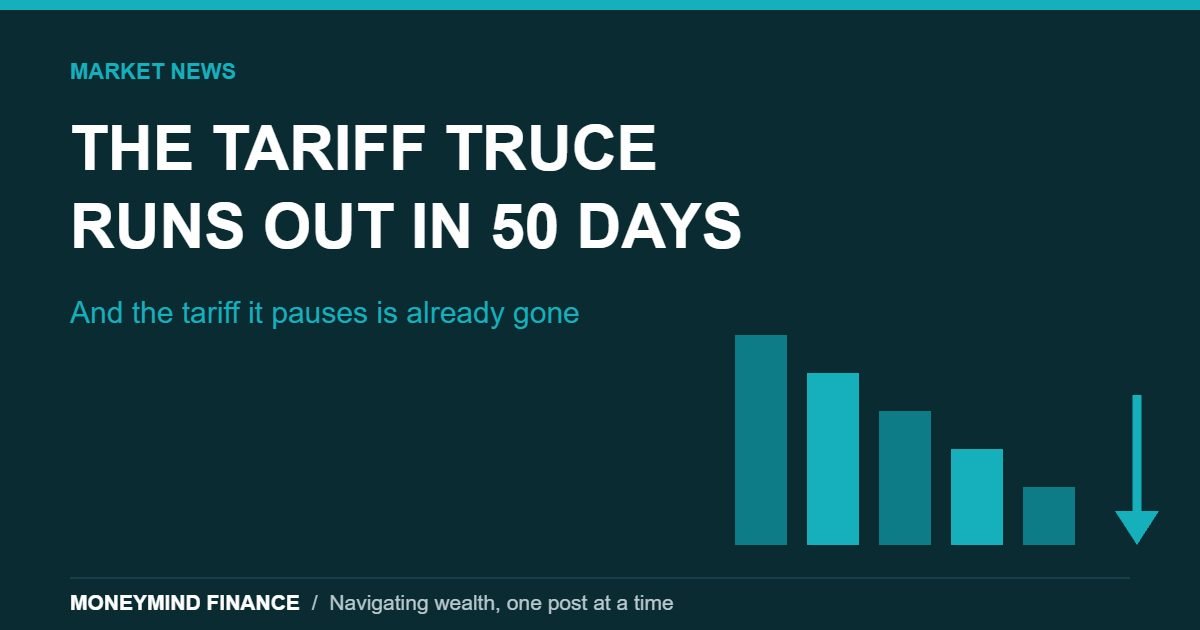
The tariff truce between the United States and China expires on November 10, and Thursday is the final scheduled opportunity for both leaders to address the issue. President Trump hosts Chinese President Xi Jinping at the White House on September 24, leaving 47 days until the deadline. Here's the part that often gets overlooked: the U.S. tariff that the deadline was meant to pause was already gone by February.
It may sound like a technical detail, but it matters. It changes the balance of leverage on Thursday and could make the deadline less significant than the headlines suggest.
What the tariff truce actually is
A tariff is simply a tax a government charges on goods coming in from another country. U.S. importers pay the tariff, not Chinese exporters, and the cost often ends up being reflected in the final price.
In April 2025 the White House put a 34 percent tariff on most Chinese goods. China responded with its own tariffs, the United States raised its rate again, and the combined country-wide charge peaked at 145 percent. After Trump and Xi met in October 2025, the rate was cut sharply and locked in place.
The lock has an end date. Executive Order 14358, published in the Federal Register, says the higher tariffs stay suspended until 12:01 a.m. eastern time on November 10, 2026. China agreed to its own dated commitments in exchange: pausing export controls on rare earth elements (the specialist metals used in electric motors and defense electronics), buying American soybeans, sorghum and logs, and expending the suspension of retaliatory tariffs on U.S. agricultural goods through December 31, 2026.
The problem with the November 10 deadline
Executive Order 14358 rested on a 1977 law called the International Emergency Economic Powers Act, usually shortened to IEEPA. It lets a president act quickly during a declared national emergency.
On February 20, 2026, the Supreme Court ruled that the law does not stretch that far. In Learning Resources, Inc. v. Trump, the Court held 6 to 3 that IEEPA gives a president no power to impose tariffs at all, because the Constitution gives that power to Congress. Four days later, at 12:00 a.m. on February 24, every tariff built on that law stopped being collected.
So the suspension expiring on November 10 applies to a tariff that has not been charged since February. If nothing were done, there would be nothing to snap back to.
What actually taxes Chinese goods today
Something did get done. The administration moved to laws that survived the ruling, and the handover was tight.
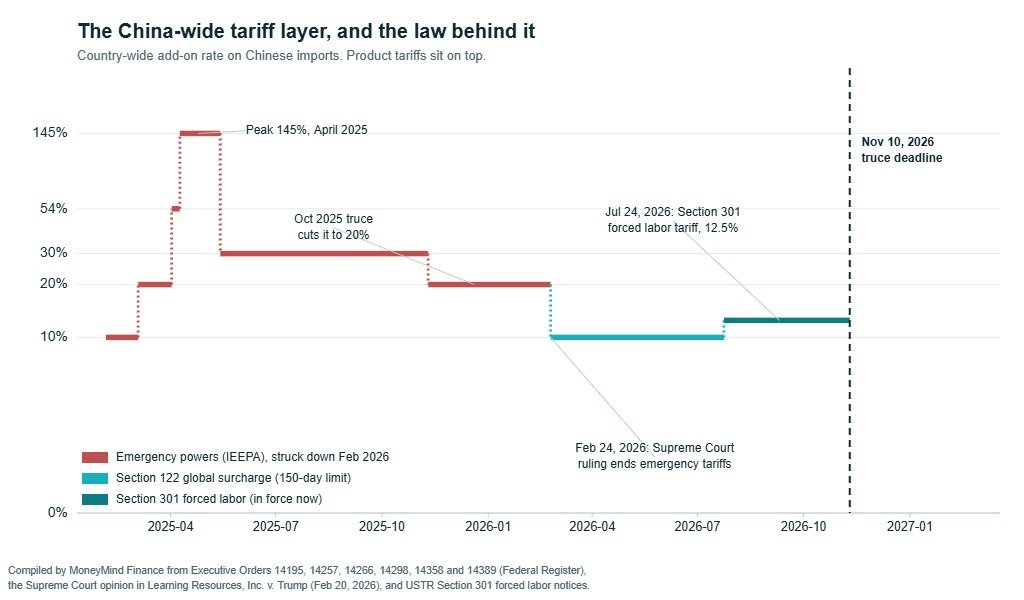
On February 24 the White House implemented a flat 10 percent charge on imports from every country under Section 122 of the Trade Act of 1974. That law is deliberately short leashed: 15 percent maximum, 150 days maximum, and any extension needs Congress. Those 150 days ran out on July 24, 2026.
They ran out on exactly the day the replacement began. At 12:01 a.m. on July 24, a new tariff took effect under Section 301, a law that lets the United States Trade Representative act against unfair foreign practices after an investigation. It covers roughly 60 economies on forced labor grounds: 10 percent for countries judged to have real enforcement, 12.5 percent for those judged to have none. As trade lawyers at White & Case noted after the ruling, tariffs built on other laws were never touched by the Court. China sits in the 12.5 percent tier.
On top of that sit older Section 301 tariffs from Trump's first term, from 7.5 percent to 100 percent by product, and Section 232 tariffs on steel, aluminum, cars, copper and timber, from 25 percent to 50 percent. An electric vehicle still faces a far higher total than a pair of shoes.
The rest of the week
Markets come into Thursday already unsettled. The Dow Jones Industrial Average closed Friday at 51,682.64 and finished down for a third week running. The S&P 500 ended at 7,650.50 and the Nasdaq Composite at 26,522.55, the only major index to gain on the week.
The reason is last week's other event. On September 16 the Federal Reserve raised its benchmark interest rate by a quarter point to a range of 3.75 to 4 percent, its first increase since year 2023, and the vote passed without opposition. The ten year Treasury yield has since pushed above 5 percent for the first time since 2007.
Read: our breakdown of why the Fed raised rates while core inflation sat at a five year low.
The economic calendar is thin, which leaves more room for the summit to set the tone:
- Tuesday: ADP private payrolls
- Wednesday: manufacturing and services PMI surveys
- Thursday: the Trump and Xi meeting, weekly jobless claims, new home sales
- Friday: durable goods orders and consumer sentiment
Earnings are quiet and consumer heavy: Costco, Paychex, Cintas, General Mills, Darden Restaurants, AutoZone and KB Home.
The Counter-Argument (And Why It's Serious)
The strongest case against everything above is that the legal plumbing is beside the point. Deals between governments are held together by willingness, not by citation. China made its concessions in exchange for lower American tariffs, and American tariffs on Chinese goods are lower today than they were before the ruling. If both sides are content, the label on the statute does not matter.
That case is serious, and it may well be right. But it cuts the other way too. The old tariffs could be changed with a signature overnight. The replacement tools cannot: a Section 232 investigation can take up to 270 days, and a Section 301 investigation can take a year. Sudden tariff threats are therefore far less credible, which is a real loss of leverage going into Thursday.
It also means China's concessions are now the more valuable half of the bargain, because rare earth export controls can be switched back on in days. China's Ministry of Commerce said in February it was evaluating the ruling and would protect its interests. It has not reimposed anything since.
Read: why critical mineral supply became a market story this year.
The One Number to Watch
12.5 percent. That is the country-wide American tariff on Chinese goods right now, and unlike the November 10 date, it is real money being collected today. If Thursday goes well, expect it to sit still. If it moves up, the truce is unravelling whatever either side says at the microphones. Watch that number, not the calendar.
Frequently asked questions
Does the tariff truce expiring mean prices jump on November 11?
No. The tariff the deadline suspends has not been collected since February 2026, so there is no automatic increase waiting behind it. Any rise would take a fresh decision under a different law.
Who actually pays a tariff?
The American company importing the goods pays it to customs. It may absorb the cost, push it onto the shopper, or negotiate a lower price from the supplier. In practice it is usually some mix of all three.
Did the Supreme Court cancel all tariffs?
No. It ruled only that one law, IEEPA, cannot be used to impose tariffs. Tariffs created under Section 301 and Section 232 were untouched and are still being collected.
What should a beginner take from this week?
That headline deadlines and actual costs are different things, and it is worth checking which one a story is really about. Nothing here calls for a trade.
Disclaimer: Content on this site is for informational and educational purposes only and does not constitute financial, investment, or trading advice. I am not a licensed financial advisor. Always conduct your own research and consult a licensed professional before making investment decisions.