The overtime tax deduction may sound simple but the detail matters: work the extra hours, and the federal government stops taxing them. The actual rules are much limited than the headline makes them sound, and the gap is where most workers get caught out. The figure you've probably seen quoted is $12,500. Only a small number of people will ever reach that amount.
Here's how the tax breaks actually works, who qualifies, and what may look different on your next W-2.
What the overtime tax deduction actually covers
First, let's clear up two important terms. A deduction is not the same as a refund. It reduces the slice of your income the government taxes, so your actual tax savings equal the deduction multiplied by your tax rate, not the full deduction amount. And qualified overtime is a much smaller thing than "overtime pay".
The deduction only applies to overtime that the Fair Labor Standards Act (the federal law that sets the 40-hour week) actually requires your employer to make the payment. That means hours worked beyond 40 in a week by non-exempt workers. Overtime you get because of a state law, a union contract, or a generous company policy does not count, even though it is included in the same paycheck.
Then comes the part that surprises almost everyone. Time-and-a-half is really two pieces stacked together: your normal hourly rate, plus a premium on top. Think of it like a restaurant bill where only the tip is tax free. The meal still gets taxed. According to the IRS guidance on the no tax on tips and overtime deductions, only that premium piece, the "half" in time-and-a-half, is deductible.
Why the $12,500 cap is almost unreachable
Run the arithmetic and the cap stops looking generous. Take a worker earning $25 an hour. Overtime pays $37.50, so the deductible premium is $12.50 for every overtime hour. Everything else is taxed as usual.
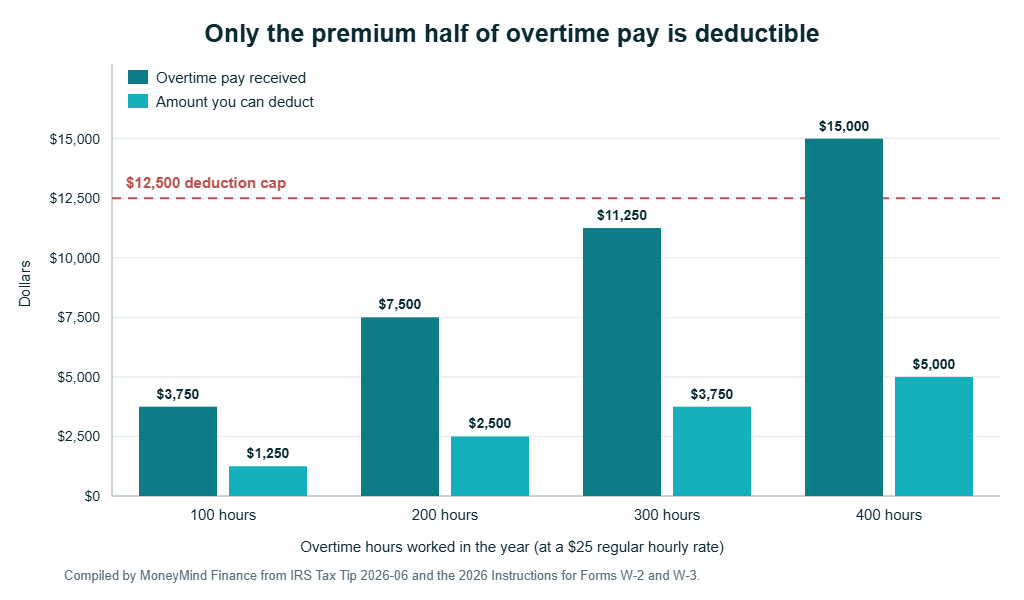
Work 400 overtime hours in a year, roughly eight extra hours every single week, and you collect $15,000 in overtime pay, but the deduction is limited to $5,000 of it. To hit the full $12,500, that worker would need 1,000 overtime hours, about 19 extra hours a week, every week, all year.
The higher your regular hourly rate, the fewer overtime hours you need, because the premium is based on half your regular rate. But for most hourly workers the practical deduction is a few thousand dollars, not $12,500. At a 12% federal tax rate, a $2,500 deduction is worth about $300.
Who qualifies, and where the income limits bite
The good news is that almost anyone earning qualifying overtime may be eligible. Here are the key requirements:
- You can claim it whether you itemize or take the standard deduction.
- You need a Social Security number valid for work.
- If you are married, you must file a joint return. Filing separately disqualifies you.
- The tax break is available for tax years 2025 through 2028, then disappears unless Congress extends it.
Then there is the income taper. Modified adjusted gross income, or MAGI, is roughly your total income after a handful of adjustments. Once MAGI passes $150,000 for a single filer or $300,000 for a couple, the cap shrinks by $100 for every $1,000 above the line. A single filer on $170,000 is $20,000 over, so the cap drops by $2,000 to $10,500. The deduction disappears entirely at $275,000 single and $550,000 joint.
Two limits people forget: this is a federal income tax break only. Social Security and Medicare tax still come out of every overtime dollar, and your state may tax the lot. And your paycheck withholding does not change, so nothing shows up until you file.
What changes on your 2026 W-2
For the 2025 tax year most employers improvised, typically writing the figure into Box 14 of the W-2 with a label like "QUAL OT". That was a stopgap. The 2026 Instructions for Forms W-2 and W-3, According to the official document published on 29 January 2026:
- Box 12, code TT is the new home for your qualified overtime compensation.
- Box 12, code TP reports the cash tips you declared to your employer.
- Box 14 has been split into 14a for the old "Other" entries and 14b for Treasury Tipped Occupation Codes.
The number in Box 12 code TT is the one you carry across. It goes on Schedule 1-A, the new IRS form for these deductions, in Part III, and the total flows to line 13b of your Form 1040. Tips go in Part II of the same form. If Box 12 code TT is blank and you know you worked federal overtime, that is worth a conversation with payroll before you file.
Read: the same one-form-or-you-miss-out pattern shows up elsewhere in this law, as our breakdown of why the $1,000 Trump account deposit is not automatic explains.
The Counter-Argument (And Why It's Serious)
The strongest case against getting excited here is that the deduction is small, temporary, and aimed at people who may not benefit much. A worker in the 12% bracket claiming a $2,500 deduction saves roughly $300 a year. Critics argue that is thin compensation for the hundreds of extra hours required to earn it, and that a tax break tied to working longer is a strange thing to build a household budget around. The break also expires after 2028, so it cannot be treated as permanent.
That critique lands. But the rebuttal is straightforward: $300 is not nothing to a household that is counting every dollar, and the money requires no extra effort beyond filing correctly, since you already worked the hours. The honest framing is that this is a modest rebate on work you were doing anyway, not a reason to volunteer for more shifts. If you are weighing what to do with the refund, our guide to the 50/30/20 budget for beginners is a sensible place to point it.
The One Number to Watch
Box 12, code TT on your 2026 W-2. That single number is your entire deduction. It is not your overtime pay, it is the premium slice of it, and if it is missing or looks too small the problem is at your employer, not the IRS. Check it in January rather than in April.
Frequently Asked Questions
Does the overtime tax deduction mean no tax is taken out of my overtime?
No. Your employer keeps withholding federal income tax, Social Security and Medicare from overtime exactly as before. You claim the deduction when you file, and any benefit comes back as a smaller tax bill or a bigger refund.
I am salaried and work long hours. Can I claim it?
Generally no. The deduction applies to overtime the Fair Labor Standards Act requires, which covers non-exempt workers paid past 40 hours in a week. Most salaried exempt employees are not owed FLSA overtime, so there is no qualified amount to deduct.
What if my employer left Box 12 code TT blank?
Ask payroll first, because the fix is usually a corrected W-2. The IRS expects the figure to come from an employer statement, so guessing at a number on your return is a bad idea.
Can I claim both the tips deduction and the overtime deduction?
Yes, if you genuinely earned both. Tips are capped at $25,000 and overtime at $12,500, each with the same income taper, and both are calculated on Schedule 1-A. Mandatory service charges added to a bill are not qualified tips.
Disclaimer: Content on this site is for informational and educational purposes only and does not constitute financial, investment, or trading advice. I am not a licensed financial advisor. Always conduct your own research and consult a licensed professional before making investment decisions.