The Zcash upgrade vote that closed in the middle of September was about as one-sided as crypto governance gets: coins representing 99.9% of the vote backed a proposal to make Zcash payments three times faster. It also came as ZEC went through a sharp rally that pushed its price. the coin that runs the Zcash network, into the top 10 largest cryptocurrencies by market size. This post breaks down what holders actually voted for, why the new-coin supplies remains unchanged, and what needs to happen before the changes take effect.
Quick size check: as of 26 September 2026, ZEC was trading around $1,543 with a market value (the price multiplied by all coins in circulation) of roughly $26.2 billion, ranking about ninth among all cryptocurrencies on both CoinGecko and CoinMarketCap. That may sound large, but ZEC is still only around one sixtieth the size of Bitcoin. Smaller coins like this tend to be more volatile, have less liquidity, and rely more on a single development team and the exchanges that list them.
What Zcash Is, in One Minute
Zcash launched in 2016 as a privacy-focused version of Bitcoin. It shares Bitcoin's 21 million coin cap and its habit of cutting the reward for new coins in half every four years or so, an event called a halving.
The difference is privacy. On Bitcoin, anyone can look up how much a wallet holds and where the money went. Zcash offers shielded transactions, which use advanced maths called zero-knowledge proofs to let the network confirm a payment is valid without revealing who paid whom or how much.
A simple analogy: Bitcoin is like sending money on a postcard that anyone at the post office can read. A shielded Zcash payment is a sealed envelope. The post office can verify that the stamp is real and the envelope is going to a valid address, but it cannot read what is inside.
The Zcash Upgrade Vote: What Holders Decided
The vote was a sentiment poll on NU7, short for Network Upgrade 7, the next big software update to Zcash. According to CoinDesk's report on the NU7 vote, nearly 2.4 million ZEC took part out of about 3.6 million that were eligible, roughly two-thirds. Organisers had set 1 million ZEC as the minimum turnout for the result to count as representative. Votes were weighted by coins, so one ZEC equalled one vote.
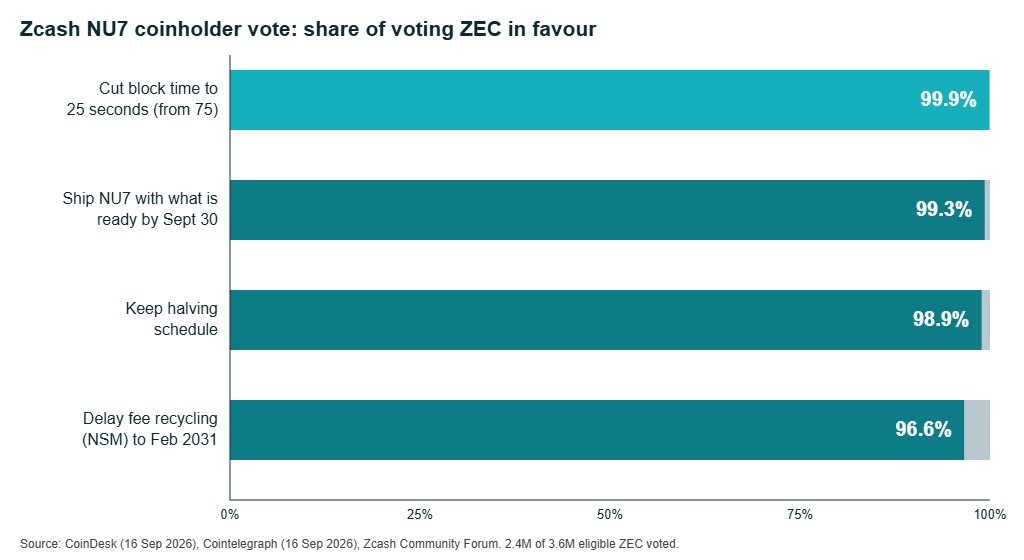
Here is what each result means in plain English:
- Faster blocks (99.9% yes): a block is a batch of transactions the network adds to its shared record. Zcash currently adds one every 75 seconds on average. The proposal cuts that to 25 seconds, In other words, you will get your first confirmation about three times faster.
- Keep the halvings (98.9% yes): the alternative was a smoother curve that would shrink new coin creation gradually instead of in big steps. Holders chose to keep the Bitcoin-style schedule.
- Ship on time (99.3% yes): any feature not ready by a 30 September deadline gets dropped from NU7 rather than delaying the whole upgrade.
- Delay fee recycling to 2031 (96.6% yes): a planned system called the Network Sustainability Mechanism (NSM) will pull at least 60% of transaction fees out of circulation and later pay them back to miners. Holders want that payback to start no earlier than February 2031.
The voting method was unusual too. Only coins held in Ironwood, Zcash's newest shielded pool, could vote, and ballots were encrypted and split into 16 pieces before counting. That let large holders use their full weight without revealing how many coins they own.
Why Faster Blocks Do Not Mean More ZEC
A fair beginner question: if three times as many blocks are made, and every block pays miners new coins, does supply triple? No. The official proposal, ZIP 218 on the Zcash improvement proposals site, divides the reward per block by three so that total issuance per hour stays the same.
Our own quick maths shows how that works. Miners are the computers that process transactions and secure the network, and today they receive 1.5625 new ZEC per block.
| Today (75 seconds) | After NU7 (25 seconds) | |
|---|---|---|
| Blocks per day | 1,152 | 3,456 |
| New ZEC per block | 1.5625 | about 0.52 |
| New ZEC per day | 1,800 | about 1,800 |
So the change is to speed and capacity, not to how fast new coins appear. ZIP 218 also notes that with the same 2 MB block size limit and three times as many blocks, the network gains room for more transactions per day.
Read: how crypto bear markets work and why altcoins usually fall hardest
Why the Price Has Moved So Much
ZEC has nearly doubled over the past 30 days, according to CoinGecko data on 26 September. The vote is only part of the story. On 17 September, the day after the results were reported, ZEC jumped 23% to about $1,369 as Matt Huang, co-founder of the crypto investment firm Paradigm, disclosed that his firm owns ZEC and called it a private complement to Bitcoin, CoinDesk reported.
For beginner investors, the lesson is that a governance vote hardly moves a price on its own. It tends to add to a story that is already attracting buyers. That cuts both ways: when the story cools, prices built on it can fall just as fast.
The Counter-Argument (And Why It's Serious)
The 99.9% headline hides some real caveats.
- Not everyone could vote. Only coins in the Ironwood shielded pool counted, about 3.6 million ZEC out of roughly 16.95 million in circulation. Most ZEC sits outside that pool.
- Coins, not people. One ZEC is one vote, so a few large holders can dominate. Zcash's Community Advisory Panel, which votes by person, was far closer on halvings: 57 members preferred the smoother curve and 54 wanted to keep halvings, Cointelegraph reported.
- A poll is not an upgrade. Nothing changes on the network until developers build, test and activate NU7, and no activation date has been set.
- Privacy brings regulatory risk. Some exchanges in some countries have delisted privacy coins in the past under regulatory pressure, and fewer places to trade usually means a less stable price.
The measured rebuttal: turnout of two-thirds of eligible coins is high for any crypto vote, far above the 7.25% share of circulating ZEC that took part in a February poll, and the options that won keep Zcash's existing supply rules rather than rewriting them. The vote reduces uncertainty about direction. It does not remove the risks of owning a volatile, mid-sized coin.
Read: what the stalled CLARITY Act means for crypto rules in the US
The One Number to Watch
The NU7 activation date. Once developers publish a testnet date (a practice network that uses coins with no real value) and then a mainnet date (the real network), the vote turns from intention into a schedule. Until then, the 25-second blocks and the new fee system are plans, not facts. Watch the Zcash improvement proposals site and the community forum for that date, and treat any price move before it with extra caution.
FAQ
What was the Zcash NU7 vote?
A poll of ZEC holders on what the next Zcash network upgrade should include. Holders backed 25-second blocks, keeping halvings, shipping on time and delaying fee recycling until 2031.
Will faster blocks create more ZEC?
No. The reward per block is cut to one third, so about 1,800 new ZEC are still created per day, and the 21 million maximum does not change.
When will the Zcash upgrade go live?
No date has been set. Features had to be ready by 30 September 2026, and testnet and mainnet activation dates are still to be announced.
Is Zcash riskier than Bitcoin?
Generally yes. It is much smaller, its price has swung far more, and as a privacy coin it faces extra regulatory and exchange-listing risk.
Disclaimer: The content on this site is for informational and educational purposes only and does not constitute financial, investment, or trading advice. I am not a licensed financial advisor. Always conduct your own research and consult a licensed professional before making investment decisions.