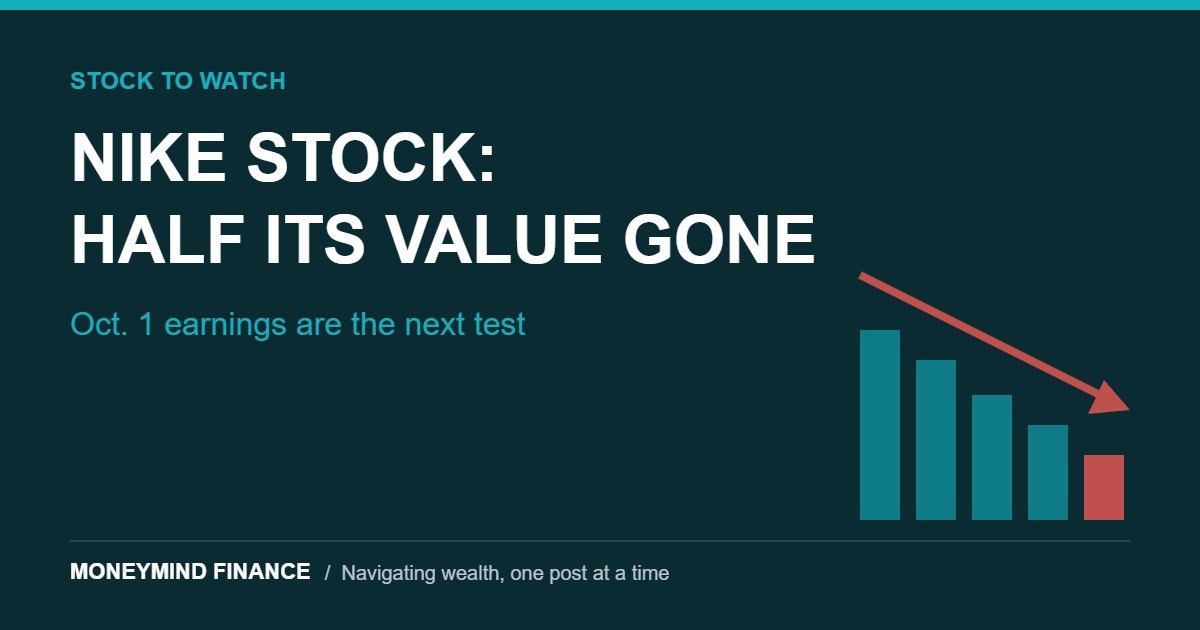
Nike stock enters autumn with one key date to watch: Thursday, October 1, when Nike reports first quarter results, with its shares trading at $36.10, less than half their October 2025 high of $76.97. For Nike, one of the world's biggest sportswear brands, that's a 53% drop.
Last week brought another set back for Nike: the stock was removed from S&P 100 (a list of the 100 largest US companies) and lost soccer star Kylian Mbappé to a smaller Swiss rival. This guide breaks down what Nike actually does, what its numbers really shows, and what to watch on October 1. It also includes our own score, a chart built from four earnings reports, and a spreadsheet you can download.
Prices are the NYSE closing price on September 22, 2026, checked on Yahoo Finance and CNBC. This is a stock to watch and understand, not a recommendation to buy or sell.
What Nike Actually Does
Nike designs, markets and sells sports shoes, clothing and equipment. Nike typically has other manufacturers produce them: independent contract factories, mostly in Asia, do the manufacturing, and Nike pays them per pair.
Think of Nike like a record label. The label signs the stars, shapes the sound and runs the marketing, but Nike relies on other companies to manufacture them. Nike signs athletes, designs the product and builds the brand. Its value lives in the swoosh, not in the factories.
It sells in two ways:
- Wholesale: selling to other shops such as Foot Locker and Dick's. This brought in $27.5 billion in the year to May 31, 2026.
- Nike Direct: Nike's own stores, website and app. This brought in $17.7 billion, down 6%.
Nike's financial year ends on May 31, so "fiscal 2027" started on June 1, 2026. Besides the Nike brand, the company owns Jordan ($7.0 billion of sales last year) and Converse ($1.2 billion, down 31%).
Why Nike Stock Is Getting Attention Now
Four dated events are piling up in a short window:
- October 1: first quarter results. This is the first report under new finance chief David Denton, who joined from Pfizer on August 17.
- September 21: out of the S&P 100. Nike was removed after about 18 years, as Fortune reported on Nike's S&P 100 exit. Index funds that track that list had to sell. Nike stays in the S&P 500.
- September 18: Mbappé leaves. The French striker ended a roughly 20 year relationship with Nike and signed with On, telling CNBC that it was time to change.
- November 10 and November 16 to 17. The US and China tariff truce expires on November 10 (read our tariff truce explainer), and Nike holds an Investor Day a week later to set out its next plan.
Nike's Revenue and Earnings, Explained Simply
First, let's clear up a few key terms, Revenue is the money a company earns from sales. Gross margin is the share of each sale left after paying to make and ship the product: a 40% gross margin means $40 of every $100 sale is left to pay for marketing, staff and profit. EPS (earnings per share) is profit divided by the number of shares. A basis point is one hundredth of a percentage point.
According to Nike's fourth quarter and full year results, revenue for the year to May 2026 was $46.4 billion, flat on the year before. Reported EPS was $2.10. That looks steady, but it hides a one-off.
In February 2026 the US Supreme Court ruled that tariffs imposed under a law called IEEPA were unauthorized. Nike expects to get $986 million of those tariffs back, and booked that benefit in its last quarter. Strip it out and the picture changes:
| Fiscal 2026 (year to May 31) | As reported | Without the tariff refund |
|---|---|---|
| Gross margin (full year) | 42.9% | 40.8% |
| Gross margin (Q4 only) | 49.2% | 40.2% |
| Earnings per share (full year) | $2.10 | $1.58 |
So the underlying business earned about $1.58 a share, and its gross margin has slid from 45.4% two years ago. The weakest spot is Greater China, where fourth quarter sales fell 17% on a currency-neutral basis (meaning with exchange rate swings removed).
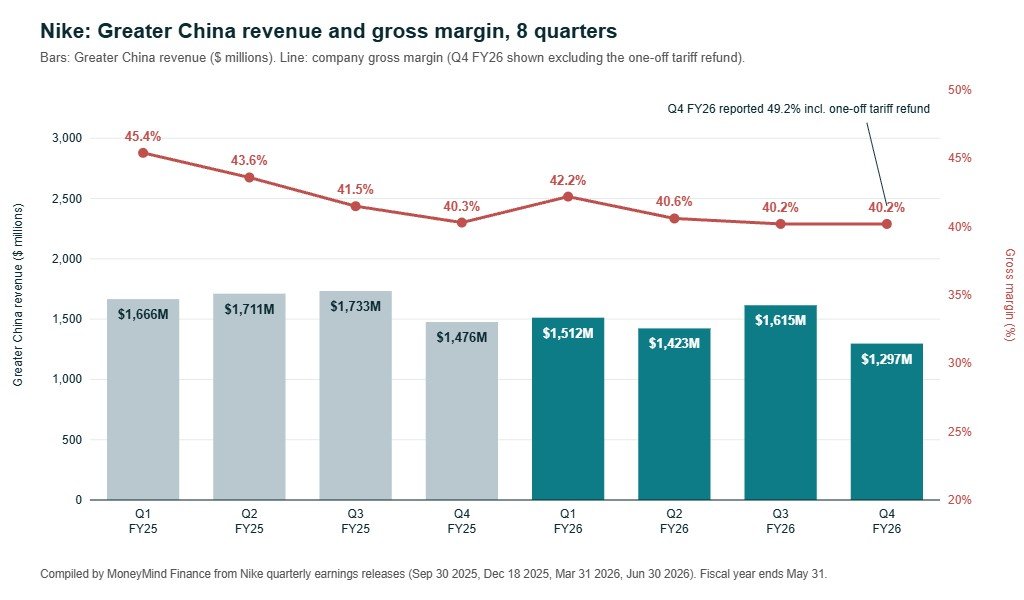
The eight quarters tell a much clear story when viewed together than any single press release does: China sales fell against the year before in every quarter of fiscal 2026, and the margin, once the refund is stripped out, has not yet turned up.
What Could Drive Growth
- Running. Management said on the June call that Running has grown by double digits for five straight quarters. It is the proof that new product can sell at full price.
- North America. Revenue in Nike's biggest region rose 5% last year, and Foot Locker grew Nike sales for the first time in over four years.
- Fewer discounts. Nike is cutting back on markdowns and off-price sales. That shrinks revenue now but should lift margins. It guided for gross margin to rise from the first quarter.
- The World Cup. Nike raised marketing spend for the 2026 tournament, which it says lifted football demand.
- New products. More than a dozen new sportswear shoe styles are due in the second half of fiscal 2027, and China specific product arrives for Holiday 2027.
What Could Go Wrong
- China keeps shrinking. Management expects recent declines to continue in the near term while it clears old stock from stores.
- Sportswear and Jordan. These lifestyle lines, roughly half of revenue, are expected to stay negative through fiscal 2027. When the fashion side weakens, discounting follows.
- Tariffs. The refund was for tariffs already paid. Nike's plan assumes an extra 15% tariff from August onward, and the November 10 truce deadline could change that.
- Rivals. Newer brands such as On and Hoka compete hard in running, and losing Mbappé to On is a public signal that athletes see other options.
- The dividend. Nike declared $1.63 a share in dividends last year, slightly more than the $1.58 it earned without the refund. A company cannot pay out more than it earns forever.
Nike Stock Valuation, Explained for Beginners
The P/E ratio (price to earnings) tells you how many dollars investors pay for each dollar of yearly profit. A P/E of 20 means paying $20 for $1 of earnings, so it would take 20 years of today's profit to earn back the price.
On the headline numbers Nike's trailing P/E is about 17. But that uses the $2.10 that includes the refund. Using the underlying $1.58, the P/E is closer to 23. CNBC lists the forward P/E, based on the next twelve months of expected profit, at about 22.
For comparison, an Insider Monkey analysis published on Yahoo Finance put forward P/Es on September 21 at roughly 11 for Adidas, 10 for Deckers (owner of Hoka) and 14 for On. In plain terms, the market still pays about twice as much for a dollar of Nike profit as for a rival's, even though Nike's sales are shrinking. That premium is a bet on a comeback.
The dividend yield (yearly dividend divided by share price) is 4.5%. That is high for Nike, but only because the price fell, and as noted above it is not comfortably covered.
The MoneyMind Stock Watch Score
We score every company we cover on the same six criteria, 1 to 5, for a total out of 30, so a sportswear brand can be compared with a defense contractor or a copper miner we covered earlier. These scores are MoneyMind Finance's own judgement, not fact.
| Criterion | Nike (NKE) | Why |
|---|---|---|
| Revenue momentum | 2 | Flat last year, guided down low to mid single digits for Q1 |
| Profit quality | 2 | Underlying EPS $1.58; headline boosted by a one-off refund |
| Balance sheet | 4 | $9.0B cash and short-term investments vs $7.9B debt |
| Customer concentration | 4 | Spread across four regions and thousands of stores |
| Valuation vs growth | 2 | About 22 times forward earnings while sales shrink |
| Catalyst clarity | 5 | Oct 1 results, Nov 10 tariffs, Nov 16 to 17 Investor Day |
| Total out of 30 | 19 |
Download the full spreadsheet: Nike stock watch score, five-year calculator and source data (CSV). The totals use live formulas, and you can change the growth and margin inputs to test your own scenario.
A Realistic Five-Year Scenario for the Business
This section projects the business, not the share price. We use fiscal 2026 revenue of $46.4 billion as the starting point and look at fiscal 2031. EBIT margin means operating profit (before interest and tax) as a share of revenue. Last year's underlying EBIT margin, without the refund, was about 6.2%; two years ago in the first quarter of fiscal 2025 it was 10.9%.
| Scenario | Yearly revenue growth | Fiscal 2031 revenue | EBIT margin | Operating profit |
|---|---|---|---|---|
| Bear: reset drags on | minus 1% | $44.1B | 7% | $3.1B |
| Base: slow repair | 3% | $53.8B | 10% | $5.4B |
| Bull: full comeback | 6% | $62.1B | 13% | $8.1B |
The gap between bear and bull is more than double the profit. That is why October 1 matters: it is the first read on which path Nike is on.
Who Nike Stock May or May Not Suit
Speaking generally, a turnaround like this typically suit people with a long time horizon (five years or more) who can sit through big swings and who already hold a spread of other investments. Nike's shares have halved in a year, which tells how wide the swings can get.
It may not suit someone who needs the money soon, who wants steady income they can count on, or who would lose sleep over another 20% drop. If you are new to judging companies, our seven step stock research checklist is a good place to start.
Nike Stock to Watch: What Comes Next
- Revenue against the guide. Nike guided to a fall of low to mid single digits. Against $11.72 billion a year ago, that is roughly $11.1 billion to $11.5 billion.
- Greater China. Is the decline still near 17%, or starting to narrow?
- Any reset of the full-year outlook from the new finance chief, and what he signals for Investor Day.
- Tariff news around the November 10 truce deadline.
The one number to watch: first quarter gross margin against 42.2% a year ago. Nike promised it would be slightly higher. If it is, the repair plan is working even while sales shrink. If it misses, the comeback timeline likely slips again. For how the last quarter played out, read our breakdown of Nike's Q4 tariff refund.
Nike Stock FAQ
Why is Nike stock down so much?
Sales have stalled, China shrank in every quarter of the last fiscal year, margins fell from tariffs and discounting, and lifestyle lines like Jordan are weak. The shares fell from $76.97 in October 2025 to $36.10 on September 22, 2026.
When does Nike report earnings next?
Thursday, October 1, 2026, after the US market closes, with a call at 2:00 p.m. Pacific time.
Is Nike still paying a dividend?
Yes. It declared $0.41 a share payable on October 1, 2026, or $1.64 a year, a 4.5% yield at the current price. Last year's payout was slightly more than underlying earnings.
Why was Nike removed from the S&P 100?
The list tracks the largest US companies by size, and Nike's market value has fallen to about $54 billion, so larger companies replaced it on September 21.
What is the Nike tariff refund?
After the Supreme Court ruled that IEEPA tariffs were unauthorized, Nike expects to recover $986 million it had paid. It is a one-time boost, which is why we look at results without it.
Disclaimer: Content on this site is for informational and educational purposes only and does not constitute financial, investment, or trading advice. I am not a licensed financial advisor. Always conduct your own research and consult a licensed professional before making investment decisions.