
Intel stock to watch: the chipmaker just posted its biggest sales jump in more than a decade, and yet its official bottom line showed an $11 billion loss. That strange split is exactly why Intel is such an interesting company to keep an eye on right now. On July 23, 2026, Intel reported that second-quarter revenue rose 25% from a year earlier to $16.1 billion, its fastest growth since 2011, according to the company and reporting from Yahoo Finance and CNBC. In this beginner-friendly guide, we will unpack what happened in plain English, why the stock is worth monitoring, the strongest argument against getting excited, and the single number to follow next.
What just happened with Intel's earnings?
Every three months, public companies like Intel share an "earnings report," a scorecard that tells investors how much money the business brought in (revenue) and how much profit was left over. Wall Street analysts guess those numbers ahead of time, and the stock often moves based on whether the company beats or misses those guesses.
Intel beat the guesses handily. Analysts had expected about $14.42 billion in revenue and adjusted earnings of 21 cents per share; Intel delivered $16.1 billion in revenue and adjusted earnings of 42 cents per share. "Earnings per share" (EPS) is simply the company's profit divided by the number of shares that exist, so it shows profit on a per-slice basis. The revenue growth of 25% was the strongest for any quarter in over 15 years.
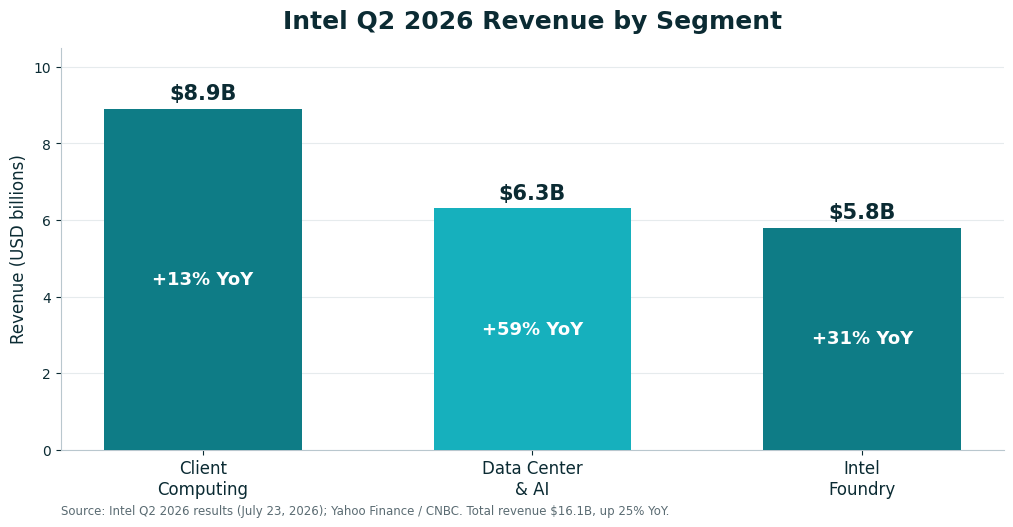
The growth was led by chips that power artificial intelligence. Intel's Data Center and AI segment (the part that sells processors for the big computer warehouses running AI) grew 59% from a year earlier to $6.3 billion. The Client Computing group, which makes chips for laptops and desktops, rose 13% to $8.9 billion, and Intel Foundry, its chip-manufacturing arm, climbed 31% to $5.8 billion. Investors clearly liked the report: Intel shares jumped about 11% in after-hours trading right after the release.
Why Intel stock is one to watch right now
A few concrete catalysts make Intel a name beginners may want to monitor (to watch, not to rush into buying). First, demand is outrunning supply. Intel said its data-center operations "cannot keep up with orders" and that it has signed 10 long-term contracts with buyers of its server chips, structured around fixed prices or guaranteed purchase volumes. Locked-in demand like that gives a company more predictable revenue.
Second, the profitability picture is healing. "Gross margin" is the slice of each sales dollar left after the direct cost of making the product; a higher margin means more room for profit. Intel's gross margin recovered to 40.4% from 27.5% a year earlier. The company also generated $7 billion in cash from operations in the quarter, and it guided for third-quarter revenue of $15.8 billion to $16.8 billion, above what analysts were expecting.
If you are new to sizing up a company like this, it helps to have a simple process. Read: How to Research a Stock Before Buying: A Beginner's 7-Step Checklist.
The Counter-Argument (And Why It's Serious)
Here is the strongest case for caution, and it deserves real attention. Despite the glowing sales numbers, Intel's official "GAAP" results (the standardized accounting rules every U.S. public company must follow) showed a net loss of $11 billion, or $2.16 per share. That loss came mostly from a $12.5 billion "mark-to-market" charge on escrowed shares tied to Intel's CHIPS Act agreement with the U.S. government. A mark-to-market charge is a paper adjustment that reflects a change in the value of an asset on the books; it is not the same as cash walking out the door, but it is a genuine hit to reported profit and a reminder that Intel's finances have some unusual, hard-to-predict moving parts.
There is also the price to consider. By several accounts, Intel shares had risen dramatically in 2026 before this report, then pulled back sharply, reportedly falling around 28% in July alone ahead of earnings. When a stock has already run up a lot, expectations get high and the shares can swing hard in both directions. On top of that, Intel competes fiercely with Nvidia and AMD in AI and data-center chips, and staying ahead requires heavy, ongoing spending on new equipment and factories, which management confirmed it is increasing.
The measured rebuttal: a one-time accounting charge tied to a government deal is very different from a business that is shrinking. The underlying engine, actual chip sales, is growing fast, margins are improving, and cash generation is strong. For a beginner, the takeaway is not "ignore the loss" but "understand what kind of loss it is," then keep watching whether the real business keeps performing. Big, fast-moving stories like this are also where inexperienced investors get burned by chasing hype. Read: Stocks That Could Explode: How to Spot Them Without Getting Burned.
The One Number to Watch
If you follow just one figure with Intel from here, make it the Data Center and AI segment growth rate, which came in at 59% year-over-year this quarter. That single number captures whether the AI-chip demand driving this story is still accelerating, holding, or fading. As long as that growth stays strong and Intel keeps converting it into better margins, the bullish narrative has legs. If that growth rate slows sharply in coming quarters, it would be an early warning that the excitement is cooling, no matter what the headline revenue looks like.
Frequently Asked Questions
Did Intel actually make money last quarter?
It depends on how you count. On an "adjusted" basis, which strips out unusual items, Intel earned 42 cents per share. On a standardized GAAP basis, it reported an $11 billion net loss, driven mostly by a $12.5 billion paper charge tied to its CHIPS Act deal. Its actual chip sales grew, and it produced $7 billion in operating cash.
What is the CHIPS Act charge that caused the loss?
The CHIPS Act is a U.S. law that supports domestic chip manufacturing. Intel's agreement with the government involves escrowed shares, and their value was "marked to market" (re-valued on the books), producing a $12.5 billion accounting charge this quarter. It is a paper adjustment, not a direct cash payment out of the business.
Why did Intel stock rise if it reported a loss?
Investors often look past one-time accounting items and focus on the underlying business. Revenue grew 25%, AI and data-center chip sales jumped 59%, margins improved, and guidance beat expectations, so the shares rose about 11% in after-hours trading despite the reported loss.
Is Intel a good stock for beginners to buy?
This article is about watching Intel, not recommending a purchase. Chip stocks can be volatile, and Intel has both strong momentum and real risks. If you are exploring it, learn how the business works, understand the risks, and consider speaking with a licensed professional before making any decision.
Read: Palantir stock to watch: 93% growth meets a sky-high price
Disclaimer: Content on this site is for informational and educational purposes only and does not constitute financial, investment, or trading advice. I am not a licensed financial advisor. Always conduct your own research and consult a licensed professional before making investment decisions.