
If you asked five experts where Bitcoin will finish 2026, you might get five wildly different answers. One big bank says $100,000. A popular betting site says the most likely landing spot is closer to $72,000. A few well-known bulls say $150,000 or more is possible. And as of July 21, 2026, Bitcoin was actually trading around $66,000, roughly half its all-time record. So who is right? The honest answer is that nobody knows, and understanding why the forecasts are so far apart is one of the most useful things a beginner can learn.
Let's break down what these predictions actually mean, why smart people land on such different numbers, and most importantly, what a beginner should watch instead of getting swept up in the guessing game.
First, What Is a "Price Prediction" Anyway?
A quick refresher on the basics. Bitcoin is a cryptocurrency, a digital form of money that runs on a global computer network rather than being issued by a government or bank. Its price swings a lot, which is what we mean by volatility (how much and how fast a price moves up and down).
A price prediction (or "price target") is simply someone's best guess about where the price will be by a certain date. It is not a promise, and it is not a fact, it is an opinion built on assumptions. When those assumptions change, the prediction changes too. That is why the same analyst can say $150,000 one month and $100,000 a few months later: the world shifted underneath the forecast.
For context, Bitcoin's all-time high was about $128,198 back on October 6, 2025. Trading near $66,000 today means it sits well below that peak, down roughly 37% from a year ago, according to Yahoo Finance. So every 2026 prediction is really a bet on whether Bitcoin claws back toward its old record, blasts past it, or keeps drifting.
That peak is worth holding on to for perspective. By August 2026 bitcoin was trading near $64,000, roughly half its record, while ether sat about 60% below its own high. We explain what drawdowns of that size actually mean for a beginner in our guide to how far bitcoin has fallen from that peak.
Why the Forecasts Are So Far Apart
Here is a rough map of where different voices see Bitcoin ending 2026, based on mid-July 2026 reporting:
- The cautious crowd ($70,000–$75,000): On the prediction market Polymarket, a site where people bet real money on future events, the top odds pointed to Bitcoin closing 2026 somewhere between $70,000 and $75,000. Traders there gave only about an 11% chance of Bitcoin reaching $100,000 by year-end.
- The big-bank base case ($100,000): In July 2026, Standard Chartered, a major global bank, renewed its call for $100,000 Bitcoin by the end of the year.
- The bulls ($150,000+): Some firms, including Fundstrat, have floated targets of $150,000 to $250,000 for 2026, betting on strong demand and more big investors piling in.
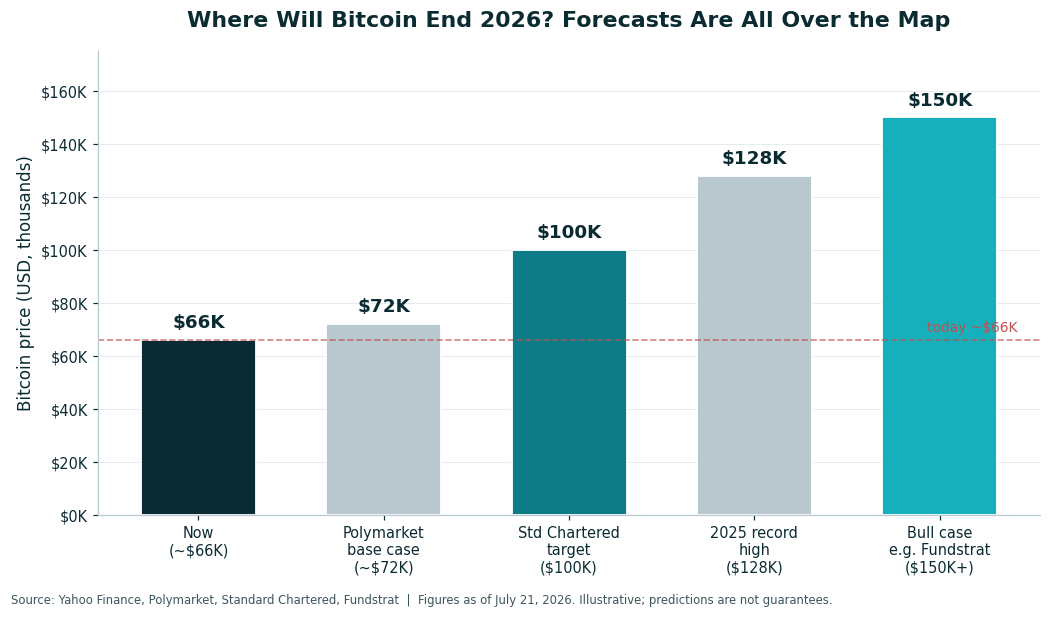
Why such a huge spread? Because each group is weighing the same facts differently. A bank analyst might focus on long-term demand and new investment products. A Polymarket bettor is reacting to Bitcoin's recent weakness and putting money where their doubt is. The bulls are assuming the good scenario plays out. None of them can see the future, they are just placing different weights on hope, history, and risk.
The takeaway for a beginner: a prediction tells you as much about the predictor's mood and method as it does about Bitcoin. A single confident number should never be the reason you buy or sell anything.
What Is Actually Moving Bitcoin Right Now
Instead of chasing forecasts, it helps to understand the forces that push Bitcoin around day to day. In mid-2026, three stand out.
1. ETF money flows. A spot Bitcoin ETF (exchange-traded fund) is a stock-market product that holds real Bitcoin, letting people invest through a normal brokerage account. When more money flows into these funds than out, it is called a net inflow, and it tends to support the price. In the week ending around July 20, 2026, Bitcoin ETFs saw their second straight week of positive net inflows, the first back-to-back positive stretch since May, per SoSo Value data. That said, those inflows had not yet made up for earlier outflows. We covered this dynamic in Bitcoin ETF Inflows Return After a Record June Selloff.
2. The mood in tech stocks. Bitcoin often moves in the same direction as risky tech stocks. On July 21, 2026, crypto rose alongside a bounce in the tech-heavy Nasdaq-100. When investors feel brave, both tend to rise; when they get nervous, both tend to fall. A big driver of that mood is interest rates — what happens when the Fed raises rates ripples out to risky assets like Bitcoin too.
3. Big-picture headlines. Global events like the U.S.-Iran conflict in the news that week, plus company earnings reports, feed uncertainty, and uncertainty fuels volatility. If you are curious how yield-earning crypto products fit in, see Ethereum Staking ETFs: A Beginner's Guide to ETH Yield.
The Counter-Argument (And Why It's Serious)
Here is the strongest case against paying attention to any of this: predictions are basically noise, so why bother? Bitcoin has repeatedly humbled forecasters. It was supposed to be near $150,000 by some 2026 estimates, yet it spent mid-year stuck around $66,000. If the experts with research teams and models keep missing, a beginner reading headlines has no edge at all, and might just get scared into selling low or excited into buying high.
That critique deserves respect, and it is partly right: no one should treat a price target as gospel. But there is a balanced rebuttal. The value of studying predictions is not in trusting the number, it is in understanding the reasoning behind each one. When you learn why a bank is optimistic (steady demand, new products) and why a betting market is cautious (recent price weakness), you build a mental checklist of what actually matters. You stop reacting to a scary headline and start asking, "Which of the real drivers just changed?" That is a durable skill, even in an asset as unpredictable as Bitcoin. The goal is not to predict, it is to understand.
The One Number to Watch
If you track just one thing, make it weekly spot Bitcoin ETF net flows, the amount of money moving into or out of those funds each week. Why this number? Because it is a clean, public signal of whether everyday and professional investors are stepping toward Bitcoin or backing away. Two straight weeks of inflows, as seen in mid-July 2026, hints that demand is stabilizing; a return to steady outflows would suggest the opposite. It won't tell you tomorrow's price, but it tells you which way the tide is running and that is far more useful than any single year-end target.
Read: Altcoins to Watch: A Beginner's Guide Beyond Bitcoin
Read: why bitcoin started trading like gold in August 2026, and the one reading that shows whether it lasts.
Frequently Asked Questions
Are Bitcoin price predictions ever accurate? Sometimes, but often by luck. Because Bitcoin is so volatile, even careful forecasts miss badly. Treat any target as one opinion among many, not a guarantee.
Why do a bank and a betting market disagree so much? They use different methods. A bank builds a long-term model based on demand and adoption; a prediction market reflects the live, money-backed mood of thousands of traders reacting to recent news. Different inputs, different answers.
What is a spot Bitcoin ETF in plain English? It is a fund you can buy through a regular brokerage account that holds actual Bitcoin for you. It lets you get exposure to Bitcoin's price without setting up a crypto wallet yourself.
Should a beginner buy Bitcoin because a bank predicts $100,000? A prediction alone is never a good reason to invest. Understand what you are buying, how much risk you can handle, and never invest money you cannot afford to lose. This article is educational, not advice.
Related beginner guides
- How to Research a Stock Before Buying: A Beginner’s 7-Step Checklist
- CLARITY Act: A Beginner’s Crypto Rulebook to Watch
- Emergency Fund Basics: How Much to Save in 2026
- What Happens When the Fed Raises Rates? A Beginner’s Guide
- Stocks That Could Explode: How to Spot Them Without Getting Burned
Disclaimer: Content on this site is for informational and educational purposes only and does not constitute financial, investment, or trading advice. I am not a licensed financial advisor. Always conduct your own research and consult a licensed professional before making investment decisions.