
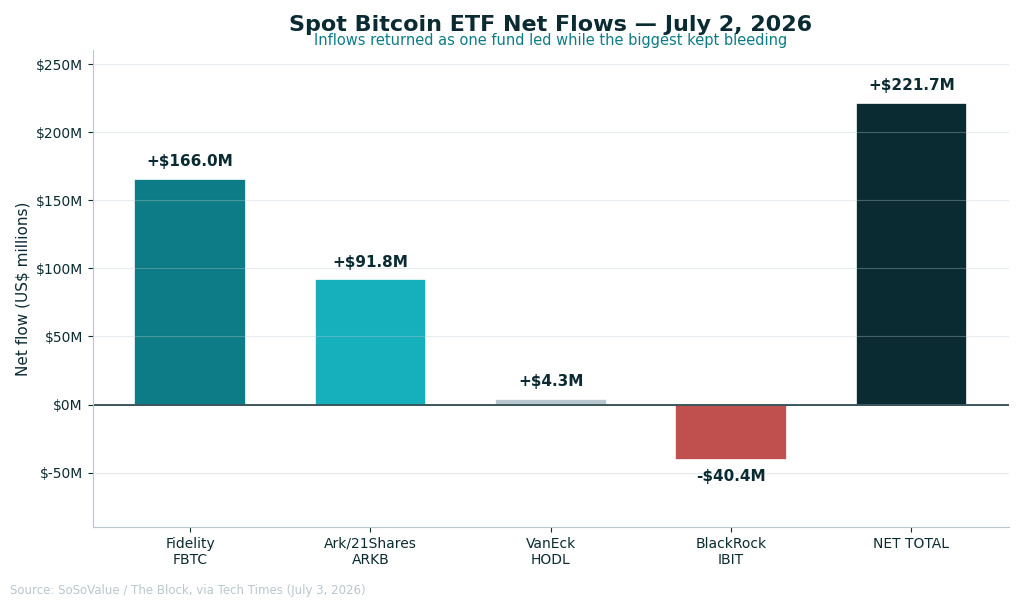
For most of June, one storyline dominated the crypto market: money was rushing out the door. Then, on the first Thursday of July, it quietly started coming back. On July 2, 2026, U.S. Bitcoin ETFs pulled in about $221.7 million of new money in a single day, their biggest one-day haul in roughly two months snapping a 10-day losing streak that had drained around $2.7 billion. If you are new to investing, that sentence probably has a few words you would like explained. This post does exactly that, and shows you why these dull-sounding “flows” quietly steer Bitcoin’s price.
What Is a Bitcoin ETF (and Why “Flows” Matter)?
An ETF (exchange-traded fund) is simply a basket you can buy and sell on the stock market like a single share. A spot Bitcoin ETF is a basket that holds real Bitcoin. When you buy a share of it through a normal brokerage account, you get exposure to Bitcoin’s price without having to set up a crypto wallet or manage passwords yourself. That convenience is why these funds became so popular after they launched in the United States in January 2024.
Now the key idea: flows. When more people buy the ETF than sell it, new money flows in, and the fund has to go buy more actual Bitcoin to back those shares. That is an “inflow.” When more people sell, money flows out, and the fund must sell Bitcoin to hand cash back. That is an “outflow.” Think of the fund like a water tank: inflows raise the level, outflows lower it, and because the tank is filled with real Bitcoin, the buying and selling spills directly into the market. That is why beginners should care about a number that sounds like accounting trivia.
What Just Happened: A Record Exodus, Then a Turn
June 2026 was brutal. Spot Bitcoin ETFs saw roughly $4.5 billion of net outflows for the month, their worst month since the funds launched, according to reporting by The Block. For the whole year so far, about $5.4 billion has left these products. That selling pressure showed up in the price: Bitcoin slipped below $58,000 on July 1, a 21-month low, having started 2026 above $93,000. In plain terms, anyone who bought at the start of the year was down more than a third.
Then came the turn. On July 2 the funds took in about $221.7 million on net. But look closely at the chart above, because the story is not as simple as “everyone bought.” Fidelity’s fund (FBTC) led with roughly $166 million in, and Ark’s ARKB added about $92 million. Meanwhile BlackRock’s IBIT, the single largest Bitcoin ETF actually lost about $40 million, its 11th down day in a row. When money leaves one fund but piles into others that hold the same asset, that looks less like people fleeing Bitcoin and more like big investors shuffling between providers. It is a hopeful sign, but a mixed one.
Why the Money Came Back
The Fed (the Federal Reserve) is America’s central bank, and its main lever is the interest rate, roughly, the reward for keeping money in safe, cash-like places. When rates are high, a savings account or government bond pays you a nice yield just for sitting still. Bitcoin pays no yield at all, so high rates make it relatively less attractive. That is a big reason money had been draining out of Bitcoin ETFs.
On July 2, the U.S. jobs report changed the mood. Non-farm payrolls, a monthly count of how many jobs the economy added rose by only 57,000, about half of what economists expected, and prior months were revised down by a combined 74,000. A cooling job market makes the Fed less likely to raise rates. Lower expected rates make non-yielding assets like Bitcoin look better again, and some of that relief flowed straight into the ETFs. If you want the bigger picture on how the Fed’s decisions ripple through markets,
Read: Stock Market Rises as Fed Rate Cut Odds Shift.
The Counter-Argument (And Why It’s Serious)
Here is the strongest case for staying skeptical. One good day is not a trend. The $221.7 million inflow recovered only about 4% of the money that has left Bitcoin ETFs this year, and earlier in 2026 a single day saw more than $753 million pour in, so by that yardstick, this was a modest trickle, not a flood. The biggest fund, IBIT, kept bleeding. And on the policy side, nine of the 18 Fed officials who submitted forecasts in June still expected an interest-rate hike before year-end. One soft jobs report does not erase that.
So how much weight should a beginner give the bounce? A measured view: it is a real but early signal. What makes it more than noise is breadth, the buying was not just Bitcoin. Ethereum, XRP, and Solana funds all saw inflows the same day, and on-chain researchers at Glassnode noted that long-term holders had started accumulating again after months of selling. When several corners of the market improve together, it is harder to dismiss as a fluke. But “encouraging” is not the same as “all clear,” and the honest answer is that the trend has not yet been confirmed. For a related look at how quickly market moods can flip.
Read: Russell 2000 Small Caps: Rotation or Rate-Cut Sugar High?
The One Number to Watch
If you follow just one figure from here, make it the daily net flow into spot Bitcoin ETFs. Analysts estimate that ETF flows now explain roughly 45% of Bitcoin’s weekly price moves, which means this ledger is not just a mood ring, it is one of the actual engines under the price. Watch for two things: several green (inflow) days in a row instead of a lone bounce, and IBIT finally turning positive rather than dragging. The next big tests are the June inflation report on July 14 and the Fed’s meeting on July 28–29. A soft inflation number could extend the inflows; a hot one could send the money back out the door.
Since this article was published, that ledger has swung the other way: U.S. spot bitcoin ETFs recorded a net $390 million of outflows in a single week in August 2026, their largest weekly withdrawal in six weeks. For what a sustained stretch of selling looks like, and how to read it without panicking, see our guide to what a crypto bear market does to ETF flows.
Regulation is the other lever on those flows. The Senate votes on September 15 on the bill that would set U.S. crypto market rules, and clearer rules are a central argument for why institutional money would return. See CLARITY Act Vote: 60 Needed, Republicans Hold 53.
Read: Bitcoin Price Predictions 2026: Why Experts Disagree.
Frequently Asked Questions
Do I own real Bitcoin if I buy a spot Bitcoin ETF?
Not directly. The fund owns the Bitcoin; you own shares of the fund. You get exposure to the price movements, but the ETF provider handles storage and security. This trades a little bit of control for a lot of convenience.
Why do ETF outflows push Bitcoin’s price down?
When investors cash out of the ETF, the fund has to sell real Bitcoin to raise the money to pay them. That selling is automatic and rule-based, so a long streak of outflows means steady selling hitting the market regardless of what any individual trader thinks.
Does one day of inflows mean the bottom is in?
No one can say that with confidence. A single positive day ended a technical streak, but analysts described it as cautious re-entry, not a confirmed turnaround. It would take several inflow days and steadier prices to call it a trend.
Where can a beginner track these flows?
Free trackers such as SoSoValue and CoinGlass publish daily spot Bitcoin ETF flow data, and major finance outlets summarize it each morning. You do not need a paid service to follow the one number that matters most here.
Disclaimer: Content on this site is for informational and educational purposes only and does not constitute financial, investment, or trading advice. I am not a licensed financial advisor. Always conduct your own research and consult a licensed professional before making investment decisions.