If you have only ever heard of Bitcoin and Ethereum, this beginner's guide to the altcoins to watch is your next step into the wider crypto world. "Altcoin" simply means any cryptocurrency that is not Bitcoin, and thousands of them exist beyond the two biggest names. Below we explain what altcoins actually are, look at a few worth keeping on your radar in 2026, such as Solana and XRP, cover the very real risks, and finish with the one number to watch. To be clear from the start: this is about coins to understand and monitor, not a list of coins to buy.
What is an altcoin?
Bitcoin was the first cryptocurrency, launched in 2009. Every coin created afterwards is often lumped together as an "alternative coin," or altcoin. Ethereum is technically the largest altcoin, but the label really shines a light on the thousands of smaller projects behind it. A quick note on jargon: a coin's market cap (short for market capitalisation) is its price multiplied by the number of coins in circulation. It is the simplest way to compare how big one crypto is versus another.
Altcoins are not all the same. It helps to sort them into rough families: smart-contract platforms that let developers build apps (such as Solana and Cardano), payment-focused coins designed to move money quickly (such as XRP), infrastructure projects that connect blockchains to real-world data, and stablecoins that are built to hold a steady value. If you want a refresher on the two giants first, Read: Bitcoin Price Predictions 2026: Why Experts Disagree and Ethereum Price: Why ETH Is Outpacing Bitcoin in 2026.
A few altcoins to watch (and why)
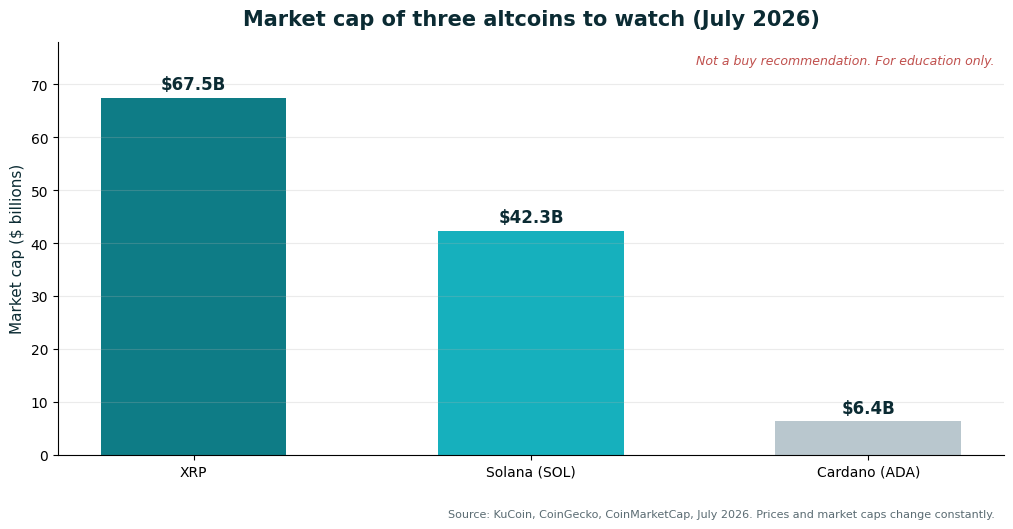
XRP is a payment-focused coin linked to a company called Ripple, and it has been one of the standout large-cap stories of 2026. As of late July 2026 it traded near $1.08 with a market cap of roughly $67.5 billion, making it the sixth-largest crypto. The catalyst worth understanding is regulatory: a multi-year legal case between Ripple and US regulators was resolved in 2025, and spot XRP exchange-traded funds (ETFs, which let ordinary investors get exposure through a normal brokerage) have opened the door to institutional money. What to watch is whether that access turns into lasting demand, and remember XRP still sits well below its 2025 peak, a reminder of how sharply these coins can fall.
Solana (SOL) is a smart-contract platform known for being fast and cheap to use, which has made it popular for apps and trading. It traded around $72.85 in late July 2026 with a market cap near $42.3 billion, the seventh-largest coin. Its appeal to watchers is that it has real activity behind it rather than just hype: its ecosystem generated an estimated $2.85 billion in revenue over the trailing year. The thing to monitor is whether that usage keeps growing and holds up against Ethereum, plus any progress on a Solana ETF.
Cardano (ADA) is a much smaller, research-driven smart-contract platform, trading near $0.17 with a market cap around $6.4 billion. It is more speculative than the two above simply because it is smaller and less used day to day. The catalysts to watch are real-world adoption and steps toward mainstream access, such as regulated custody and potential ETF eligibility. Being smaller can mean bigger swings in both directions, which is exactly why it belongs on a watch list rather than an automatic shopping list.
Stablecoins: the "boring" coins that matter
Not every coin is trying to shoot to the moon. Stablecoins like USDC and USDT are designed to stay pinned to $1, usually by being backed by real dollars and short-term assets. You would not hold them hoping for gains; instead people use them to park cash inside the crypto world or to move between coins without cashing out to a bank. They are worth watching for a different reason: if a stablecoin ever loses its $1 peg, it signals stress in the market. For beginners, the key questions are whether the coin is fully backed and how regulators treat it.
The Counter-Argument (And Why It's Serious)
Here is the strongest case against paying attention to altcoins at all: most of them fail. Of the thousands launched over the years, the large majority have faded toward zero, and even the survivors are far more volatile than Bitcoin. The market underlined this by entering August 2026 on a defensive note, with major altcoins including XRP and SOL sliding alongside a broader pullback. This objection is serious because beginners often discover a "good coin" only after it has already soared, then buy near the top and get burned when the hype fades.
The balanced response is not to dismiss altcoins, but to size them honestly. A small handful have built genuine usage, resolved regulatory clouds, and attracted institutional products like ETFs, which is exactly why they are worth understanding. But "worth watching" is not the same as "safe." A sensible beginner approach is to keep the bulk of any crypto exposure in the most established assets, treat altcoins as small positions you could afford to lose entirely, and never use money you actually need. Watching and learning is free; chasing every rally is what gets expensive.
The One Number to Watch
If you follow a single figure to gauge the altcoin mood, make it Bitcoin dominance. This is Bitcoin's share of the entire crypto market's value, shown as a percentage on most price websites. When Bitcoin dominance is falling, it usually means money is rotating out of Bitcoin and into altcoins, the backdrop for what traders call an "altcoin season." When dominance is rising, altcoins tend to struggle. It will not tell you which coin to pick, but it is a simple, free gauge of whether the wind is at altcoins' backs or in their faces. Pair it with a look at each project's real-world usage, and you will understand far more than the average newcomer.
Frequently Asked Questions
What is the difference between a coin and a token? A coin usually runs on its own blockchain (like Solana), while a token is built on top of another blockchain. For a beginner the distinction matters less than understanding what the project actually does.
Are altcoins safer than Bitcoin? Generally no. Altcoins are usually smaller and more volatile, so they can rise faster but also fall much harder. Bitcoin is considered the most established crypto.
How many altcoins should a beginner hold? There is no magic number, but simpler is usually better. It is wiser to understand a couple of projects well than to scatter money across dozens you cannot explain.
What is a stablecoin actually for? It is a way to hold a steady dollar-like value inside crypto, handy for parking funds or moving between coins, not for chasing growth.
Disclaimer: Content on this site is for informational and educational purposes only and does not constitute financial, investment, or trading advice. I am not a licensed financial advisor. Always conduct your own research and consult a licensed professional before making investment decisions.