
If you own even a little crypto, or you are just crypto-curious, there is a bill in Washington you should have on your radar this summer. It is called the CLARITY Act, and its whole job is to answer a surprisingly basic question that has haunted the industry for years: who is actually in charge of regulating cryptocurrency in the United States? Right now the honest answer is “it depends who you ask,” and that fuzziness has meant lawsuits, confusion, and companies threatening to move overseas. The CLARITY Act tries to draw a clear line. Here is what it does, why the market keeps reacting to it, and what a beginner should watch for.
Update, September 2026: The Senate has set its first procedural vote on the bill for Tuesday, September 15. For the current vote count, the four dated cuts to its odds and what each outcome would signal, read CLARITY Act Vote: 60 Needed, Republicans Hold 53.
What the CLARITY Act actually is
CLARITY stands for the “Digital Asset Market Clarity Act.” In plain terms, it is a rulebook that sorts every crypto token into one of two buckets and hands each bucket to a different referee.
The two referees are the SEC and the CFTC. The SEC (Securities and Exchange Commission) is the agency that polices stocks and other “securities”, investments where you are betting on the efforts of a company or team. The CFTC (Commodity Futures Trading Commission) is the smaller agency that oversees “commodities” like oil, wheat, and gold. The core idea of the CLARITY Act is simple: tokens that behave like commodities go to the CFTC, and tokens that behave like company shares stay with the SEC.
How do you tell which is which? The bill uses a test based on how decentralized a network is. “Decentralized” just means no single company or person is really in control, the network runs itself across thousands of computers. Under the proposed framework, Bitcoin clearly clears that bar and would be treated as a “digital commodity” under the CFTC. Ethereum would likely get there too, but only after passing a maturity test. Newer tokens whose value still depends on a founding team’s ongoing work would stay under the SEC’s watch until their networks grow up. If you want a refresher on how these assets trade in the real world, see our beginner’s guide to Bitcoin ETF inflows.
Why this matters to an ordinary investor
You might be thinking: this sounds like a turf war between two government agencies, why should I care? The answer is that clear rules tend to bring in bigger, more cautious players. Banks, pension funds, and traditional brokerages have largely stayed on the sidelines of crypto partly because they did not want to accidentally break a rule that nobody had actually written down yet. A defined rulebook lowers that fear.
That is a big reason the market has been sensitive to the bill’s progress. After Bitcoin’s worst month in four years in June 2026, prices steadied and recovered in early July, and analysts pointed to “increasingly positive sentiment surrounding the pending CLARITY Act” as one of the tailwinds. By Tuesday, July 14, 2026, Bitcoin was trading around $62,900 and Ethereum near $1,785, according to Yahoo Finance. None of that is a guarantee, crypto swings on a dozen factors at once, including Federal Reserve policy and events in the Middle East, but it shows that beginners are not the only ones watching this bill. Wall Street is too.
How high could Bitcoin actually go? See our guide to Bitcoin price predictions for 2026.
Where the bill stands right now
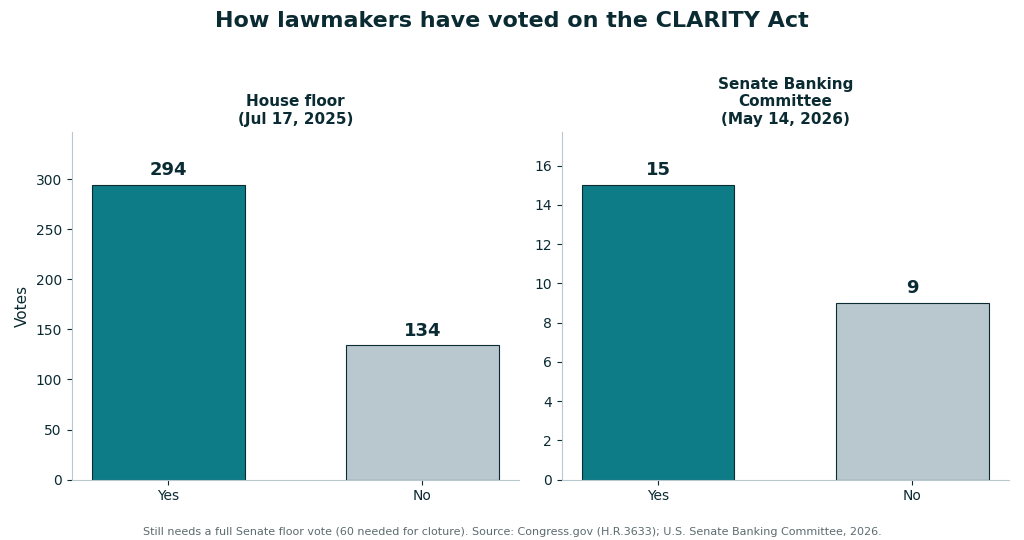
The CLARITY Act has come further than most crypto legislation ever does, but it is not law yet. The House of Representatives passed it on July 17, 2025, by a 294-to-134 vote, with more than 70 Democrats joining Republicans. On May 14, 2026, the Senate Banking Committee advanced it 15-9. On June 1 it was placed on the Senate’s calendar, making it eligible for a full floor vote.
Then it stalled. The bill missed a symbolic July 4 target, and by early July, prediction-market traders on Polymarket put its odds of becoming law in 2026 at roughly 39%. A “cloture” vote, the Senate procedure that needs 60 votes to end debate and move forward would require around seven Democrats to sign on, and several remain unconvinced. Analysts describe the few weeks before Congress’s August recess as the last realistic window for 2026; miss it, and the fight likely slides toward the fall and into midterm-election season, where controversial bills get much harder to pass.
Those odds have since fallen sharply. By mid-August 2026, Galaxy Research put the chance of the bill becoming law in 2026 at roughly 10%, with prediction markets nearer 17%, and a cloture vote scheduled for September 15. We cover the latest odds and the vote math in full, alongside the wider market backdrop.
The Counter-Argument (And Why It’s Serious)
Not everyone thinks the CLARITY Act is a win. The strongest objection is about consumer protection. Critics argue that by routing most tokens to the CFTC, an agency with a smaller budget and less experience policing retail investors than the SEC, the bill could effectively weaken oversight of a market famous for scams, blow-ups, and sudden collapses. They also point to unresolved fights holding up the bill: questions about a president’s personal crypto holdings, legal protections for software developers, and whether “stablecoins” (crypto tokens pegged to the dollar) should be allowed to pay interest like a bank account. These are not trivia; they go to who bears the risk when things go wrong.
That critique deserves to be taken seriously. But the measured rebuttal is that the current situation, regulation by lawsuit, with no clear rules at all, arguably protects consumers less, not more. When nobody knows the rules, bad actors exploit the gray zones and honest builders leave for friendlier countries. A flawed-but-clear framework that can be amended later may beat permanent ambiguity. Reasonable people disagree on the balance, which is exactly why this is worth following rather than tuning out.
The One Number to Watch
If you only track one thing, track the Senate vote count for cloture, the race to 60. Everything else about this bill is noise until enough senators agree to actually bring it to a final vote. The House already passed it; the Senate floor is the real bottleneck. Watch whether the roughly seven undecided Democrats move toward “yes” before the August recess. If that number reaches 60, the odds of the bill becoming law in 2026 jump dramatically. If Congress leaves town without it, expect the timeline and much of the related market optimism to cool until fall. One number, 60, tells you most of what you need to know.
Want to understand the assets the bill would reclassify? Read our beginner’s guide to Ethereum staking ETFs.
Frequently Asked Questions
Is the CLARITY Act now law?
No. As of mid-July 2026 it has passed the House and cleared a Senate committee, but it still needs a full Senate floor vote and the president’s signature before it becomes law.
Will the CLARITY Act make my crypto go up?
Nobody can promise that. Clearer rules could attract more big institutional buyers over time, which some see as supportive for prices, but crypto is volatile and moves on many factors. Treat regulation as one piece of a much larger puzzle, not a guaranteed catalyst.
What is the difference between the SEC and the CFTC?
The SEC regulates securities investments tied to the efforts of a company or team, like stocks. The CFTC regulates commodities standardized goods like oil, gold, or, under this bill, decentralized tokens such as Bitcoin.
What happens if the Senate does not pass it before the August recess?
The bill would not die, but its path gets harder. Analysts expect the debate to slip toward the fall and into midterm-campaign season, when passing any contested legislation becomes more difficult.
Related beginner guides
- How to Research a Stock Before Buying: A Beginner’s 7-Step Checklist
- Emergency Fund Basics: How Much to Save in 2026
- What Happens When the Fed Raises Rates? A Beginner’s Guide
- Stocks That Could Explode: How to Spot Them Without Getting Burned
Disclaimer: Content on this site is for informational and educational purposes only and does not constitute financial, investment, or trading advice. I am not a licensed financial advisor. Always conduct your own research and consult a licensed professional before making investment decisions.