The July CPI report lands this Wednesday, August 12, and it could be the week's most important economic release for investors. CPI stands for Consumer Price Index, the government's main measure of inflation, showing how fast prices are rising for everyday expenses like food, rent, and gas. This week's report comes at an unusual time: the stock market just hit a record high, even though the latest jobs report was surprisingly weak. Here is what's happening, why it matters, and what beginners should actually watch.
What Is the CPI Report and Why Does It Move Markets?
Every month, the Bureau of Labor Statistics (a government agency) checks the prices of thousands of goods and services and rolls them into one index. When you hear "inflation was 3.5%," that means prices were 3.5% higher than a year earlier. That yearly comparison is called the year-over-year rate, and it is the headline number everyone quotes.
Markets care because of the Federal Reserve, or "the Fed," uses inflation data to help guide monetary policy. The Fed sets interest rates, which are essentially the price of borrowing money. When inflation is high, the Fed tends to keep interest rates high to slow spending. When inflation cools, the Fed has room to cut rates, and lower rates generally make stocks more attractive. So a single inflation figure can shift expectations for interest rates, which can move the entire stock market in minutes.
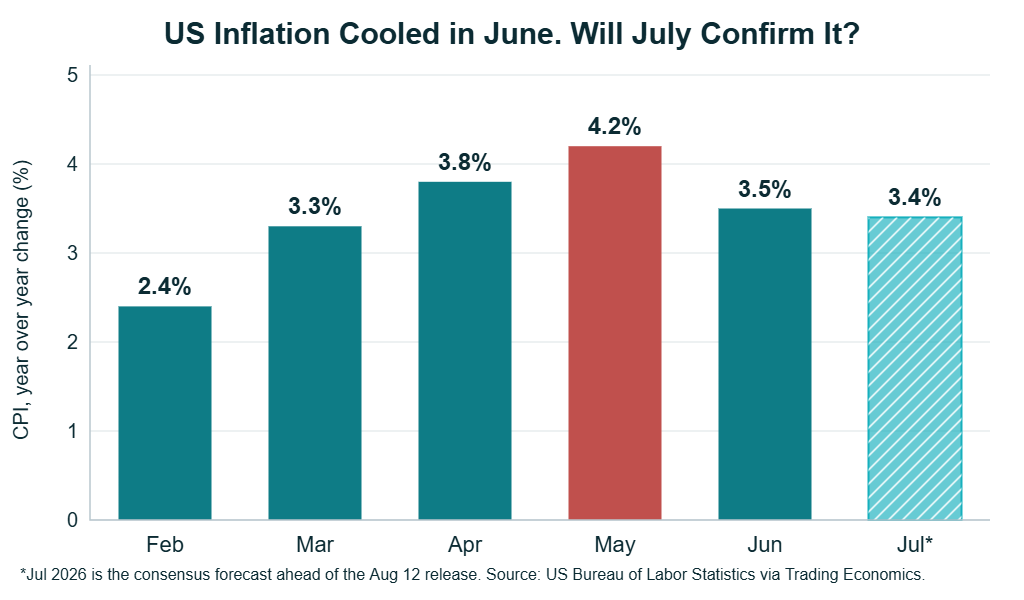
The chart tells this year's story. Inflation was a calm 2.4% in February, then the conflict with Iran sent oil and gasoline prices soaring, pushing inflation up to a peak of 4.2% in May, the highest in about three years. After a ceasefire, energy prices fell sharply and inflation cooled to 3.5% in June, the first decline in five months. Wednesday's question: was June a one-off, or the start of a real cooling trend? Forecasters expect roughly 3.4% for July.
A Strange Setup: Weak Jobs, Record Stocks
Last Friday's jobs report was a shock. The economy lost 23,000 jobs in July when economists expected it to add about 83,000, and earlier months were revised down by a combined 103,000 jobs. Yet the S&P 500, the index tracking 500 of America's biggest companies, finished the week at a record high of about 7,758 after its best week since April.
Why would bad news push stocks up? Because weak jobs data makes traders believe the Fed will cut interest rates sooner, and markets love the prospect of cheaper money. There are some caveats to the weakness: government payrolls fell by over 50,000 (partly a seasonal quirk), while private employers actually added about 30,000 jobs. Still, the market's logic right now is "bad news for the economy is good news for rate cuts." That logic only holds if inflation keeps cooling, which is exactly what this week's data will test. Notably, the Fed does not meet again until September 16, so this CPI reading will shape expectations for weeks.
Read: Jobs Report Week: What Beginners Should Watch for a plain-English guide to how jobs data feeds into all of this.
What Wall Street Expects This Week
Wednesday's CPI is forecast to show prices up about 0.2% for the month and roughly 3.4% year over year, a touch cooler than June's 3.5%. "Core" inflation, which strips out volatile food and energy prices to reveal the underlying trend, is expected to rise around 0.3% on the month. Core matters because the Fed watches it closely; energy prices swing wildly, but core shows whether inflation is truly settling down.
Two more reports round out the week: the Producer Price Index (PPI) on Thursday, which measures the prices businesses pay before costs reach consumers, and retail sales on Friday, which shows whether shoppers are still spending. On the earnings side, networking giant Cisco reports Wednesday and chip-equipment maker Applied Materials reports Thursday; both are watched as barometers of AI infrastructure spending, the theme that has powered much of this year's rally.
Read: Retail Earnings Week: What Beginners Should Watch for what Walmart, Home Depot and Target say about the shopper behind those retail sales numbers.
Read: AMD Stock to Watch: AI Chips vs Thin Margins for a closer look at one of the chipmakers riding that AI spending wave.
The Counter-Argument (And Why It's Serious)
The skeptics' case goes like this: the rally is built on hope, and Wednesday could break it. June's cooling came mostly from falling energy prices after the ceasefire, a one-time gift rather than proof that underlying inflation is beaten. If July's number comes in hot, say 3.6% or higher, the "Fed will rescue us with rate cuts" story collapses while the economy is losing jobs. That combination, stubborn inflation plus a weakening job market, is the worst of both worlds, because the Fed cannot cut rates to help workers without risking even higher prices. And with stocks at record highs, there is little cushion for disappointment.
It is a serious argument, and worth taking seriously. But there is a measured rebuttal. Core inflation has been trending lower, wage growth has slipped to about 3.2%, the slowest in years, which reduces pressure on prices, and forecasters broadly expect the cooling to continue. One hot month also rarely changes the bigger trend on its own. The honest answer is that nobody knows which way Wednesday breaks, which is exactly why beginners should watch the data rather than bet the farm on either outcome.
Retailers are where that squeeze shows up first. Read: Home Depot Stock: What Beginners Should Watch Now for how one big chain’s customers actually behaved.
The One Number to Watch
Watch the year-over-year CPI rate released at 8:30 a.m. ET on Wednesday. At or below the expected 3.4%, the cooling story stays intact and the market's rate-cut hopes survive. Meaningfully above 3.5%, and expect turbulence, because it would suggest June's relief was temporary. One number, one clear signpost. If you are just starting out, remember that long-term investors do not need to react to any single report; a diversified plan matters far more than one Wednesday morning. Read: Index Funds Explained: A Beginner's Guide for the simplest version of that plan.
Update: that July reading came in at 3.4 percent, and the argument it started is still running. Three Fed officials have since voted to raise rates rather than hold them. Read: Jackson Hole Preview: 3 Fed Votes Say Hike, Not Cut.
Read: September Rate Hike: Core Inflation Hits 5-Year Low
FAQ
What time does the CPI report come out?
The Bureau of Labor Statistics releases it at 8:30 a.m. Eastern Time on Wednesday, August 12, before the stock market opens.
What is the difference between CPI and core CPI?
CPI measures all consumer prices. Core CPI excludes food and energy, which jump around a lot, so it gives a steadier picture of the underlying inflation trend. The Fed pays special attention to core.
Why did stocks go up after a bad jobs report?
Traders bet that a weaker job market will push the Federal Reserve to cut interest rates sooner. Lower rates tend to boost stock prices, so "bad" economic news is sometimes treated as good news for markets.
Should I change my investments before the CPI report?
Trying to trade around one data release is closer to gambling than investing, and even professionals get it wrong. For most beginners, sticking to a long-term, diversified plan matters far more than any single report.
Read next: Rate Hike Odds Top 60% Before Friday’s CPI Report
Disclaimer: Content on this site is for informational and educational purposes only and does not constitute financial, investment, or trading advice. I am not a licensed financial advisor. Always conduct your own research and consult a licensed professional before making investment decisions.