
AMD stock to watch is one of the terms getting a lot attention this week, because the chipmaker posted record results on August 4, 2026, only to see its shares slide anyway. If you are new to investing, AMD (short for Advanced Micro Devices) is one of the world's largest chipmakers, the tiny brains that power everything from laptops to the massive data centers behind artificial intelligence (AI). Its latest earnings report shows beginners why beating expectations doesn't always mean a stock will rise. Let's break it down in plain English.
The headline numbers AMD just reported
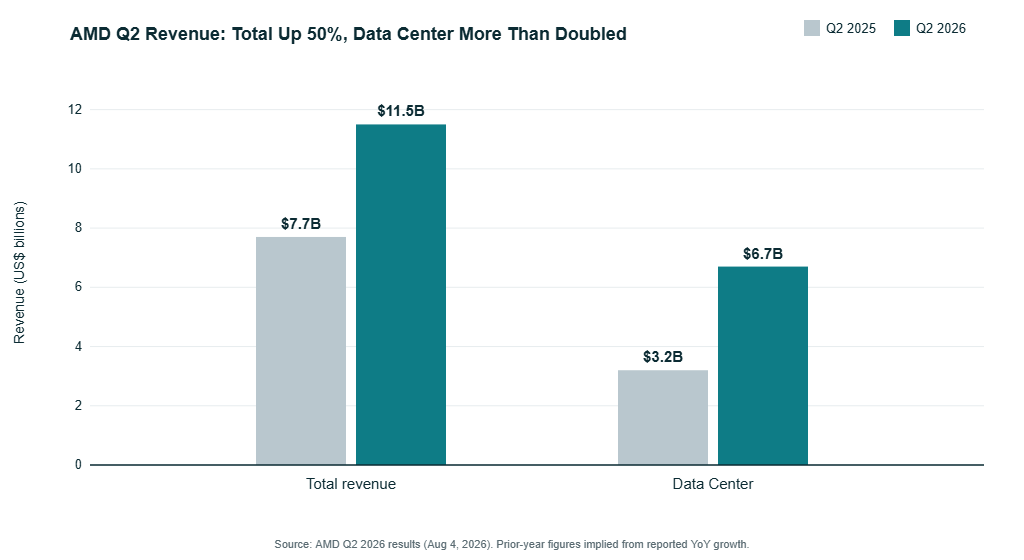
For its second quarter of 2026, AMD reported revenue of about $11.5 billion. Revenue simply means total sales, the money coming in before any costs are subtracted. That number was up roughly 50% compared with the same three months a year earlier, setting a new company record. Earnings per share, or EPS (the company's profit divided by the number of shares that exist), came in at an adjusted $1.66, ahead of what Wall Street analysts had penciled in.
The data center business, led the company's growth. This is the part of AMD that supplies chips to the massive data centres powering AI and cloud services. Data center revenue was about $6.7 billion, more than double the prior year, and it now makes up more than half of everything AMD sells. The client and gaming side (chips for personal computers and game consoles) grew a more modest 6% to $3.8 billion, though the PC-chip piece within it rose a healthier 23%. In short, AI is a major growth driver for AMD right now.
AMD is only one layer of a much longer chain. Read: AI Infrastructure Stocks: 3 Companies to Watch for the power and cloud companies that sit alongside the chipmakers.
Why the stock fell on good news
Here is the part that often confuses a lot of new investors: AMD beat on sales, beat on profit, and even raised its forecast for the current quarter to around $13 billion, above what analysts expected. A forecast like this is called guidance, the company's own estimate of how the next quarter will go. Yet the shares still fell roughly 8% to 9% in after-hours trading. Do you know why?
The sticking point was gross margin. Gross margin is the slice of each sales dollar left over after paying the direct cost of making the product; a higher margin means the company keeps more of every sale. AMD's gross margin came in near 54%, below the roughly 56% investors were hoping for, partly because building out its new AI hardware is expensive right now. When a stock has already climbed a lot before earnings, even a small disappointment can trigger what traders call profit taking, where people sell to lock in gains. It is a reminder that share prices reflect expectations, not just results.
Read: Intel Stock to Watch: 25% Revenue Jump, $11B Loss for how a very different chipmaker is navigating the same AI boom.
The AI bet: Helios, MI450 and the Anthropic deal
The reason so many people are watching AMD is its push to challenge Nvidia in AI chips. During the quarter AMD launched its Instinct MI450 series of AI accelerators (specialized chips built to train and run AI models) and a rack-scale system called Helios, which bundles many chips into a single ready-to-install unit. It also announced a headline agreement with AI company Anthropic to deploy up to 2 gigawatts of MI450 chips, one of the larger AI infrastructure commitments the industry has ever seen. AMD said early Helios systems are expected to ship to customers including Meta and OpenAI in the coming months.
For a beginner investor, the takeaway is not the technical jargon but the strategy: AMD is trying to turn itself from a supporting player into a genuine second source for artificial artificial computing power. If that works, today's thin margins could be a temporary cost of scaling up. If it does not, the spending is a risk. That tension is exactly what makes this a stock to watch rather than a settled story.
The Counter-Argument (And Why It's Serious)
The strongest case against getting excited is valuation. AMD trades at a high multiple of its sales and profits, meaning investors are already paying today for growth they expect years from now. Nvidia remains the dominant force in AI chips, with a huge lead in software and customer relationships, and the margin miss shows that competing head-on is costly. If AI spending cools, or if AMD keeps sacrificing profitability to win deals, a richly priced stock has a long way to fall. This is a serious point, not a throwaway caution.
The measured rebuttal: AMD is not promising perfection, and its guidance suggests demand is real and growing, not hypothetical. Doubling data center revenue and signing multi-year commitments are concrete signs of traction, and margins often dip when a company invests ahead of a ramp. The honest answer is that both things can be true at once: the opportunity is large and the price already assumes a lot will go right. A beginner's job is not to pick a winner today but to watch whether the evidence improves or deteriorates over the next few quarters.
Read: CPI Report Week: What Beginners Should Watch for the macro backdrop, since inflation data and Fed rate hopes move chip stocks like AMD too.
The One Number to Watch
If you follow just one number, make it gross margin. It is the cleanest signal of whether AMD's AI push is turning into durable profit or just impressive-sounding revenue. A margin that climbs back toward the mid-50s and beyond in coming quarters would suggest the Helios and MI450 ramp is paying off and the recent dip was temporary. A margin that keeps sliding would suggest AMD is buying growth at too high a price. Sales growth grabs the headlines, but margin is where the real story hides.
Read: Index Funds Explained: A Beginner's Guide if you would rather own a slice of many companies than bet on a single chipmaker.
Frequently Asked Questions
What does AMD actually make? AMD designs computer chips: processors for laptops and desktops, chips for game consoles, and increasingly the powerful accelerators that run artificial intelligence inside data centers.
Why did AMD stock fall if earnings were strong? The results beat expectations, but gross margin came in lighter than hoped and the stock had already risen a lot beforehand. Investors sold to lock in gains, a pattern known as profit taking.
Is AMD a buy right now? This post is not a recommendation to buy or sell. AMD is a company worth watching because of its AI momentum and its risks. What matters is doing your own research and understanding what you would be paying for.
What is gross margin in simple terms? It is how much of each dollar of sales a company keeps after paying the direct cost of making its products. Higher is generally better, and rising margins often signal a healthier business.
Disclaimer: Content on this site is for informational and educational purposes only and does not constitute financial, investment, or trading advice. I am not a licensed financial advisor. Always conduct your own research and consult a licensed professional before making investment decisions.