This is one of the busiest weeks of the year for the stock market, and you don't need a finance degree to follow along. It's the heart of earnings season, the few weeks each quarter when big public companies open their books and tell investors how much money they actually made. This coming week (July 20–24, 2026) is the third-busiest stretch of the current earnings season, with 86 companies in the S&P 500 scheduled to report. Two of the most-watched names in the world, Tesla and Alphabet (Google's parent), both report on Wednesday. Here's a plain-English guide to what's happening and why it matters, even if you own no stocks at all.
What "Earnings Season" Actually Means
Four times a year, every company listed on a U.S. stock exchange has to publish its financial results for the previous three months. That report includes revenue (total sales) and earnings, the profit left over after costs. Because so many companies report within the same few weeks, investors call it "earnings season."
A key term you'll hear is EPS, or earnings per share. It's simply the company's total profit divided by the number of shares that exist, a way to measure profit on a per-slice basis. Before each report, Wall Street analysts publish an estimate of what they think EPS will be. When the real number comes in higher, it's called a "beat." When it comes in lower, it's a "miss." Share prices often jump or drop in the minutes after a report, based on how the result compares to that expectation not just whether profit went up.
The S&P 500, mentioned above, is an index that tracks 500 of the largest U.S. companies. Think of it as a scoreboard for the overall American stock market. When people ask "how did the market do today?", they're usually looking at the S&P 500.
The Numbers So Far Look Strong
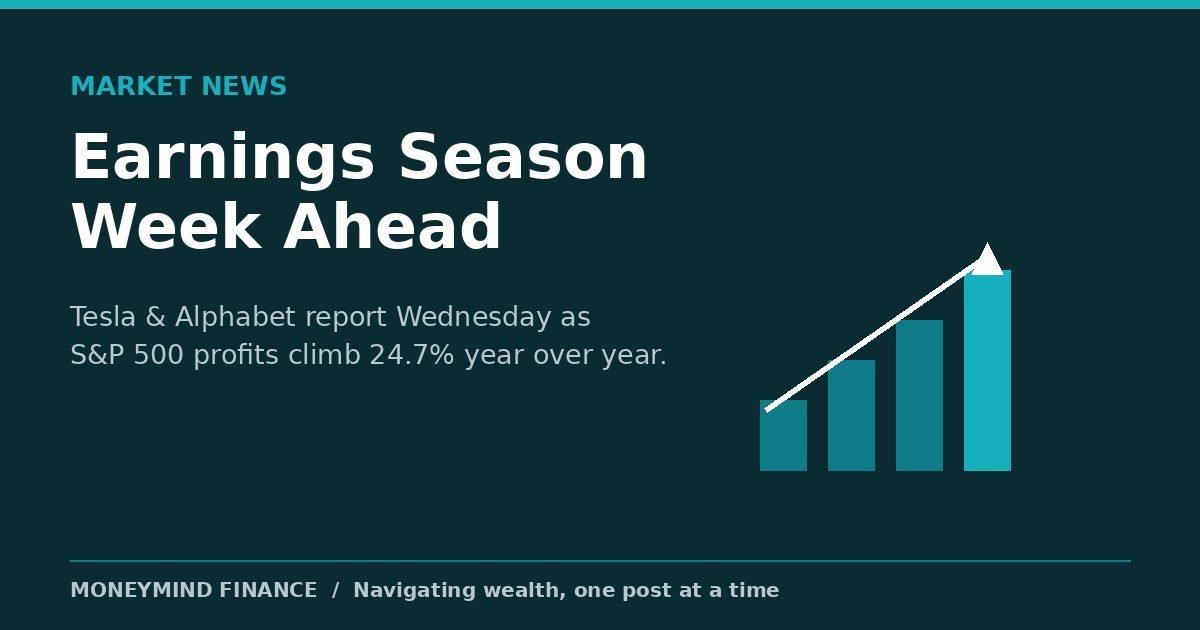
Early results have been encouraging. According to data from FactSet (a widely used financial research firm), about 88% of the S&P 500 companies that have reported so far have beaten analysts' profit estimates — though only around 10% of companies had reported as of mid-July. Combining actual results with estimates for the companies still to come, the S&P 500 is on track for profit growth of roughly 24.7% compared with the same quarter a year ago. That's above the 23.3% growth analysts expected when the quarter ended, and it would mark another quarter of strong double-digit growth.
For a beginner, the takeaway is simple: corporate profits, the fuel that ultimately drives stock prices over the long run — are still growing at a healthy pace. Banks like JPMorgan, Goldman Sachs and Wells Fargo kicked off the season with better-than-expected results, which is part of why the overall outlook has improved.
Why a Few Giants Do the Heavy Lifting
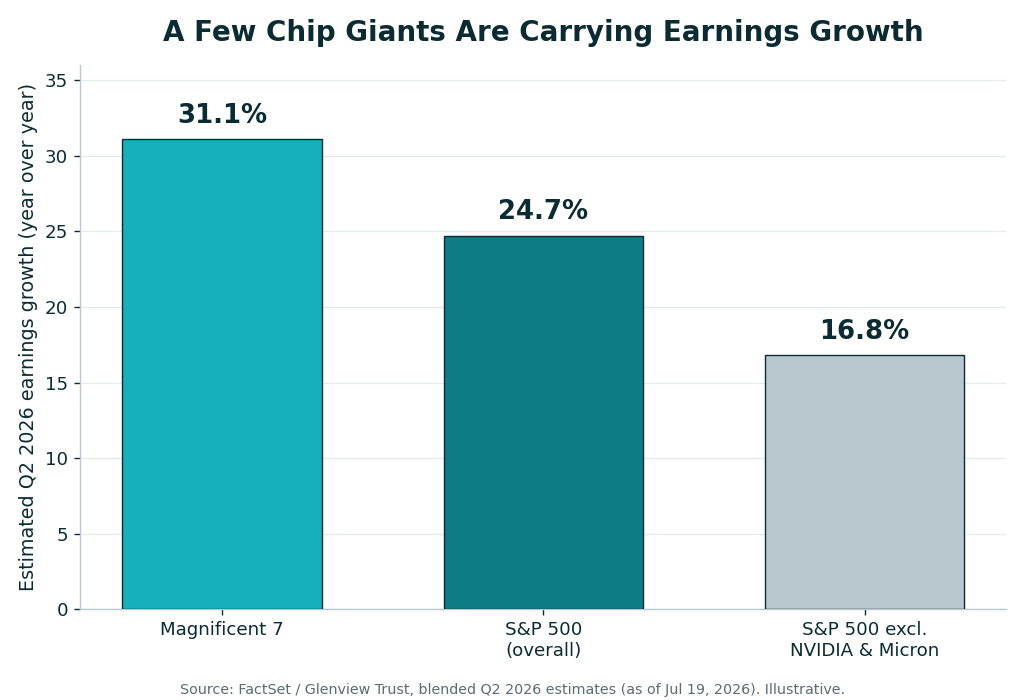
Here's where it gets interesting. A big slice of that growth comes from a small handful of technology companies often nicknamed the Magnificent 7: Microsoft, Apple, Nvidia, Amazon, Alphabet, Meta and Tesla. As a group, their profits are expected to jump about 31.1% this quarter, well above the 24.7% for the market as a whole.
The concentration is even starker with chip makers. If you strip out just two companies, Nvidia and Micron, both riding the wave of artificial-intelligence spending the S&P 500's expected profit growth drops from 24.7% all the way down to about 16.8%. In other words, a very small number of AI-linked giants are carrying an outsized share of the market's growth. That's a pattern worth understanding, because it means the market's health can hinge on just a few reports. We covered this dynamic in more depth here: Read: Market Breadth: Why Record Highs Rest on a Few Stocks.
That's why Wednesday's reports from Tesla and Alphabet, due after the market closes, are such a big deal. Investors will be listening closely to what Alphabet says about how much it's spending on AI and whether that spending is starting to pay off. Tesla, meanwhile, has its own make-or-break storylines. For more on what to track there, see Read: Tesla Stock to Watch: Record Deliveries Meet Robotaxi.
The Wild Card: Oil and Geopolitics
Strong earnings aren't the only story this week. Oil prices jumped more than 14% over the past week as tensions with Iran flared up, including disruptions near the Strait of Hormuz, a narrow shipping lane that a large share of the world's oil passes through. Brent crude, a global oil benchmark, climbed above $87 a barrel, its highest in a month.
Why should a beginner care? Because higher oil feeds into the price of gas, shipping and many everyday goods. That can nudge inflation (the general rise in prices) back up, which in turn affects what the Federal Reserve, the U.S. central bank that sets interest rates, often just called "the Fed" decides to do next. Markets are currently pricing in the possibility of one more small rate increase before the end of 2026. Rising oil is a reminder that even a great earnings season can be knocked off course by events far outside any single company's control. New to how the Fed moves markets? Read: What Happens When the Fed Raises Rates? A Beginner’s Guide.
The Counter-Argument (And Why It's Serious)
If profits are growing nearly 25%, why did the S&P 500 actually fall about 1.5% last week? This is the strongest case for caution, and it deserves a fair hearing. The skeptics' argument goes like this: good news may already be "priced in." When expectations are sky-high, even a solid report can disappoint if it isn't spectacular. Last week showed the risk in real time memory-chip maker Micron dropped more than 13% in a single week despite the AI boom, dragging sentiment down with it. If the market's growth truly leans on a few AI names, then a stumble by even one of them can hurt far beyond that single stock.
The balanced rebuttal: concentration cuts both ways, and one down week is not a trend. Profit growth is broad enough that ten of the eleven market sectors are expected to grow this quarter, not just tech. Smaller companies actually outperformed the giants last week, a hint that strength may be spreading rather than narrowing. For a long-term saver, short-term wobbles like a 1.5% dip are normal noise, not a signal to panic. The honest answer is that both things are true at once: the earnings backdrop is genuinely strong, and the market is leaning heavily on a few names, so it pays to watch, not to assume.
The One Number to Watch
If you track just one figure this week, make it the S&P 500 blended earnings growth rate, currently around 24.7%. "Blended" simply means it mixes results already reported with estimates for companies still to come, so the number updates as the week unfolds. If it holds steady or ticks higher as Tesla, Alphabet and dozens of others report, it signals that corporate America's profit engine is still humming. If it starts sliding as big names come in below expectations, that's your early warning that the market's optimism may be running ahead of reality. You can find this figure in FactSet's free weekly "Earnings Insight" reports.
Frequently Asked Questions
What is earnings season in simple terms?
It's the few weeks each quarter when most large companies publicly report how much money they made. Because the reports cluster together, they can move the whole stock market up or down.
Why does a stock sometimes fall even after a good earnings report?
Share prices reflect expectations. If investors already expected great results and the company merely meets that high bar, there may be no pleasant surprise left to push the price up, and sometimes it drifts down.
Do I need to trade around earnings reports?
No. Reports right after earnings can be volatile, and reacting quickly is risky even for professionals. Most beginners are better served watching to learn how companies are doing, rather than trying to trade the swings.
How do oil prices connect to the stock market?
Higher oil raises costs for airlines, shippers and manufacturers, and can push up inflation. That can influence interest rates and dent profits, so a sharp oil move can ripple across many stocks at once.
Read next: Market Week Ahead: Fed Meeting and Big Tech Earnings
Disclaimer: Content on this site is for informational and educational purposes only and does not constitute financial, investment, or trading advice. I am not a licensed financial advisor. Always conduct your own research and consult a licensed professional before making investment decisions.