
Microsoft stock to watch tops a lot of investors' lists this week, because the company behind Windows, Office and the Azure cloud reports its latest quarterly earnings after the market closes on Wednesday, July 29, 2026. If you are new to investing, this is a useful real-world example to learn from: a household-name company, a hotly anticipated report, and a share price that has actually fallen this year even as the business keeps growing. Let's unpack what is happening in plain English, and focus on what a beginner should keep an eye on rather than whether to buy anything.
Every dollar Microsoft commits to AI capacity lands as revenue somewhere else. Read: AI Infrastructure Stocks: 3 Companies to Watch for the suppliers on the receiving end of hyperscaler spending.
Why Microsoft Is on Everyone's Watchlist Right Now
Every three months, public companies must tell investors how they did. This report is called earnings. Two numbers get the most attention. Revenue is the total money a company brought in from sales. Earnings per share (EPS) is the company's profit divided by the number of shares that exist, so it shows how much profit belongs to each single share. For this report, Wall Street analysts expect Microsoft to post roughly $87.7 billion in revenue and about $4.24 in EPS, according to consensus estimates compiled ahead of the release.
Here is the twist that makes Microsoft interesting to watch: despite being one of the most valuable companies on earth, its stock has had a rough 2026. By late July the shares were down roughly 18% for the year and trading near a one-year low, based on market data from the week of the report. That gap, a growing business but a falling share price, is exactly the kind of situation beginners can learn a lot from. It usually means investors are worried about something specific, not the whole company.
The Numbers Beginners Should Understand
A few pieces of jargon will come up when people discuss this report, so let's define them simply. Market cap (short for market capitalization) is the total value of all a company's shares added together; think of it as the price tag for the entire business. Cloud computing means renting computing power and storage over the internet instead of owning your own servers, and Microsoft's cloud service is called Azure. Capital expenditure, or capex, is money a company spends on big long-term assets, in Microsoft's case the giant data centers and chips needed to run artificial intelligence (AI).
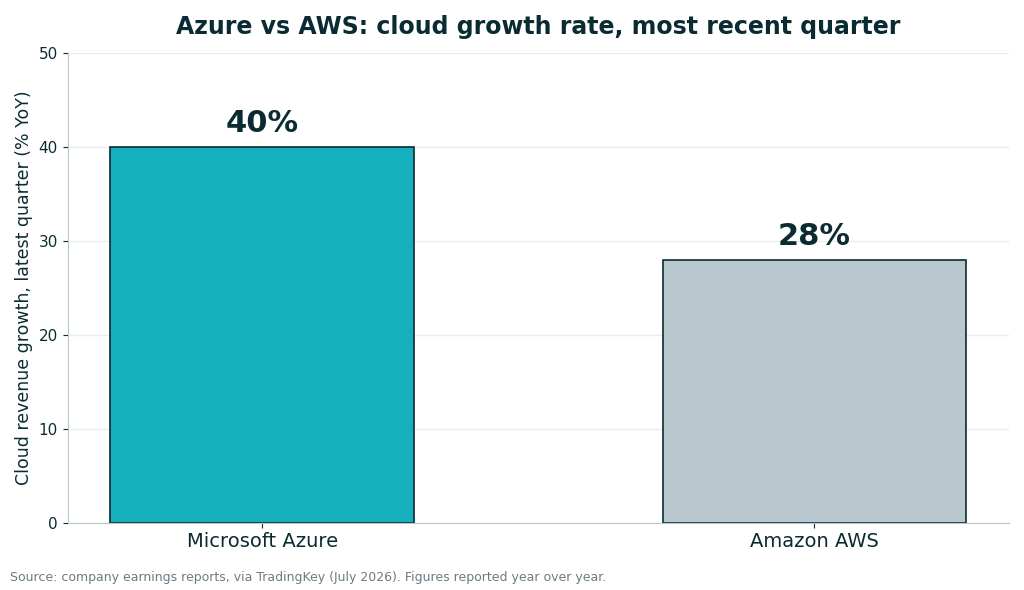
Why does this matter? Microsoft's growth story right now is largely an AI and cloud story. The company guided investors to expect Azure to grow around 39% to 40% versus a year earlier, and last quarter Azure grew about 40%, faster than Amazon's rival AWS cloud at roughly 28% (see the chart above). Management has also said its annualized AI revenue reached about $37 billion, more than double a year earlier, and that paid seats for its Copilot AI assistant passed 20 million. Those are the signposts that tell you whether the AI bet is actually paying off.
Read: Alphabet Stock to Watch: AI Spending vs Cloud Boom
The Counter-Argument (And Why It's Serious)
Now for the strongest case against getting excited, because a good beginner learns to hear both sides. The bears' worry is spending. Microsoft is expected to lay out on the order of $190 billion in capital spending tied to AI infrastructure, a staggering sum. The concern is simple: what if all that money is being poured into data centers faster than the AI products can earn it back? If free cash flow (the cash left over after a company pays for running and expanding the business) shrinks while spending balloons, investors can lose patience, which is part of why the stock has slipped this year.
That is a serious argument and worth respecting. The measured rebuttal is that Microsoft is not spending blindly. It sits on a reported commercial backlog (contracts already signed but not yet delivered) of around $627 billion, which suggests real demand behind the buildout, and its Azure growth rate has stayed high rather than collapsing. The honest answer is that nobody knows yet whether the returns will justify the bill. That uncertainty is the whole reason this is a stock to watch and study, not a slam-dunk anything. Reasonable investors currently disagree, and this earnings report is one more data point in a long debate.
The One Number to Watch
If you only track one figure, make it the Azure cloud growth rate. Because Azure and AI are the engine of Microsoft's growth story, the market tends to react most to whether that growth speeds up, holds steady, or slows down. A telling example: earlier in 2026 Azure grew 38%, which actually beat the company's own guidance, yet the stock still fell about 10% because some investors had quietly hoped for closer to 39.4%. That shows how the expectation can matter as much as the result. So watch the reported Azure growth percentage and, just as importantly, compare it with what management had guided (around 39% to 40%). Beating or missing that bar is what usually moves the shares.
Read: Market Week Ahead: Fed Meeting and Big Tech Earnings
Frequently Asked Questions
When exactly does Microsoft report earnings?
After the U.S. market closes on Wednesday, July 29, 2026. Companies often release results after hours so investors have time to read them before trading resumes the next morning.
What is Azure in simple terms?
Azure is Microsoft's cloud platform, where other businesses rent computing power, storage and AI tools over the internet instead of buying their own machines. It is one of Microsoft's fastest-growing and most closely watched businesses.
Why has the stock fallen if the company is still growing?
Mostly worry about how much Microsoft is spending on AI. When a company invests enormous sums up front, investors sometimes fear the payoff will take too long, which can push the share price down even while sales rise.
Does "stock to watch" mean I should buy it?
No. "Watch" simply means it is worth following and learning from because of an upcoming catalyst. Whether any stock fits your own goals and risk tolerance is a personal decision, ideally made with a licensed professional.
Read: Palantir stock to watch: 93% growth meets a sky-high price
Disclaimer: Content on this site is for informational and educational purposes only and does not constitute financial, investment, or trading advice. I am not a licensed financial advisor. Always conduct your own research and consult a licensed professional before making investment decisions.