

Artificial intelligence (AI) is no longer a distant trend, it’s a generational opportunity for investors. While some may feel cautious after the AI hype of recent years, the reality is that spending on AI technology and computing power is only set to grow in 2026 and beyond. If you’re looking at this space, certain AI hardware stocks are worth keeping on your radar.
Here are four companies leading the AI charge that investors should keep an eye on.
The AI Hardware Boom Is Just Getting Started
Nvidia, Broadcom, and AMD are the heavyweights driving AI hardware innovation. Among them, Nvidia clearly leads the pack. Its GPUs (graphics processing units) have become the standard for AI computing since the surge in AI investment in 2023. The demand is so strong that Nvidia reported being completely sold out of cloud GPUs in its most recent earnings report, a clear sign of the massive appetite for its products.
The long-term opportunity is even bigger. Nvidia projects that global data center spending could reach $3–4 trillion by 2030, up from $600 billion in 2025. This surge in investment represents a huge potential for Nvidia and its competitors.
Read: Nvidia Stock Forecast 2026: Buy NVDA Now? a closer beginner’s look at the market leader.
Advanced Micro Devices (NASDAQ: AMD):
While AMD offers similar AI-focused products, its ecosystem is smaller than Nvidia’s, making its data center business about one-tenth the size. However, AMD sees an opportunity: as Nvidia remains sold out of GPUs, companies may turn to AMD for computing power.
This could help AMD close the gap with Nvidia. Management expects its data center division to achieve a 60% compound annual growth rate (CAGR) through 2030, an ambitious target, but if met, it would make AMD one of the more compelling names to watch in this group.
Read: AMD Stock: The $950B Breakout Isn’t About GPUs how AMD’s story has developed since.
Read: AMD Stock to Watch: AI Chips vs Thin Margins AMD's most recent quarter and what to monitor next.
Broadcom’s Unique Approach to AI Chips

Broadcom is taking a different route from GPU makers. While GPUs are versatile, they are not always the most efficient for specialized AI workloads. Broadcom focuses on application-specific integrated circuits (ASICs), which are customized chips designed for particular tasks.
By working directly with AI hyperscalers to design ASICs for their models, Broadcom is seeing rapid growth. The company expects AI semiconductor revenue to double year over year in the first quarter alone, signaling that these chips could become even more critical than GPUs in the near future.
Taiwan Semiconductor: The Silent Powerhouse
Here’s the kicker—all three of the companies above are fabless: they design chips but don’t manufacture them. That’s where Taiwan Semiconductor Manufacturing Company (TSMC) comes in.
TSMC is the largest chip foundry in the world and produces the hardware that powers Nvidia, AMD, and Broadcom. Its AI chip business is projected to see a mid- to high-50% CAGR from 2024 to 2029, a level of growth rarely seen in the semiconductor industry. This makes TSMC a crucial part of the story alongside the other three.
Read: Micron’s HBM Supercycle Could Redefine AI Growth another “picks-and-shovels” name powering AI hardware.
The chips are only half the story. Every one of these companies depends on data centres that have to be built, powered and wired, and copper is where that demand shows up first. Read: Copper Stocks: Freeport Up 65% as Grasberg Doubles Output
Why These Stocks Are Worth Watching
AI is not just a tech buzzword, it’s shaping industries and creating enormous market opportunities. Keeping AI hardware stocks on your watchlist means tracking a trend that could shape the next decade. Nvidia, AMD, Broadcom, and TSMC are all positioned to benefit from this growth in different ways:
- Nvidia: Dominates AI GPUs with strong demand.
- AMD: Positioned to capture overflow demand and grow rapidly.
- Broadcom: Specializes in efficient, high-performance ASICs.
- TSMC: Powers all three companies as the leading chip manufacturer.
Together, these four names give a broad view of the AI hardware story worth following.
Update — Mid-2026: How the Four Are Tracking
Here’s a refresh on the numbers since this article was written. The growth story has held, but the stocks themselves have been bumpy, a useful reminder of why these are names to watch and understand rather than chase.
- Nvidia: Full-year (FY2026) revenue reached about $215.9 billion, up roughly 65%, with data center around $194 billion and momentum carried into the new fiscal year (Q1 FY2027 revenue near $81.6 billion, up about 85%). Even so, the stock isn’t a straight line: it slid roughly 12% in the month to early July.
- Broadcom: The ASIC bet described above paid off second-quarter (FY2026) revenue hit about $22.2 billion (up 48%), and AI revenue jumped roughly 143% year over year to around $10.8 billion, on track to top $30 billion for the year. It also pulled back sharply (about 20%) in the recent chip selloff.
- AMD: Its data center segment set a record of roughly $5.8 billion in Q1 2026 (up about 57%), and AMD approached a $950 billion market value.
- TSMC: Kept compounding, 2025 revenue was about $122.9 billion (up ~32%), with roughly 30% growth expected again in 2026, and it held up better than its peers during the recent pullback.
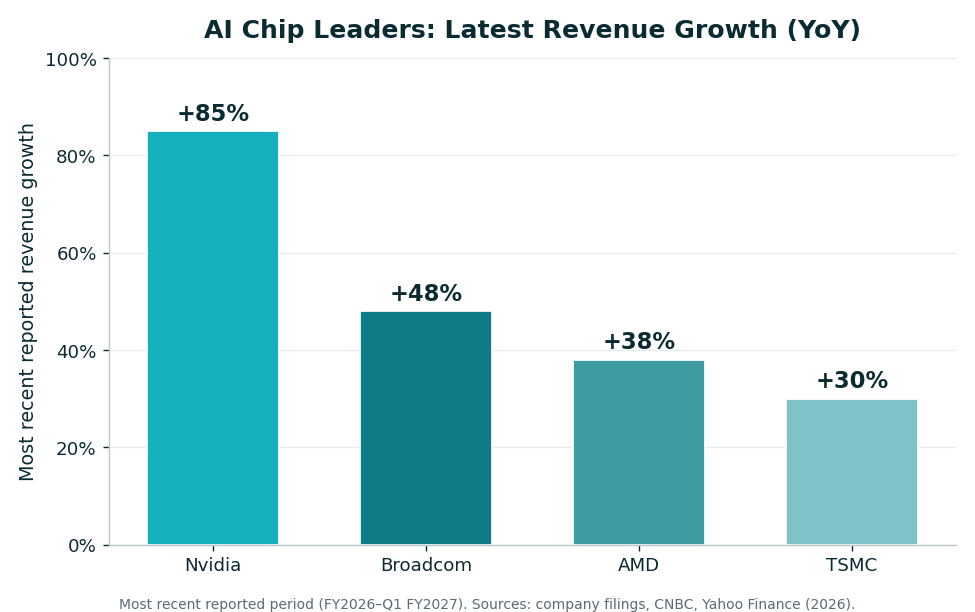
The takeaway for beginners: the theme in this article is intact, AI hardware spending keeps climbing but the double-digit pullbacks in Nvidia and Broadcom show why even the strongest names carry real risk. Watch the catalysts and the risks together. Read: Chip Stock Selloff: Why Micron, AMD and Intel Slid for a closer look at that volatility.
Disclaimer: This article is for informational purposes only and does not constitute financial advice. Investing in stocks involves risk, including the loss of principal. Always conduct your own research or consult with a licensed financial advisor before making investment decisions.