Roth IRA basics start with one idea: it is a retirement account you open yourself, fund with after-tax money, and, if you follow the rules, you can withdraw from tax-free. That last part is why beginners keep hearing about it, and why Roth IRA basics are worth understanding before you open an account. This guide explains the account in plain English: what it is, what the 2026 rules allow, why the tax benefits matter over decades, and why it may not be the right first step for everyone.
What a Roth IRA Actually Is
IRA stands for individual retirement arrangement. It is an account, not an investment itself. Think of it as a special box with a tax rule attached. You open the account, deposit money into it, and then choose what to hold inside, such as funds, stocks, or cash. The box is what gets the tax break; what you put inside is a separate decision.
The Roth version has a specific deal. You fund the account with after tax-money, which means there's no tax deduction for your contributions this year. In exchange, the growth inside the account and qualified withdrawals later come out tax-free. A traditional IRA flips that: you may get a tax break now and pay tax when you withdraw.
Read: Trump Account Rules: The $1,000 Is Not Automatic, the new traditional IRA for children, and why the federal $1,000 only arrives if someone files for it.
Two features tend to surprise people. First, according to the IRS guidance on Roth IRAs, the money you contributed can be taken back out at any time without tax or penalty, because it was already taxed. Second, a Roth IRA has no required minimum distributions during the original owner's lifetime, so you are never forced to start withdrawing at a certain age.
The catch sits on the earnings, meaning the growth on top of what you put in. To take earnings out tax-free you generally need to be 59 and a half or older, and the account needs to have been open for at least five tax years. That five-year clock is worth starting early, even with a small amount.
The 2026 Rules: How Much, and Who Qualifies
For 2026, the limit on annual contributions to an IRA rose to $7,500 from $7,000, and the catch-up amount for people aged 50 and over is $1,100, according to the IRS announcement of 2026 retirement limits. That is a combined cap across all of your traditional and Roth IRAs, not per account. You also cannot contribute more than you earned during the year.
Roth IRAs also have income limits. For 2026, the IRS says the phase-out range for contributing to a Roth IRA is $153,000 to $168,000 for single filers and heads of household, and $242,000 to $252,000 for married couples filing jointly. Below the bottom of the range you can contribute the full amount; inside the range the amount you may contribute shrinks; above the top you cannot contribute directly at all.
The figure that matters here is your modified adjusted gross income, or MAGI. In everyday terms, that is your income after certain adjustments the tax code allows. Most beginners are comfortably under these thresholds, so the practical takeaway is simply to check the number once a year rather than assume.
AGI matters beyond Roth eligibility. It is also the figure that sets your monthly bill on the new federal student loan plans. Read: SAVE Plan Deadline: Miss It and You Lose Your $0 Bill
One more piece of timing: you generally have until the tax filing deadline in April of the following year to make a contribution for the prior year. That gives you a longer runway than the calendar suggests.
Why Tax-Free Growth Matters So Much Over Time
Compound interest is the reason a boring account can end up doing something dramatic. Compounding simply means your growth starts earning its own growth. Year one is unremarkable. Year thirty is not.
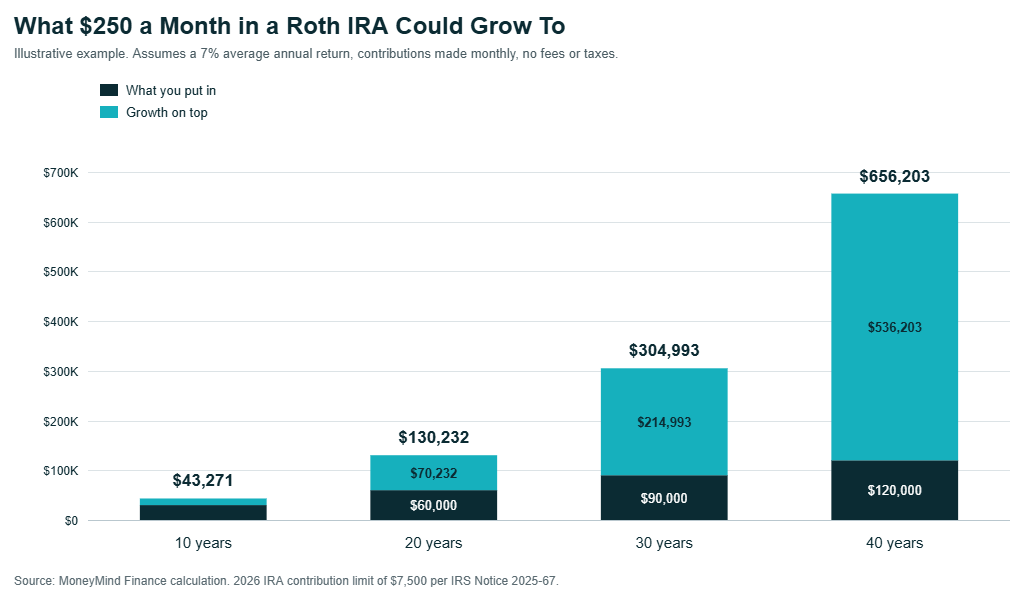
The chart above shows an illustrative example: $250 a month, or $3,000 a year, well under the 2026 limit. At an assumed 7% average annual return, that stream would be worth roughly $43,000 after 10 years, about $305,000 after 30 years, and around $656,000 after 40 years. Only $120,000 of that 40-year figure is money you contributed. The rest is growth. To be clear, this is a simplified illustration, not a forecast. Real returns are uneven, some years are negative, and fees reduce the result.
Now add the Roth wrapper. In a regular taxable account, you would typically owe tax on gains along the way and when you sell. In a Roth IRA, qualified withdrawals come out whole. The bigger the growth portion becomes, the more that tax treatment is worth.
What you hold inside the account still drives the outcome. Many beginners start with broad, low-cost funds rather than individual stocks. Read: Index Funds Explained: A Beginner's Guide.
The Counter-Argument (And Why It's Serious)
The strongest objection is not that Roth IRAs are bad. It is that they are often the wrong first step.
Money in a Roth IRA is meant to sit for decades. If you lock away savings you will need next year, you may end up pulling it back out or, worse, reaching for a credit card when something breaks. Cash you might need soon belongs somewhere safe and reachable. Bankrate's survey puts the national average savings account yield at 0.62% APY as of August 15, 2026, while the best high-yield savings accounts pay around 4%, so parking short-term money well is worth a few minutes of effort. Read: Emergency Fund Basics: How Much to Save in 2026.
A second objection: paying tax now only wins if your tax rate later is similar or higher. Someone in a high-earning year may genuinely be better served by a pre-tax account. And there is a plain-arithmetic point too. If you carry credit card debt at 20-plus percent interest, clearing that is a guaranteed return no market can promise.
The measured response is that this is a sequencing question, not a verdict. A short cash buffer first, then high-interest debt, then any employer retirement match you are leaving on the table, then long-term retirement contributions. The Roth IRA is rarely a mistake; it is just rarely step one. And because contributions (not earnings) can come back out penalty-free, the account is less of a trapdoor than people assume.
The One Number to Watch
Track your annual contribution as a percentage of the limit. In 2026 that limit is $7,500, so $150 a month is 24% of it, and $312 a month is roughly 50%.
This number is useful because it is the part you control. Markets are not up to you. Your contribution rate is. Watching a percentage also stops the all-or-nothing thinking that keeps people from starting: going from 0% to 20% of the limit matters far more than the gap between 20% and 100%. Check it once a quarter and nudge it up when your income does.
Roth IRA FAQ
Can I have a Roth IRA and a 401(k) at the same time?
Yes. They are separate accounts with separate limits. A 401(k) is offered through an employer; a Roth IRA is one you open on your own. Having a workplace plan does not stop you contributing to a Roth IRA, though it can affect the deductibility of a traditional IRA.
What happens if I need the money before retirement?
The contributions you made can generally be withdrawn at any time without tax or penalty. Earnings are the restricted part, and taking them out early can trigger tax and a penalty unless you meet an exception. Treat early withdrawals as a last resort, since money removed loses its future compounding.
Do I have to invest the money right away?
No, and this trips up a lot of first-timers. Contributing money to a Roth IRA and investing it are two separate steps. Cash that lands in the account and is never invested simply sits there. After you contribute, check that the money has actually been put to work.
Is $50 a month too small to bother with?
No. Small amounts started early beat large amounts started late, because time is the ingredient compounding needs most. A small first contribution also starts the five-year clock on tax-free earnings, which is a benefit you cannot buy back later.
Read: another tax-advantaged account got a boost for 2027: our HSA for beginners guide to the new $4,500 contribution limit.
Disclaimer: Content on this site is for informational and educational purposes only and does not constitute financial, investment, or trading advice. I am not a licensed financial advisor. Always conduct your own research and consult a licensed professional before making investment decisions.