The 50/30/20 budget is one of the easiest ways for a beginner to take control of their money, and this guide breaks down exactly how it works. The idea is simple: split your take-home pay into three buckets: 50% for needs, 30% for wants, and 20% for savings and debt. That is the whole 50/30/20 budget in one sentence. It is a rule of thumb popularized by U.S. Senator Elizabeth Warren, and its appeal is that you do not have to track dozens of tiny categories to make real progress. Below we will cover what each bucket means, how to set it up step by step, the strongest objection to the method, and the single number to keep your eye on.
What is the 50/30/20 budget?
The plan divides your after-tax, take-home income (the amount that actually lands in your account, not your salary before deductions) into three simple slices:
- 50% Needs the essentials you cannot skip: housing, utilities, groceries, transportation, insurance, and minimum debt payments.
- 30% Wants the nice-to-haves: dining out, streaming, hobbies, travel, and shopping that is not essential.
- 20% Savings and debt building an emergency fund, saving or investing for the future, and paying extra toward debt beyond the minimums.
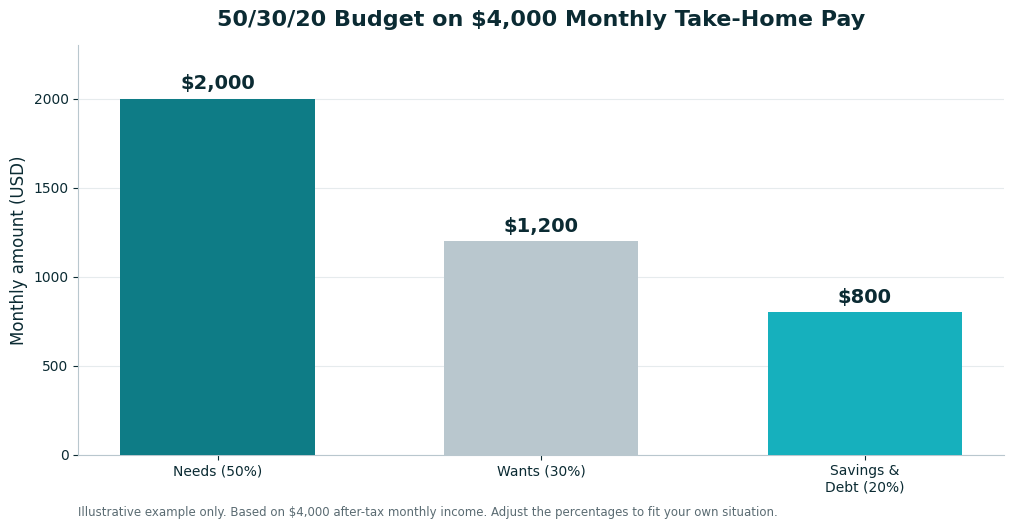
Here is what that looks like for someone bringing home $4,000 a month. This is an illustrative example; your own numbers will differ.
How to set up your 50/30/20 budget
You can build this budget in about 30 minutes with a notebook or a simple spreadsheet. Start by finding your monthly take-home pay, the amount you receive after taxes and any automatic deductions. This is the number you will divide, because budgeting from your pre-tax salary would overstate what you actually have to spend.
Next, multiply that number by 0.50, 0.30, and 0.20 to get your three targets. On $4,000 of take-home pay, that is $2,000 for needs, $1,200 for wants, and $800 for savings and debt. Then list your actual expenses and sort each one into needs or wants. This step alone is eye-opening for most beginners, because it reveals exactly where the money goes. Finally, compare your real spending to the targets and adjust. If your needs are above 50%, look for wants you can trim, or treat the 20% savings goal as the priority and build toward the other targets over time. A powerful trick is to "pay yourself first": set up an automatic transfer to savings on payday so the 20% happens before you can spend it.
One of the best first uses of your 20% bucket is a starter emergency fund. Read: Emergency Fund Basics: How Much to Save in 2026.
Once that buffer is in place, the next home for the 20% bucket is usually a retirement account. Read: Roth IRA Basics: A Beginner's Guide for 2026.
The Counter-Argument (And Why It's Serious)
Here is the strongest objection, and it is a fair one. For many people, spending only 50% of take-home pay on needs is simply unrealistic. In high-cost cities, rent alone can eat 40% or more of income, which leaves little room for the tidy 30% and 20% slices. Critics also argue the rule is too rigid and too simple: it lumps all savings and debt together, even though someone drowning in high-interest credit card debt has very different priorities from someone with none. And the categories can be fuzzy, since one person's "need" is another person's "want."
The measured rebuttal: the 50/30/20 budget was never meant to be a strict law, it is a starting framework. The exact percentages matter far less than the habit of dividing your money on purpose. If your needs run to 60%, you might aim for a 60/20/20 or 70/20/10 split while you work to raise your income or lower fixed costs, then move toward the classic ratios over time. Used flexibly, the method gives beginners something rigid detailed budgets often fail to deliver: a plan simple enough to actually stick with. Rising costs can squeeze every bucket, which is why it helps to understand the bigger forces at play. Read: What Happens When the Fed Raises Rates? A Beginner's Guide.
The One Number to Watch
If you track just one number, make it your savings rate: the share of your take-home pay that goes to savings and extra debt payoff. In this framework the target is 20%, but the real value is watching it over time. A savings rate climbing from 5% to 12% to 20% is a clear sign your finances are getting healthier, even in months when the other buckets are not perfect. Because it captures the gap between what you earn and what you spend, your savings rate is the single best pulse-check on your money, and nudging it up even a few points a year compounds into a very different future.
Frequently Asked Questions
Should I use gross or take-home pay for the 50/30/20 budget?
Use your take-home (after-tax) pay. That is the money you actually control. If a large chunk of your paycheck already goes to taxes or pre-tax retirement contributions, budgeting from your gross salary would make your targets larger than what you can really spend.
What counts as a need versus a want?
A need is something you truly cannot go without: housing, basic groceries, utilities, transportation to work, insurance, and minimum debt payments. A want is a choice that improves your life but is not essential, like dining out or streaming services. When unsure, ask whether skipping it for a month would cause a real problem.
What if my needs are more than 50% of my income?
That is common, especially with high housing costs. Treat 50/30/20 as a goal rather than a rule. Start with a split that reflects your reality, protect some savings no matter what, and work over time to raise income or reduce fixed costs so the ratios can move closer to the target.
Is the 50/30/20 budget good for paying off debt?
It can be a solid starting point, since minimum debt payments sit in needs and extra payments come from the 20% bucket. If you carry high-interest debt, many people choose to temporarily direct more than 20% toward it. The framework is flexible enough to support that.
If your federal student loan payment restarts this year, it belongs in the needs bucket. Read: SAVE Plan Deadline: Miss It and You Lose Your $0 Bill
Read: before you budget around a tax refund from extra hours, check what the overtime tax deduction is really worth.
Disclaimer: Content on this site is for informational and educational purposes only and does not constitute financial, investment, or trading advice. I am not a licensed financial advisor. Always conduct your own research and consult a licensed professional before making investment decisions.