
Netflix Stock to Watch: Record Revenue, Falling Shares
Netflix Stock to Watch: Record Revenue, Falling Shares
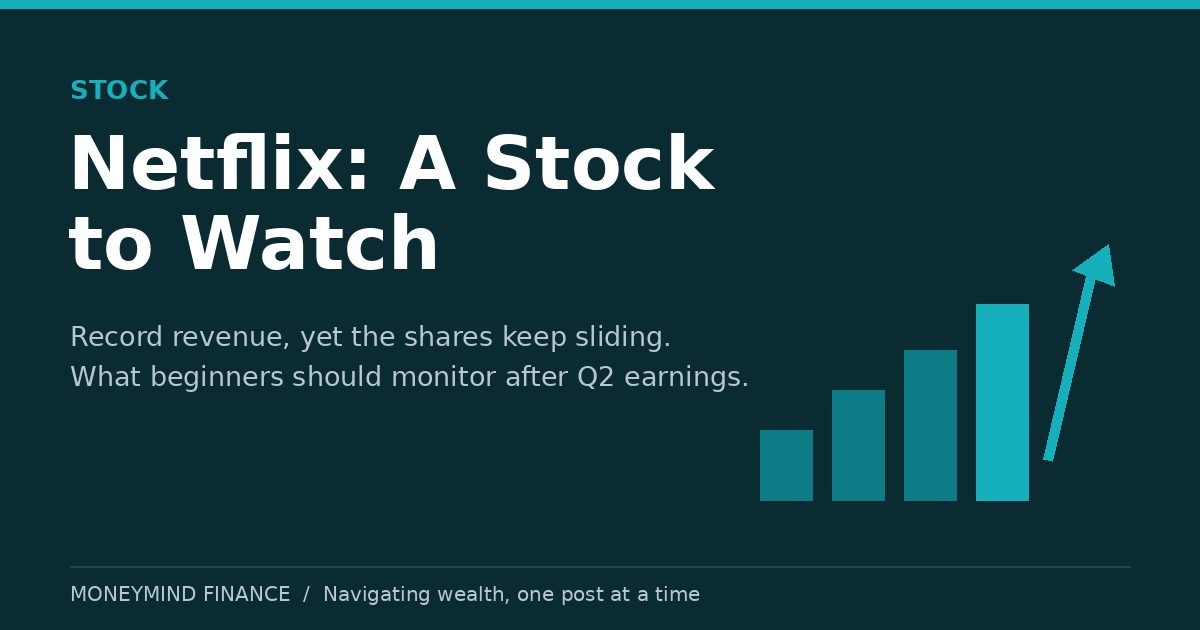
Here is a puzzle that trips up a lot of new investors: a company can post its best sales ever and still watch its stock price fall. That is exactly what happened to Netflix (ticker symbol: NFLX) after it reported results on July 16, 2026. The streaming giant pulled in record revenue, yet the shares kept sliding. If you are learning how the market works, Netflix is a fascinating stock to watch right now, not because we are telling you to buy it, but because it teaches one of the most important lessons in investing: the market cares less about where a company is today and more about where it is heading next.
Let's walk through what happened in plain English, what beginners should keep an eye on, and the honest case for why the worriers might be right.
What Just Happened With Netflix
Four times a year, public companies like Netflix report an "earnings" update, a scorecard showing how much money they made over the past three months (a "quarter"). For the second quarter of 2026, Netflix reported revenue (the total money coming in from subscriptions and ads) of roughly $12.6 billion, up about 13% from a year earlier. That is a record.
Its operating margin (the slice of each dollar of sales left over as profit after running costs) came in around a healthy 33%. By almost any measure, that is a strong quarter. And yet the stock dropped, extending a rough year in which Netflix shares have fallen roughly 26% in 2026 and about 40%–48% over the past twelve months, according to reporting from CNBC and The Motley Fool.
So why the sell-off? The answer is all about the direction of growth.
Why Record Revenue Didn't Rescue the Stock
Think of a stock price as a bet on the future. When investors bought Netflix in past years, they were paying up for fast growth. The problem is that Netflix's growth is cooling off. Here is how its year-over-year revenue growth has trended, including the company's own forecast ("guidance") for the current quarter:
| Quarter | Revenue growth (vs. a year earlier) |
|---|---|
| Q4 2025 | 17.6% |
| Q1 2026 | 16.2% |
| Q2 2026 | 13.4% |
| Q3 2026 (Netflix's forecast) | 11.7% |
See the steady step-down? Netflix is still growing, but a little slower each quarter, and management guided to just 11.7% growth for the next quarter. Wall Street tends to obsess over that trend line. When a company that was priced for speed starts to look more like a steady cruiser, investors often reset how much they are willing to pay, and the stock re-prices downward, even after a record quarter.
One helpful gauge here is the price-to-earnings (P/E) ratio, which compares a stock's price to its yearly profit per share; a high number means investors are paying a premium for expected growth. After the slide, Netflix trades at roughly 19 times its 2026 expected earnings, well below the lofty levels it once commanded. In plain terms, the market has cooled on the "fast-grower" story. (For a real-world echo of this exact pattern, see our TSMC stock to watch piece, where record profit also met a falling share price.) Google's parent, Alphabet, ran into the same wall: our Alphabet stock to watch piece shows how record cloud growth still could not lift the shares.
The Bright Spot Worth Monitoring: Netflix's Ad Business
Here is the part of the story that could change everything, and the main reason Netflix belongs on a watchlist. A couple of years ago, Netflix launched a cheaper, ad-supported tier, a lower-priced subscription where you pay less each month but see commercials. It is the same trade-off broadcast TV made for decades: viewers get a discount, and advertisers foot part of the bill.
That bet is paying off. Netflix's advertising revenue is on track to reach roughly $3 billion in 2026, about double the prior year, and the number of advertisers has grown to more than 4,000, up about 70% year over year. The ad tier has become the fast-growing engine inside a maturing business. For a beginner, the key question to watch is simple: can the ad business grow fast enough to offset the slowdown in the core subscription business? If it can, the gloom may prove overdone. If it stalls, the bears have a point.
One complication to note: Netflix has said it will share less detailed data on subscribers and viewing going forward. That makes it a little harder for outsiders to judge momentum, so the ad-revenue figures become even more important as a signpost.
The Counter-Argument (And Why It's Serious)
It would be easy to say "the sell-off is overdone, the business is fine." But the bearish case deserves real respect, and beginners should understand it before forming any view.
The strongest argument against Netflix is that the slowdown may not be a blip, it may be the new normal. Streaming is a crowded field, and Netflix is no longer just competing with other streaming services. It is fighting for your attention against video games, short-form video, and social media, all of which are free or cheap. If people have only so many hours in the day, Netflix's growth ceiling could be lower than the bulls hope. Add in the decision to disclose less data, and skeptics argue the company is getting harder to trust exactly when its story is getting harder to prove.
Here is the balanced rebuttal. A slower-growing Netflix is not a broken Netflix. The company is still highly profitable, still generating strong cash flow, and still finding fresh ways to make money from its enormous audience, from the ad tier to live sports events. History also shows that a single breakout hit, the next Squid Game-style sensation, can reignite growth almost overnight. The honest takeaway is not "buy" or "avoid," but that both the risk (a permanent slowdown) and the opportunity (a cheaper stock with a new growth engine) are real. That tension is precisely what makes it worth watching rather than ignoring. Understanding why a stock moves, as we cover in what happens when the Fed raises rates, is a skill that pays off far beyond any single company.
The One Number to Watch
If you track just one figure from here, make it Netflix's year-over-year revenue growth rate, the same number in the table above. Netflix has guided to 11.7% for the current quarter. The single most important thing to watch is whether that number keeps falling, holds steady, or turns back up in the quarters ahead.
Why this number? Because the entire debate, bull versus bear, comes down to whether the slowdown is temporary or permanent. If growth stabilizes around the low teens and the ad business keeps compounding, the recent fear may look overdone in hindsight. If growth keeps sliding quarter after quarter, the skeptics were early, not wrong. One clean, honest number tells you which story is winning, no jargon required.
Frequently Asked Questions
Why did Netflix stock fall even though revenue hit a record?
Because a stock price reflects expectations about the future, not just the present. Netflix's revenue is still growing, but more slowly each quarter, and its own forecast points to further slowing. When a company priced for fast growth downshifts, investors often lower what they will pay, so the stock can fall on good-but-decelerating results.
What does "stock to watch" mean, exactly?
It simply means a stock worth paying attention to because something interesting is happening, a catalyst, a risk, or a turning point. It is not a recommendation to buy. Watching a stock helps you learn how the market reacts to news before you ever risk a dollar. When you are ready to evaluate a company yourself, use our 7-step guide to researching a stock before buying.
What is Netflix's ad-supported tier?
It is a lower-priced Netflix subscription that includes commercials. You pay less per month, and advertisers cover part of the cost. It is Netflix's fastest-growing revenue source and a key thing to monitor.
Is a slowing growth rate always bad for a stock?
Not necessarily. Many mature, profitable companies grow slowly and still reward long-term shareholders through steady profits, cash flow, and dividends. The market's worry with Netflix is about the speed of the slowdown and how much investors had already paid for faster growth.
Disclaimer: Content on this site is for informational and educational purposes only and does not constitute financial, investment, or trading advice. I am not a licensed financial advisor. Always conduct your own research and consult a licensed professional before making investment decisions.
All Categories
Recent Posts

CLARITY Act Vote: 60 Needed, Republicans Hold 53
Copper Stocks: Freeport Up 65% as Grasberg Doubles Output

Rate Hike Odds Top 60% Before Friday’s CPI Report
Tags

Navigating wealth, One post at a time