This Jackson Hole preview begins with a fact most week ahead articles overlook: at the Federal Reserve's last meeting, all three officials who disagreed all wanted interest rates higher, not lower. The reality is quite different from what most beginners assume.
The Fed's yearly symposium runs from Thursday 27 August until Saturday 29 August, in the same week as the July inflation report, an updated estimate for second quarter growth, and Nvidia's earnings. Here's what each one means in plain English and the one number worth remembering.
What Actually Happens at Jackson Hole (And Why 2026 Is Different)
Every August the Kansas City Fed brings together central bankers, academics and economists to a lodge in Wyoming for a three day conference on monetary policy, one of the tools central banks use to influence the cost of borrowing. Investors pay close attention because the Fed Chair usually speaks, and chairs have used the venue to offer clues about changing views before those changes show up in the official decision. Nothing is voted on there.
Two things make this year rare Kevin Warsh became Fed chair in the month of May 2026, so this is his first Jackson Hole in the job. And the Kansas City Fed set the official topic as "Financial Innovation: Implications for Payments and Policy," which is about digital payments and financial technology, not interest rates. The program and the thing markets want to hear are not the same subject, which creates a real risk of disappointment.
Jackson Hole Preview: The Inflation Number That Splits the Room
On 29 July the Fed voted 9 to 3 to leave its target range for the federal funds rate at 3.5 to 3.75 percent. That rate is what banks charge each other overnight, and it sets the floor under almost every other borrowing cost. In the official FOMC statement, Beth Hammack, Neel Kashkari and Lorie Logan are recorded as preferring to raise the range by a quarter point. The statement also includes an unusually flat sentence: "The Committee will deliver price stability."
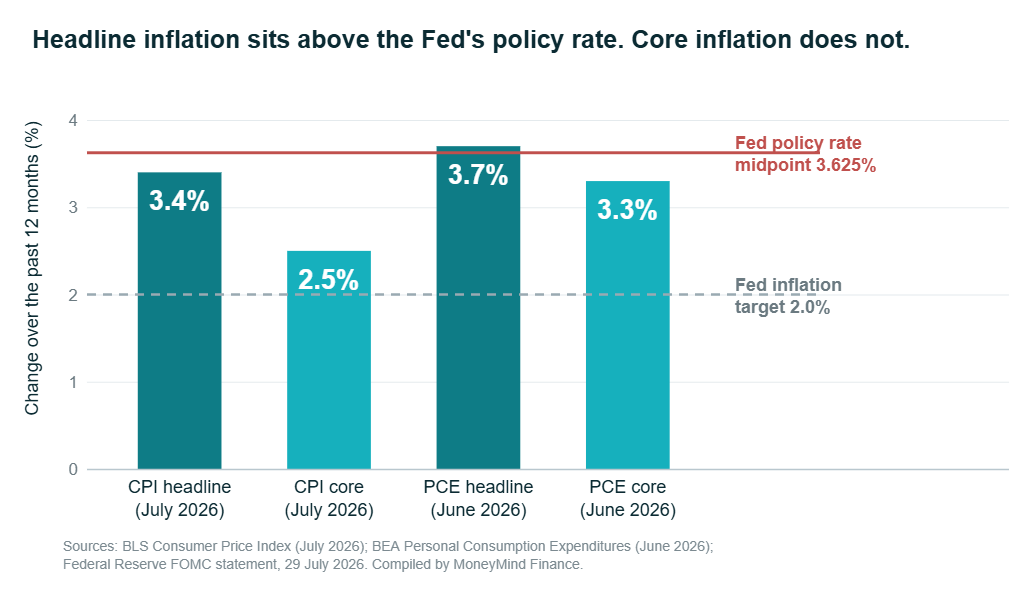
Why would anyone want higher rates when inflation has been declining? The chart above shows it. According to the Bureau of Labor Statistics report for July 2026, consumer prices rose 3.4 percent over the past year. Strip out food and energy, which swing for reasons unrelated to Fed policy, and the "core" figure is only 2.5 percent. That 0.9 point gap is almost entirely energy: the BLS energy index rose 14.7 percent, with gasoline up 24.6 percent. So:
- Judged against headline inflation of 3.4 percent, a policy rate of about 3.625 percent leaves almost no gap. Borrowing costs barely exceed the pace prices are rising, which is not a restrictive setting.
- Judged against core inflation of 2.5 percent, that same rate sits more than a full point above inflation, which is restrictive and already working.
- Nothing about the Fed changed between those two readings. Only the yardstick did.
That is the whole argument in the room this week, and it is why three votes went the other way. For the mechanics of how a monthly inflation print moves share prices, Read: CPI Report Week: What Beginners Should Watch.
Wednesday Is the Week's Real Traffic Jam
Warsh is not expected at the podium until Friday. Wednesday 26 August is when three market moving items land within hours of each other:
- 8:30am ET, July PCE price index. PCE stands for Personal Consumption Expenditures, a second inflation measure built by a different agency using a different basket. It is the one the Fed targets. In June it ran at 3.7 percent headline, 3.3 percent core.
- 8:30am ET, second estimate of Q2 GDP. GDP measures total output. The first estimate showed a 1.5 percent annual pace, down from 2.1 percent in Q1. The second estimate redoes the sum with fuller data.
- After the closing bell, Nvidia's quarterly results. Nvidia guided to revenue of about 91.0 billion dollars, give or take 2 percent, in its most recent earnings release. The prior quarter came in at 81.6 billion dollars.
One detail in that Nvidia figure is worth understanding, because headlines will miss it. Against a year earlier, 91.0 billion dollars is enormous growth. Against the previous quarter, it is a step up of roughly 11 percent, while the three quarters before that each grew about 20 percent. Big yearly number, slower quarterly step. Which one gets emphasised will shape how the shares react. Read: AI Infrastructure Stocks: 3 Companies to Watch.
Two lighter items bookend the week: consumer confidence on Tuesday, 90.8 in July, and final University of Michigan sentiment on Friday, whose preliminary August reading fell to 51.0 from 55.2.
The Counter-Argument (And Why It's Serious)
Everything above frames the hawkish case, meaning the case for keeping rates high or raising them. The serious argument against it: the Fed does not set the price of oil. Energy prices rose on supply problems, including the Middle East conflict the Fed named in its own July statement. Rate rises cannot produce more crude. They can only slow the economy until people buy less, which is a blunt instrument for a problem the Fed did not create.
The supporting evidence is real. Core inflation at 2.5 percent is close to target, growth already slowed from 2.1 percent to 1.5 percent, and consumer sentiment dropped sharply in early August. Tightening into that risks a recession to fix an energy shock that may fade on its own.
The measured rebuttal: the dissenters are not arguing about oil, they are arguing about credibility. Inflation has been above 2 percent since 2021, and the longer people expect that to continue, the more they build it into wages and prices. The University of Michigan survey put one year inflation expectations at 4.3 percent in early August. That is the number the hawks point to. Both sides are reading the same data honestly and weighing different risks.
The One Number to Watch
Core PCE inflation, year over year, at 8:30am ET on Wednesday 26 August. June's reading was 3.3 percent.
This is the Fed's own preferred gauge with the noisy parts removed, so it is the cleanest read on which side has the better case. Below 3.3 percent and the argument that policy is already tight enough gets stronger, and whatever Warsh says on Friday gets heard through that lens. A tick up, and the three dissenting votes stop looking like outliers.
Read: what Warsh’s Jackson Hole keynote did to bitcoin and gold.
Read: September Rate Hike: Core Inflation Hits 5-Year Low
Frequently Asked Questions
Does the Fed decide anything at Jackson Hole?
No. It is an academic conference hosted by one regional Federal Reserve bank. Rate decisions happen only at scheduled Federal Open Market Committee meetings. The symposium offers a long speech rather than a short statement, so listeners get more reasoning than usual.
What is the difference between headline and core inflation?
Headline covers everything a household buys. Core removes food and energy, which swing on weather, harvests and geopolitics rather than on borrowing costs. Core is not more "real", just less noisy, which makes it better for judging whether rate policy is working.
Why does one company's earnings matter to the whole market?
Major indexes are weighted by company size, so the largest companies pull the index around more than smaller ones. Nvidia's results also work as a proxy for how much everyone else is spending on artificial intelligence hardware.
Should a beginner do anything differently in a week like this?
Busy calendars produce bigger daily swings, not better information. Most of what moves prices this week will be revised or forgotten within a month. Watching data to understand it is useful. Trading around it is a different activity with a different risk profile.
Read next: Rate Hike Odds Top 60% Before Friday’s CPI Report
Disclaimer: Content on this site is for informational and educational purposes only and does not constitute financial, investment, or trading advice. I am not a licensed financial advisor. Always conduct your own research and consult a licensed professional before making investment decisions.