Delta stock to watch is a fair label for the week ahead, because it reports its September quarter results on Friday, Oct. 9, 2026, and the biggest factor that could affect its performances something it can not control: the price of jet fuel.
This guide is written for beginner investors. I explain every financial term the first time I use it, and nothing here is a recommendation to buy or sell a stock. All share prices are as of the midday of Oct. 7, 2026.
What Delta Actually Does
Delta Air Lines carries passengers and cargo through major airport in Atlanta, Detroit, Minneapolis-St. Paul, Salt Lake City and other coastal cities. According to its Yahoo Finance company profile, it runs two segments: the airline itself, and a refinery. It has about 103,000 employees and a fleet of roughly 1,314 aircraft.
Here is a simple way to picture it. Imagine a restaurant that also owns a farm. The restaurant sells the meals, which is the airline selling seats. The farm grows some of the ingredients, which is Delta's refinery turning crude oil into jet fuel. When ingredient prices spike, the farm softens the blow a little, but the restaurant still feels it.
Delta also earns money in ways that have nothing to do with seat prices. The biggest is a partnership with American Express: the card company pays Delta for airline miles that it hands out to cardholders. That one stream was $2.4 billion in the June quarter alone, according to Delta's June quarter earnings release. Delta also repairs aircraft for others and carries air freight.
Delta Stock to Watch: The Dated Catalyst
A catalyst is an event that can move a stock. Delta's is dated and public. The company holds its September quarter earnings call on Oct. 9, 2026 at 10 a.m. Eastern time, a date confirmed on the Yahoo Finance quote page.
In July, Delta gave guidance for this quarter. Guidance means the company's own forecast, and it is the yardstick analysts use to judge the report. The September quarter targets were:
- Revenue growth in the mid-teens, compared with a year earlier.
- An operating margin of 11% to 13%. Operating margin is the share of each sales dollar left after the costs of running the business, before interest and taxes.
- Earnings per share (EPS, the profit attributed to each share) of $2.00 to $2.50.
- An average fuel price of about $3.15 per gallon.
For context, in the same quarter last year Delta earned $1.71 per share with an 11.2% operating margin and paid $2.25 per gallon for fuel, per its September 2025 quarter filing.
The shares traded near $82.50 midday on Oct. 7, about 14% below the 52-week high of $95.68 and well above the 52-week low of $55.03. Yahoo Finance and Google Finance showed prices within about 20 cents of each other. The stock was up roughly 20% so far in 2026, ahead of the S&P 500's 13.5%.
Revenue and Earnings, Explained Simply
Revenue is the total money coming in from customers. Delta reports it two ways. The headline figure, called GAAP (the standard accounting rules), was $19.8 billion for the June quarter. The adjusted figure, $17.7 billion, strips out $2.1 billion of fuel Delta's refinery sold to outside buyers, because that is not airline business. Most analysts use the adjusted number, and so does this guide.
Adjusted revenue rose 14% from a year earlier. The surprise is how it got there. Delta added only about 1% more seats, so the growth actually came from higher prices and richer sales mix, not from flying more. Unit revenue, which is revenue per seat flown one mile, rose 12.4%. Premium cabins (first class, Comfort and similar) brought in $6.92 billion, up 17%, while the main cabin brought in $6.85 billion.
The cost side tells the other half of the story. Fuel cost Delta $4.4 billion in the quarter, up 77%, and the average price reached $3.93 a gallon, up 75%. Delta's own release called it the highest quarterly fuel bill in its history. Costs other than fuel also rose 6.8% per seat mile, to 14.09 cents.
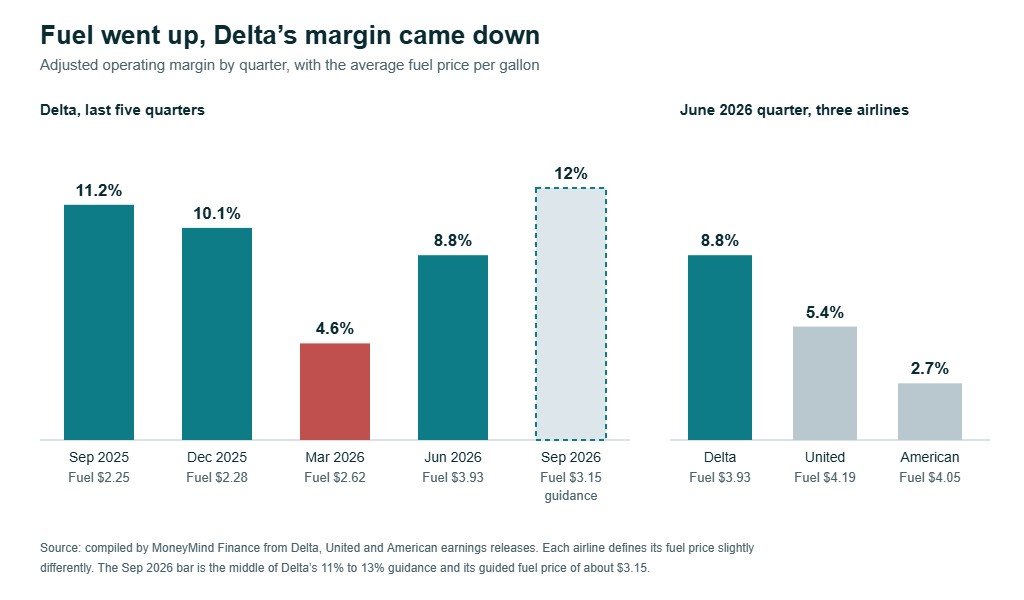
The result was an adjusted operating margin of 8.8% and adjusted EPS of $1.56, which beat the $1.51 analysts expected, according to Yahoo Finance's report on the quarter. But cash was thin. Free cash flow, the money left after paying for planes and upkeep, was only $209 million in the quarter, against $1.2 billion in the March quarter. Adjusted net debt ended June at $13.6 billion.
| Quarter | Adjusted revenue | Adjusted operating margin | Fuel per gallon | Adjusted EPS |
|---|---|---|---|---|
| Sept 2025 | $15.2B | 11.2% | $2.25 | $1.71 |
| Dec 2025 | $14.6B | 10.1% | $2.28 | $1.55 |
| Mar 2026 | $14.2B | 4.6% | $2.62 | $0.64 |
| Jun 2026 | $17.7B | 8.8% | $3.93 | $1.56 |
| Sept 2026 (guidance) | Mid-teens growth | 11% to 13% | About $3.15 | $2.00 to $2.50 |
The MoneyMind Stock Watch Score
To compare companies fairly, we score every stock we cover on the same six criteria, from 1 (weak) to 5 (strong). These scores are MoneyMind Finance's own judgement, not fact, and they are not a recommendation.
| Criterion | Score | One-line reason |
|---|---|---|
| Revenue momentum | 4 | Revenue up 14% and guided to mid-teens, but capacity grew only about 1%, so price is doing the work. |
| Profit quality | 3 | Margin fell from 11.2% to 8.8% as fuel jumped, and June quarter free cash flow was only $209 million. |
| Balance sheet | 4 | Adjusted net debt of $13.6 billion is down from year-end, and management targets leverage near 2x. |
| Customer concentration | 4 | Millions of travelers, but one partner, American Express, supplies $2.4 billion a quarter. |
| Valuation vs growth | 4 | About 11.8 times the midpoint of 2026 profit guidance, for a business growing revenue in double digits. |
| Catalyst clarity | 5 | A dated report on Oct. 9 with published guidance to measure it against. |
| Total | 24 / 30 | Solid, with fuel as the main swing factor. |
What Could Drive Growth
- Cheaper fuel. Delta expects about $3.15 a gallon in the September quarter, roughly 20% below June's $3.93. On June's fuel volumes, a drop that size is worth on the order of $0.9 billion a quarter, though seasons and flying schedules will change the real figure.
- Premium cabins. Premium ticket sales grew 17% and premium corporate sales grew 25%. Customers paying more per seat are the main reason revenue grew faster than capacity.
- Loyalty and card income. Loyalty revenue grew 19% and the American Express payment grew 16%. This income is far less sensitive to fuel than ticket sales.
- Cargo and maintenance. Cargo revenue rose 39% on higher volume, giving Delta a side business that does not depend on passengers.
- Cash returned to owners. Delta said it was raising its dividend 15% beginning in the September quarter, a signal of management's confidence.
What Could Go Wrong
Fuel is the big one. Jet fuel jumped in 2026 after the conflict involving Iran raised fears of supply disruption in the Strait of Hormuz, the narrow shipping lane for much of the world's oil. Yahoo Finance noted in March that U.S. airlines are now largely unhedged, meaning they have not locked in fuel prices in advance, so they pay whatever the market charges. Delta's refinery cushions this, but does not remove it.
The pain shows up clearly across the industry. For the June quarter, here is how three airlines compared:
| Airline | Adjusted operating margin | Fuel per gallon |
|---|---|---|
| Delta | 8.8% | $3.93 |
| United | 5.4% | $4.19 |
| American | 2.7% | $4.05 |
American now expects full-year adjusted earnings between a loss of $0.65 and a profit of $0.65 per share. Delta's guide is $6.50 to $7.50. That gap shows Delta is stronger than rivals, but it also shows how quickly the numbers can move.
Costs are rising even without fuel. Non-fuel cost per seat mile rose 6.8% while Delta added only about 1% more seats. If ticket prices stop rising, that cost growth would eat into profit.
Demand could soften. Main cabin revenue, the cheaper seats, grew for only the second quarter in a row. Airlines are cyclical, which means profits swing with the economy, and travel is one of the first things households trim.
Debt and cash. Delta carries a debt to equity ratio of about 97% per Yahoo Finance. Debt is manageable while profits are healthy, but it limits flexibility when cash flow shrinks, as it did to $209 million in June.
Valuation Explained for Beginners
Valuation asks whether a share price is high or low compared with what the company earns. The most common tool is the price to earnings ratio, or P/E: the share price divided by yearly profit per share. A P/E of 12 means investors pay $12 today for each $1 of annual profit.
Yahoo Finance and Google Finance both show a trailing P/E of about 13.7, which uses the last 12 months of reported profit. Looking forward, Delta guides to 2026 adjusted EPS of $6.50 to $7.50. At $82.50 a share, that works out to a P/E of 12.7 at the low end, 11.8 at the midpoint and 11.0 at the high end. That math is ours, using the guidance and the Oct. 7 price.
What does that imply? Airlines tend to trade at lower multiples than steadier businesses, because investors know profits can vanish when fuel spikes or recessions hit. A multiple near 12 suggests the market already expects some bumpiness. It does not say the shares are cheap or expensive, and a low P/E can become a trap if the earnings behind it fall.
A Realistic Five-Year Scenario for the Business
This section projects the business, not the share price. We start from about $61.7 billion of adjusted revenue, the total of Delta's last four reported quarters (September 2025 through June 2026), and apply three sets of assumptions out to 2031. These are illustrations, not forecasts.
| Scenario | Revenue growth | Operating margin in 2031 | Revenue in 2031 | Operating profit in 2031 |
|---|---|---|---|---|
| Cautious | 2% a year | 6% | $68.1 billion | $4.1 billion |
| Middle | 4% a year | 10% | $75.1 billion | $7.5 billion |
| Optimistic | 5.5% a year | 12% | $80.6 billion | $9.7 billion |
Download the full spreadsheet: Delta Stock Watch Score, calculator and source data (CSV). It includes the scoring table with live SUM formulas, a calculator where you can change the growth and margin assumptions, and every figure in this post with its date and source.
Who This May and May Not Suit
Airline stocks can suit people with a long time horizon, who can sit through sharp drops, and who understand that the company's results depend heavily on things nobody controls, such as oil prices. Delta's 52-week range from $55.03 to $95.68 shows how wide those swings can be.
It may suit less well anyone who needs their money soon, who dislikes large short-term swings, or who wants steady, predictable earnings. Spreading money across many companies, as in an index fund, is one common way investors reduce reliance on a single industry. Our 7-step checklist for researching a stock covers how to think about that before deciding anything.
Read: our earlier Delta Air Lines stock guide for the company's background before this fuel shock.
What to Watch Going Forward
On Oct. 9, these are the signposts that matter most:
- Whether the operating margin lands inside the 11% to 13% guidance.
- Whether EPS lands inside $2.00 to $2.50.
- What Delta says about December quarter revenue and fuel.
- Whether free cash flow recovers from June's $209 million.
- Whether premium revenue keeps growing in the mid-teens.
The one number to watch: fuel price per gallon. Guidance is $3.15. If the actual figure comes in well above that, the margin target becomes hard to hit. If it comes in at or below, the margin range looks safer. Compare it with June's $3.93 and last year's $2.25.
Delta Stock to Watch: Frequently Asked Questions
When does Delta report earnings?
Delta reports its September quarter results on Friday, Oct. 9, 2026, with a webcast at 10 a.m. Eastern time at ir.delta.com.
What is the difference between adjusted and GAAP earnings?
GAAP follows standard accounting rules and includes everything. Adjusted figures remove items the company thinks distort the picture, such as one-off charges or, for Delta, fuel sold by its refinery to outside buyers. Looking at both is a good habit.
Does Delta really own an oil refinery?
Yes. Delta reports two segments, airline and refinery. The refinery turns crude oil into fuel, which helps Delta manage costs when fuel prices jump. It does not fully protect the company, as June's record fuel bill shows.
Does Delta pay a dividend?
Yes. Delta pays a quarterly dividend and said it raised it 15% starting in the September quarter. Yahoo Finance shows a yield of about 1%, so most of the return from owning the stock comes from the share price, not the payout.
Why do airline stocks swing so much?
Airlines have large fixed costs, such as planes and crews, and a big variable cost in fuel. A small change in ticket prices or fuel can turn a healthy margin into a thin one quickly.
Disclaimer: Content on this site is for informational and educational purposes only and does not constitute financial, investment, or trading advice. I am not a licensed financial advisor. Always conduct your own research and consult a licensed professional before making investment decisions.