Here is a head-scratcher for anyone new to investing: Alphabet stock fell about 5% right after the company reported blockbuster results. Alphabet, the parent company of Google, YouTube, and Google Cloud, posted record revenue for the second quarter of 2026 on July 22, with its cloud business growing a stunning 82% in a year. And yet investors sold the shares. Why would a stock drop on such strong numbers? The answer is a single, eye-popping decision about spending, and it makes Alphabet one of the most useful stocks to watch right now, not because we are telling you to buy it, but because it teaches a lesson that applies to almost every company in the AI era.
Let's unpack what happened in plain English, what a beginner should keep an eye on, and the honest case for why the worriers might be right.
What Alphabet Actually Reported
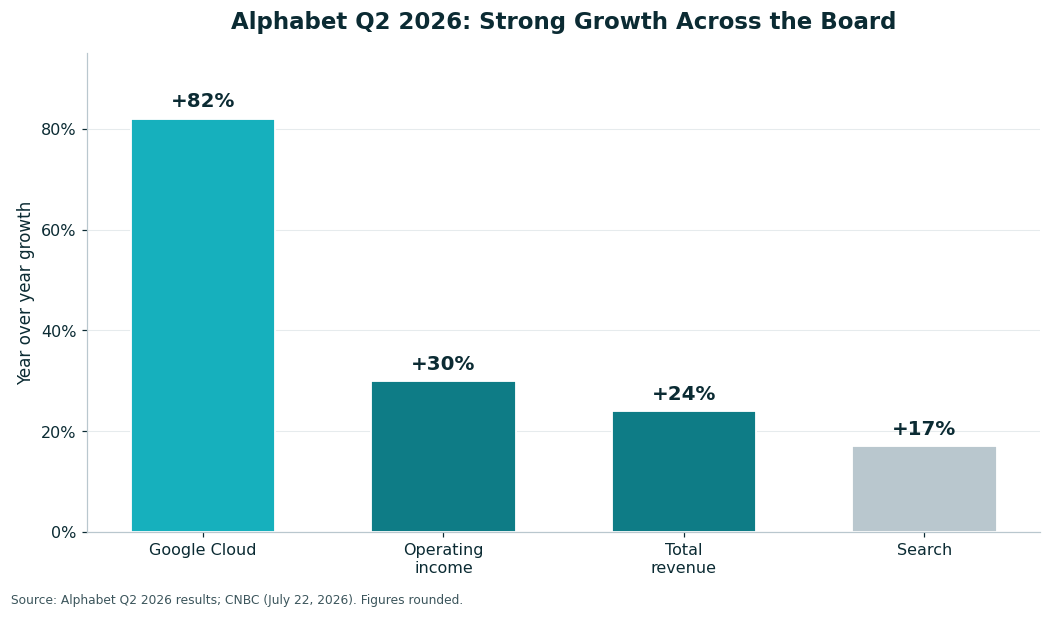
Four times a year, big public companies share an earnings report, a scorecard of how they did over the past three months. Alphabet's Q2 2026 scorecard was strong almost everywhere you looked:
- Total revenue: about $119.8 billion, up 24% from a year earlier. Revenue is simply the total money coming in from sales.
- Google Cloud: about $24.8 billion, up 82%. Cloud computing means renting out computing power and software over the internet, and it is where a lot of the AI action is.
- Search (Google's ads business): about $63.3 billion, up 17%, still the company's cash engine.
- Operating income: about $40.8 billion, up 30%. Operating income is the profit from running the actual business, before one-off items and taxes.
One number looked huge but is a bit misleading: Alphabet's headline net income jumped nearly 300%. Most of that came from a large one-time paper gain on investments it owns, not from selling more ads or cloud services. It is a good reminder for beginners that a giant "profit" number can be inflated by one-off items, so the steadier operating income (up 30%) is the truer read on the core business.
Why the Stock Fell Anyway: The $205 Billion Bet
Here is the twist. Alongside those great results, Alphabet told investors it now plans to spend as much as $205 billion in 2026 on things like data centers and AI chips. That kind of spending on long-lived physical assets is called capital expenditure, or capex for short, think of it as the money a company pours into building its factories, warehouses, and, in this case, the enormous computer facilities that power AI.
In just this one quarter, capex hit a record of roughly $44.9 billion. That spending was so heavy it pushed Alphabet's free cash flow to about negative $5.9 billion. Free cash flow is the cash left over after a company pays its running costs and its capex; it is the money a business can use for dividends, buybacks, or a rainy day. When it goes negative, the company is spending more cash than it is bringing in, even if it is still "profitable" on paper.
That is what spooked investors. They love the growth, but they are nervous about a company shoveling record sums into AI with no guarantee of when, or whether, that spending pays off. A stock price reflects expectations about the future, so a huge, sudden increase in spending can knock the shares even on a great quarter. If you want a framework for weighing numbers like these yourself, see our beginner's guide to researching a stock before buying.
What a Beginner Should Watch From Here
This is the heart of why Alphabet is a stock to watch rather than a buy-and-forget name. The whole debate comes down to one question: is the massive AI spending building something valuable, or just burning cash? A few signposts help you judge:
- Cloud growth staying strong. The 82% jump suggests real, paying demand for Alphabet's AI and cloud services. If that growth holds up, the spending looks justified.
- Cloud profitability. Alphabet said its cloud profit margin more than tripled to around 35.6%, and its order backlog (future business already signed) swelled to about $514 billion. Rising margins and backlog are signs the investment is turning into real money.
- Free cash flow recovering. Negative free cash flow is tolerable for a while if growth is booming, but you want to see it climb back toward positive over time.
This same "great results, falling stock" puzzle has shown up elsewhere in 2026. For a close cousin, see our Netflix stock to watch piece, where record revenue also met a sliding share price. And because all that AI spending needs enormous electricity, it connects to the nuclear and AI-power stocks beginners are watching too.
The Counter-Argument (And Why It's Serious)
The bears have a real case, and beginners should understand it before forming any view. Their worry: Alphabet, along with other tech giants, may be caught in an AI spending arms race, pouring hundreds of billions into data centers because rivals are, not because the returns are proven. History is full of booms where companies overbuilt capacity and then spent years regretting it. Negative free cash flow and a capex bill that keeps rising are exactly what you would expect to see if that is happening. If AI demand cools, all that expensive hardware becomes a very heavy anchor.
Here is the balanced rebuttal. Alphabet is not spending blindly; the early evidence suggests the demand is real. Cloud revenue up 82%, a backlog north of $500 billion, and margins that tripled are not the signs of a business throwing money into a void. Alphabet also still has its hugely profitable Search and advertising engine to fund the buildout, a luxury many AI hopefuls lack. The honest takeaway is not "buy" or "avoid," but that both the risk (an expensive overbuild) and the opportunity (an early lead in AI infrastructure) are genuine. That tension is precisely what makes it worth watching.
The One Number to Watch
If you track just one figure from here, make it Google Cloud's revenue growth rate, currently that eye-catching 82%. Why this number? Because it is the clearest test of whether Alphabet's giant AI spending is meeting real demand. As long as cloud growth stays strong, the case that the company is building something valuable holds up, and the heavy capex looks like investment rather than waste. If that growth rate starts sliding quarter after quarter while spending keeps climbing, the bears' "overbuild" fear gets a lot more credible. One clean number tells you which story is winning.
Frequently Asked Questions
Why did Alphabet stock fall if earnings were strong? Because the company sharply raised its planned AI spending (capex) to as much as $205 billion in 2026, which pushed its free cash flow negative. Investors worried about the cost and uncertain payoff, and a stock reflects expectations about the future, not just today's results.
What does "capex" mean in simple terms? Capital expenditure is money a company spends on long-lasting physical assets, here, data centers and AI chips. It is an investment in future capacity, but it uses up cash now and only pays off if that capacity gets used profitably.
What does "stock to watch" mean? Is it a recommendation to buy? No. It means a stock worth paying attention to because something important is happening, a catalyst, a risk, or a turning point. Watching a company helps you learn how the market reacts before you ever risk a dollar.
Is negative free cash flow always bad? Not necessarily. A fast-growing company can run negative free cash flow for a while if it is investing in real, profitable growth. The concern is when the spending stays huge but the growth it is supposed to fund starts to fade.
Read next: Market Week Ahead: Fed Meeting and Big Tech Earnings
Read: Palantir stock to watch: another AI name where growth meets a sky-high price
Disclaimer: Content on this site is for informational and educational purposes only and does not constitute financial, investment, or trading advice. I am not a licensed financial advisor. Always conduct your own research and consult a licensed professional before making investment decisions.