If you have been watching the news and feeling a little whiplash, the stock market keeps setting records, yet everything at the store still feels expensive this past week finally brought some encouraging news on that second part. In June, inflation (the rate at which prices rise over time) cooled off faster than most experts expected. At the same time, the S&P 500, a basket of 500 large U.S. companies that investors treat as a scoreboard for the whole market has been flirting with an all-time high, trading near the 7,600 level.
The days ahead are a big deal for beginners to understand, because they set the stage for the Federal Reserve's next interest-rate decision on July 29 and a flood of company earnings reports. You do not need to trade on any of this. But knowing what the market is watching and why is one of the best ways to build confidence as a new investor. Let's break it down in plain language.
Inflation Just Cooled - Here's What That Means
The headline number everyone reacted to is the Consumer Price Index, or CPI. Think of CPI as a giant shopping basket the government prices every month, groceries, rent, gas, haircuts, and more. When the total cost of that basket goes up, that is inflation. We usually measure it “year-over-year” (often shortened to YoY), meaning we compare today's prices to the same month a year ago.
In June, headline CPI rose 3.5% from a year earlier, according to reporting on the Bureau of Labor Statistics data. That is a meaningful drop from 4.2% in May, and it came in below the 3.8% that economists had forecast. On a month-to-month basis, prices actually fell 0.4% reportedly the first monthly decline since 2020. “Core” CPI, which strips out food and energy (two categories that jump around a lot), eased to 2.6% from 2.9%.
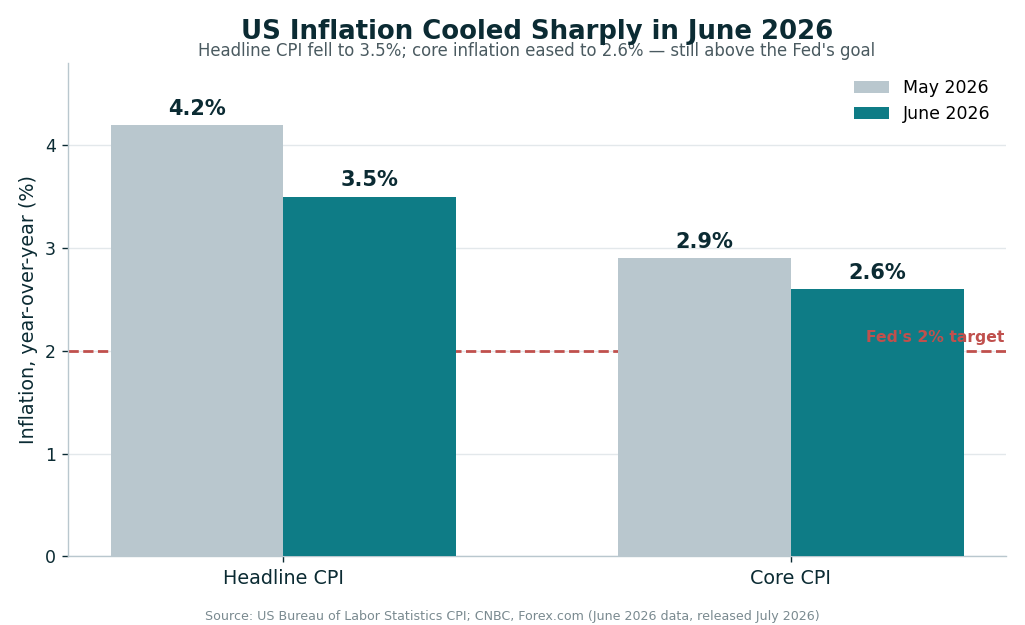
Why should a beginner care? Because falling inflation is generally good news for both your wallet and your investments. When prices rise more slowly, your paycheck stretches further, and it gives the Federal Reserve room to eventually lower borrowing costs something the stock market tends to cheer. But notice that core inflation, at 2.6%, is still above the Fed's official 2% target. One cool month is welcome; it is not yet a finished job.
Why the Fed Is the Main Event
The Federal Reserve often just called “the Fed”, is the United States’ central bank. Its most powerful tool is the interest rate it sets, which ripples out to the rates you pay on mortgages, car loans, and credit cards, and the rates savers earn at the bank. When the Fed raises rates, borrowing gets more expensive and the economy cools; when it cuts rates, money gets cheaper and activity tends to speed up. The Fed’s next decision lands on July 29, and this particular meeting does not include fresh economic projections, so investors will hang on the wording of the statement and the press conference. For a plain-English deep dive on how rate hikes reach your wallet and your stocks, Read: What Happens When the Fed Raises Rates? A Beginner’s Guide.
Here is the twist that makes this week interesting: for most of the past year, investors debated when the Fed would cut rates. But recently, higher oil prices tied to Middle East tensions briefly pushed some traders to price in a small chance of a rate hike instead with those odds jumping toward roughly 31% before the soft inflation report pulled them back down to around 17%, per futures-market gauges. In other words, the picture is unusually two-sided right now, and this week's data and Fed commentary could tip it either way. For a deeper look at how a few giant stocks have been carrying the whole market higher, Read: Market Breadth: Why Record Highs Rest on a Few Stocks.
Earnings Season Is the Other Big Story
While everyone watches the Fed, hundreds of companies are reporting their earnings, the official quarterly scorecards showing how much money each business actually made. A key figure is EPS, or earnings per share, which is a company's profit divided by its number of shares. It tells you how much profit each slice of ownership earned. Earnings matter because, over the long run, stock prices tend to follow profits: rising earnings support rising prices, and disappointing earnings can knock a stock down fast.
Analysts are projecting roughly 22% year-over-year earnings growth for the S&P 500 this quarter, with close to half of that growth tied to spending on artificial-intelligence infrastructure, according to reporting on Wall Street estimates. The week ahead brings a heavy slate of reports, including electric-car maker Tesla on July 22 and dozens of other large companies. As a beginner, you do not need to react to each headline but watching how the market responds to strong or weak results is a great, low-stakes way to learn how earnings move prices.
The Counter-Argument (And Why It's Serious)
It would be easy to read “inflation cooled and stocks are near records” and assume clear skies ahead. The strongest opposing case deserves a fair hearing. First, one soft inflation report is not a trend, core inflation at 2.6% is still comfortably above the Fed's 2% target, and a single month can be noisy. Second, the recent bounce in oil prices is a real risk: energy costs feed into almost everything, so a renewed spike could push inflation back up and even revive talk of a rate hike, which markets usually dislike. Third, as our market-breadth coverage notes, this year's record highs have leaned heavily on a small group of giant companies, which can make the overall market more fragile than the headline index suggests.
The measured rebuttal: the cooldown, while early, showed up in both headline and core numbers and in the rare monthly price decline, which is encouraging rather than a fluke. The Fed has repeatedly said it is “data-dependent,” meaning it will follow the incoming numbers rather than a fixed script so if inflation keeps easing, the door to lower rates stays open. And a resilient economy with 20%-plus earnings growth can support stock prices even without a rate cut. The honest takeaway is not “all clear” or “danger”, it is “promising, but keep watching.” For a related debate about whether smaller stocks can broaden the rally, Read: Russell 2000 Small Caps: Rotation or Rate-Cut Sugar High?
The One Number to Watch
If you track just one figure through the week ahead, make it core CPI, currently at 2.6% year-over-year. Core inflation is the Fed's favorite gauge because, by stripping out jumpy food and energy prices, it reveals the market's underlying trend. The Fed wants to see it move convincingly toward 2%. If core inflation keeps drifting lower in the coming reports, the case for eventual rate cuts strengthens, which historically supports stock prices. If it stalls or ticks back up, especially alongside rising oil, expect the “higher for longer” debate to return. One number, and it tells you which way the wind is blowing.
Frequently Asked Questions
What is the difference between headline and core inflation?
Headline inflation (headline CPI) measures the price change of the entire shopping basket, including food and energy. Core inflation removes food and energy because those prices swing wildly month to month. Core is often seen as a cleaner read on the lasting trend.
Why does the stock market care so much about the Fed?
The Fed sets a key interest rate that influences borrowing costs across the economy. Lower rates make it cheaper for companies and consumers to borrow and can make stocks relatively more attractive than savings accounts, so investors watch the Fed's every signal closely.
What is the S&P 500?
The S&P 500 is an index that tracks about 500 of the largest publicly traded U.S. companies. Because it covers so much of the market, investors and news outlets use it as a shorthand for how “the market” is doing overall.
Should I do anything with my investments this week?
For most beginners, the answer is simply to keep learning and stick to a long-term plan rather than reacting to any single report. Watching how the market responds to inflation data and earnings is a valuable, low-pressure way to build understanding before you make any moves.
Read next: Market Week Ahead: Fed Meeting and Big Tech Earnings
Disclaimer: Content on this site is for informational and educational purposes only and does not constitute financial, investment, or trading advice. I am not a licensed financial advisor. Always conduct your own research and consult a licensed professional before making investment decisions.