The latest PCE inflation report is due Wednesday, the report comes just two weeks after the Federal Reserve raised interest rates for the first time since 2023, and it will help answer one simple question: is that hike really working? With Friday's job report also due, markets face their busiest week for economic data in months.
On September 16, all 12 members of the Fed's rate setting committee voted 12 to raise the target rate by a quarter point, to a range of 3.75% to 4.00%. If you haven't seen the term before, A "basis point," is one hundredth of a percentage point, so a quarter point move equals 25 basis points. The Fed’s official statement said inflation "remains elevated" and that the rate hike would help bring inflation back towards its 2% goal sooner." Now investors want to know whether this week's data backs that up, or weakens it.
This Week's Calendar: PCE Inflation Report, Jobs Data and More
Beginner investors sometimes think there is one "jobs report" and one "inflation report" every month. In reality, several key data releases are arriving one after the other, and traders are watching all of them because each one shifts the odds of what the Fed does at its next meeting, on October 27 and 28.
- Tuesday, Sept. 29: JOLTS job openings, a count of how many positions employers are actively trying to fill, plus the Conference Board's Consumer Confidence index.
- Wednesday, Sept. 30: ADP's private payrolls estimate, then the PCE inflation report itself, the Fed's own preferred inflation gauge (it tracks a broader basket of what people actually buy than the more widely quoted Consumer Price Index).
- Thursday, Oct. 1: The ISM Manufacturing PMI, a survey that shows whether factory activity is expanding or shrinking, plus the weekly jobless claims count.
- Friday, Oct. 2: The September jobs report, formally called the nonfarm payrolls count, with unemployment expected to hold at 4.1%.
July's PCE reading, the most recent one on record, highlighted headline inflation at 3.7% year over year and core inflation (which strips out volatile food and energy prices) at 3.3%. The two are still well above the Fed's 2% target, which is exactly why this Wednesday's update is very important.
Why the Fed Just Hiked Instead of Cutting
For most of the past two years, the debate around the Fed was about when it would cut rates, not raise them. That changed under new Fed Chair Kevin Warsh, sworn in this past May, whose committee has leaned toward treating still elevated inflation as the bigger risk. The September statement explained economic activity as "expanding at a solid pace," with "resilient" consumer spending, "strong" productivity growth and "robust" capital investment, while noting job gains have kept pace with the growth of the workforce.
The Fed also published updated "dot plot," the anonymous chart showing where each official expects rates to land. That updated figure was higher, not lower: officials now see the federal funds rate ending 2026 in a range of roughly 4.1% to 4.4%, up from the 3.6% to 4.1% range they had projected back in June. In simple terms, the people who set interest rates now expect one more quarter point hike before the year ends, most likely in December.
What Friday's Jobs Report Could Show
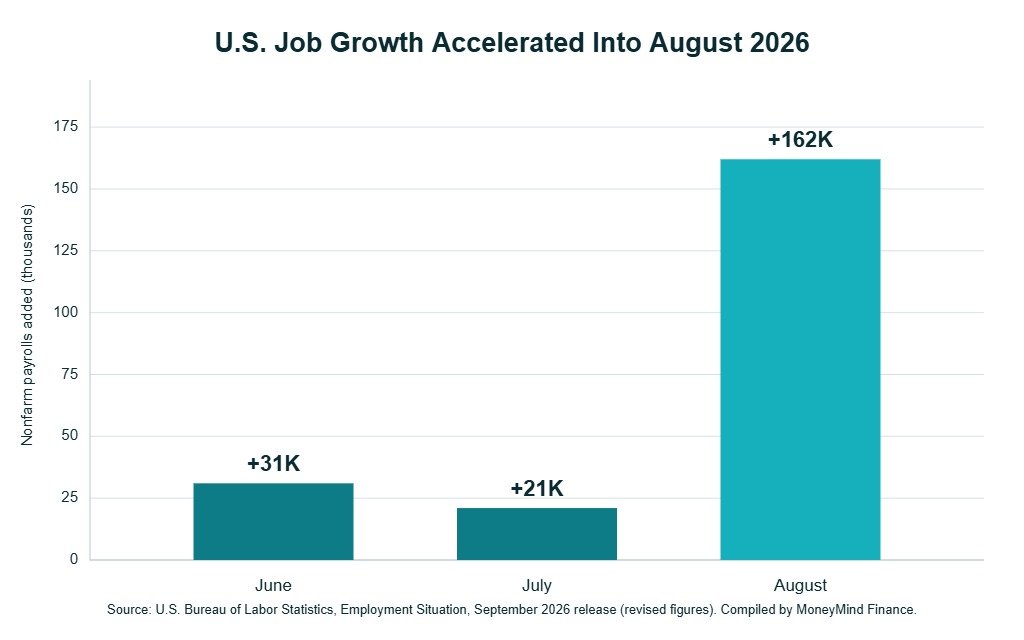
August's jobs report was the surprise that helped push the Fed toward hiking rather than cutting. Employers added 162,000 jobs, according to the Bureau of Labor Statistics’ Employment Situation report, roughly three times the 53,000 that economists had expected, while unemployment held at 4.1%. That single report was revised alongside data for June and July: June's gain was revised up to 31,000 and July's to 21,000, both stronger than first reported.
For September, a Bloomberg survey of economists published on September 26 points to a much cooler 90,000 new jobs, with unemployment still expected at 4.1%. That is only a forecast, not the actual number. The real count arrives Friday morning, and given how far August's result missed expectations, this is not a report anyone should expect they already know the answer to.
The Counter Argument (And Why It's Serious)
The bull case says the Fed is hiking from a position of strength, not weakness. The committee itself described spending as resilient and productivity as strong, and a labor market that just added 162,000 jobs in a single month is not a labor market in trouble. On this view, a Fed willing to raise rates while the economy keeps growing is exactly the kind of soft landing investors have hoped for since 2022.
The rebuttal is worth taking seriously. Core inflation stuck at 3.3%, more than a point and a half above target, with the Fed's own year end projection moving higher rather than lower, is not a picture of a problem that is close to solved. Every additional hike raises the cost of a mortgage, a car loan, a small business line of credit and a credit card balance for the same households whose "resilient" spending the Fed is counting on. If the September jobs and inflation data disappoint at the same time, the market could actually face a scenario it has mostly avoided this cycle: a Fed still raising rates into signs of a slowing economy.
Read: for the case the Fed was building before it actually pulled the trigger, see our earlier look at the September rate hike and what pushed core inflation to a five year low. We also broke down the betting odds ahead of that meeting in our piece on how traders were pricing a hike before the CPI report that preceded it.
The One Number to Watch
Watch core PCE year over year when it lands Wednesday morning. A reading at or below July's 3.3% keeps a December pause on the table. A reading that reaccelerates toward 3.5% or higher makes the Fed's projected December hike look close to a lock, and it is the single number most likely to move markets this week.
FAQ: PCE Inflation Report and This Week's Fed Data
What is the PCE inflation report, and why does the Fed use it instead of CPI?
The Personal Consumption Expenditures (PCE) price index tracks what people actually spend money on, and it adjusts as shoppers substitute one good for another. The Fed has used core PCE as its official 2% inflation target since 2012, even though the Consumer Price Index (CPI) tends to get more headlines.
Why did the Fed hike rates instead of cutting them in 2026?
The committee pointed to inflation that remains above its 2% target alongside an economy it described as expanding at a solid pace. Under Chair Kevin Warsh, the Fed has treated the risk of inflation staying elevated as more serious than the risk of slowing growth too much, which is the reverse of the debate markets expected a year ago.
What does a Fed rate hike mean for my savings account or credit card?
In general, savings account and CD yields tend to move in the same direction as the federal funds rate, so savers often see modestly better returns. Variable rate debt, including most credit cards and some loans, tends to get more expensive. Exact terms vary by bank and account, so this is general education, not a recommendation for your situation.
When does the Fed meet next?
The next Federal Open Market Committee meeting is scheduled for October 27 and 28, 2026, with a final meeting of the year to follow in December.
Disclaimer: Content on this site is for informational and educational purposes only and does not constitute financial, investment, or trading advice. I am not a licensed financial advisor. Always conduct your own research and consult a licensed professional before making investment decisions.