The September rate hike that futures markets now expect on Wednesday arrives at a strange moment, because the inflation gauge the Federal Reserve watches most closely just fell to its lowest level in five years. Core prices rose 2.4 percent over the 12 months through August, the softest reading since March 2021. Yet the headline number everyone sees stayed at 3.4 percent, and traders spent the weekend betting the Fed tightens anyway. Here is how both things can be true, and what to watch when the decision lands at 2 p.m. Eastern on Wednesday, September 16.
What the August CPI report actually said
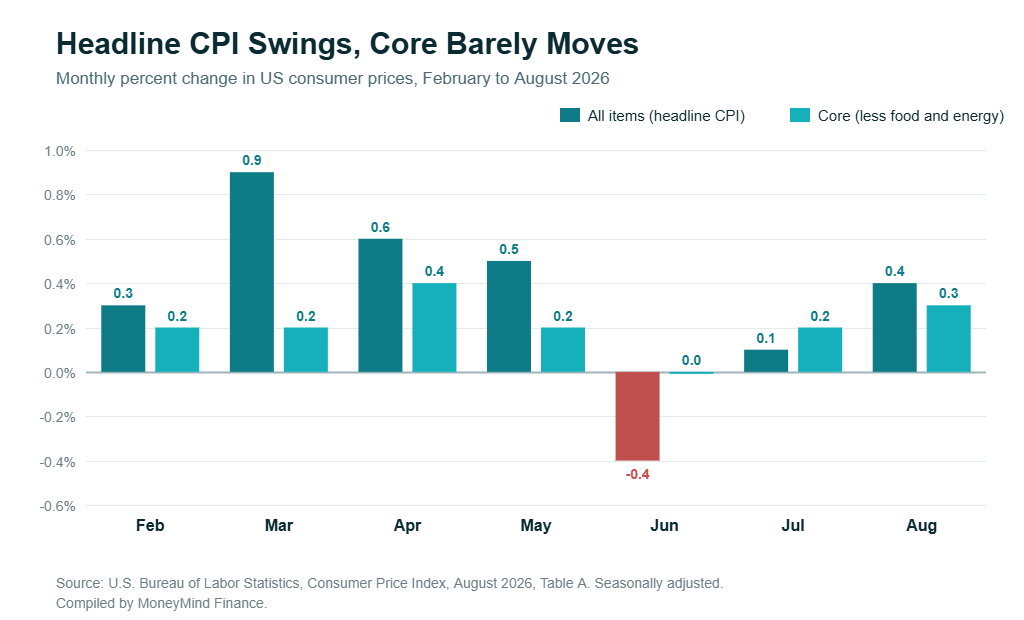
The Bureau of Labor Statistics released August consumer price data on Friday, September 11. Prices across the economy rose 0.4 percent during the month, after a 0.1 percent rise in July. Over the past 12 months the all items index was up 3.4 percent, exactly where it sat in July.
Underneath that headline, the picture splits in two. Core inflation is the all items index with food and energy stripped out. It rose 0.3 percent on the month and 2.4 percent over the year, down from 2.5 percent in July. Economists watch core because food and energy prices jump around for reasons that have little to do with the wider economy, so core gives a cleaner read on the underlying trend. The full breakdown is in the BLS Consumer Price Index summary for August 2026.
| Measure | Change in August | Change over 12 months |
|---|---|---|
| All items (headline CPI) | +0.4% | +3.4% |
| Core (less food and energy) | +0.3% | +2.4% |
| Gasoline | +3.9% | +27.4% |
| Shelter | +0.3% | +3.0% |
| Groceries (food at home) | 0.0% | +2.2% |
Why gasoline is doing the heavy lifting
Gasoline rose 3.9 percent in August alone, and the BLS said it accounted for over one third of the entire monthly increase in the all items index. Compared with a year ago, gasoline is up 27.4 percent, fuel oil is up 52.0 percent, and the whole energy index is up 16.3 percent.
That energy spike leaks into prices that do not look like energy at first glance. Airline fares, which move with the cost of jet fuel, rose 2.7 percent in August and sit 23.4 percent above where they were a year ago.
Here is the awkward part. Interest rates do not produce oil. The federal funds rate, the overnight rate banks charge each other, is the lever the Fed actually pulls, and it cools demand for houses, cars and business investment over many months. It does almost nothing to the price of a barrel of crude this week.
Read: Rate Hike Odds Top 60% Before Friday's CPI Report
Why a September rate hike still looks likely
The Fed has held its target range at 3.50 percent to 3.75 percent for five consecutive meetings. At the July meeting, three members of the rate setting committee dissented, preferring an increase of 25 basis points. A basis point is one hundredth of a percentage point, so 25 of them add up to a quarter of a percentage point.
Since July the August jobs report came in stronger than expected, and both the producer and consumer price reports have kept inflation above the Fed's 2 percent target. Writing on September 11, Kiplinger reported that CME Group's FedWatch tool showed futures traders pricing roughly an 85 percent chance of a quarter point increase, in its weekly economic calendar for September 14 to 18. Estimates elsewhere that weekend ran closer to 90 percent, so treat the precise figure as a moving market estimate.
If the committee goes ahead, it would be the first increase since 2023, and it would lift the target range to 3.75 percent to 4.00 percent.
Read: Jackson Hole Preview: 3 Fed Votes Say Hike, Not Cut
What else lands this week
- Tuesday, September 15: the Empire State Manufacturing Index for September, at 8:30 a.m. Eastern.
- Wednesday, September 16: August retail sales at 8:30 a.m., then the Fed statement and the Summary of Economic Projections at 2 p.m., then Chair Kevin Warsh's press conference at 2:30 p.m.
- Thursday, September 17: weekly jobless claims, August housing starts and building permits at 8:30 a.m., and pending home sales at 10 a.m.
- Friday, September 18: industrial production and capacity utilization at 9:15 a.m., plus a scheduled appearance by Fed Governor Michelle Bowman.
Retail sales matter more than the dull name suggests. Consumer spending drives roughly two thirds of United States economic output, so a soft August reading landing hours before the decision would complicate the case for tightening.
The Counter-Argument (And Why It's Serious)
The case against raising rates this week is stronger than an 85 percent probability suggests. Core inflation at 2.4 percent is close to the Fed's 2 percent goal, especially once you allow for the fact that the shelter component of the CPI lags real world rents by many months. Goods prices are already falling: used cars are down 2.3 percent over the year and medical care commodities are down 2.7 percent. What is left pushing the headline up is an energy shock, and the textbook response to a supply shock is to look through it, because higher rates cannot create more oil.
The rebuttal is about credibility, not arithmetic. Households do not experience core inflation. They experience the pump, and the pump says 27.4 percent. If higher prices start to feel normal, people ask for higher wages and accept higher prices, and the expectation becomes self fulfilling. The Fed has sat still for five meetings while headline inflation ran above 3 percent, and three of its own members have already voted to move. Both sides of this argument are serious, which is why Wednesday is interesting rather than obvious.
The One Number to Watch
It is not the rate decision. Watch the median projection for the federal funds rate at the end of 2026, published in the Summary of Economic Projections at 2 p.m. Eastern on Wednesday. This is the chart usually called the dot plot, where each policymaker marks where they think rates should end up. One hike and then a flat line would say the Fed sees this as a single insurance move against energy driven inflation. A projection showing further increases would say the committee has changed its mind about where rates belong, and that matters far more for mortgages, savings rates and stock valuations than Wednesday's quarter point.
Frequently asked questions
What is core inflation, and why does the Fed care about it?
Core inflation is the consumer price index with food and energy removed. Those two categories swing sharply for reasons like weather and oil politics, which can hide the underlying trend. In August, core inflation ran at 2.4 percent over 12 months, the lowest since March 2021, while the headline figure was 3.4 percent.
Does raising interest rates bring gas prices down?
Not directly. A higher federal funds rate makes borrowing more expensive, which cools spending over a period of months. Crude oil prices are set by global supply and demand. Higher rates can eventually trim fuel demand, but nobody should expect a Wednesday rate decision to show up at the pump in October.
What would a rate hike mean for my savings and my mortgage?
Savings accounts and money market funds usually reprice quickly, so a hike tends to help savers within weeks. Fixed rate mortgages track longer term bond yields rather than the Fed's overnight rate, so they may not move much. Variable rate debt, including most credit cards, tends to get more expensive fastest.
Disclaimer: Content on this site is for informational and educational purposes only and does not constitute financial, investment, or trading advice. I am not a licensed financial advisor. Always conduct your own research and consult a licensed professional before making investment decisions.