
The CLARITY Act vote scheduled for Tuesday, September 15 is the closest Congress has come to writing permanent crypto rules into American law. It may still fail on arithmetic rather than on argument. Sixty senators have to say yes, and Republicans hold only 53 seats. This guide explains what actually happens on Tuesday, why one research firm cut the odds of passage from 60% to 10% over the summer, and the single number a beginner should watch.
What the CLARITY Act Vote Actually Decides
Tuesday's vote does not make anything law. It is a cloture vote, which is the Senate's procedure for ending debate. Think of it as a vote on whether to open the door to the room, not a vote on what happens once everyone is inside.
The bill itself is the Digital Asset Market Clarity Act. It settles a question that has hung over American crypto for a decade: who is in charge? Two agencies both claim authority. The SEC (Securities and Exchange Commission) regulates securities, which broadly means an investment in a business that other people run. The CFTC (Commodity Futures Trading Commission) regulates commodities, which broadly means raw goods and the contracts written on them.
A token can look like either one, depending on who is squinting at it. The bill would write down a legal test for telling them apart and hand the CFTC primary authority over most crypto assets traded on the spot market, meaning ordinary buying and selling for immediate delivery rather than a bet on a future price.
Republicans circulated a fresh draft on Thursday, September 10. According to CoinDesk's reporting on the revised bill text, it changes when decentralised finance projects would need to register with the CFTC and gives credit unions clearer footing on digital assets. Senator Cynthia Lummis, one of the bill's chief negotiators, said the text now folds in more than 114 separate provisions added at the request of her Democratic colleagues.
The Vote Math: Why 53 Is Not 60
This is the part most coverage skips, and it is the part that decides the outcome.
Almost every contested bill in the Senate needs 60 votes to clear cloture, even though there are 100 senators and a simple majority is 51. The 60-vote rule exists so that a determined minority can keep talking a bill to death, a tactic known as the filibuster. Shutting that down takes a supermajority.
Republicans hold 53 seats. Democrats, plus the two independents who caucus with them, hold 47. So even if all 53 Republicans vote yes, the bill is still seven votes short and needs Democrats to cross the aisle. In practice the number needed is higher, because several Republicans have their own reservations. When the motion was first filed in August, CoinDesk reported that the bill would likely need at least 10 Senate Democrats to get over the line.
What is holding those Democrats back is not the SEC and CFTC plumbing. It is an ethics provision governing whether senior government officials, including the President, may profit from crypto ventures while in office. Key Democrats have said that without a bipartisan deal on that section, they will vote no.
Why the Odds Fell From 60% to 10%
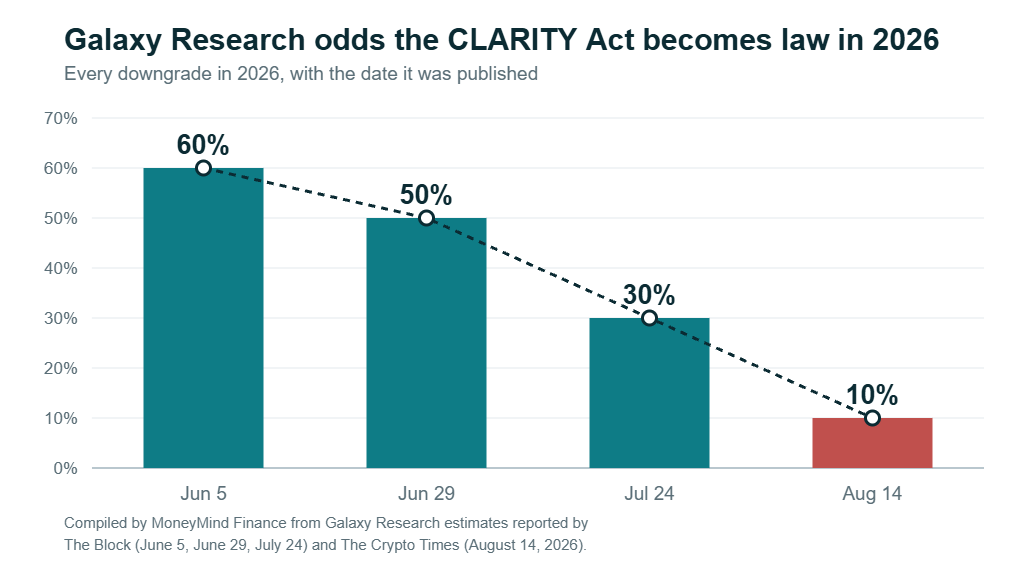
Galaxy Research, the research arm of digital asset firm Galaxy Digital, publishes a running estimate of whether the bill becomes law in 2026. That estimate was cut four times in ten weeks:
- June 5: 60%, with no floor date scheduled.
- June 29: 50%, on a tightening Senate calendar.
- July 24: 30%, after seven Democratic negotiators said the draft still fell short.
- August 14: 10%, after the Senate left for recess without voting.
The driver is the calendar rather than the content. In The Block's coverage of the July downgrade, Galaxy head of research Alex Thorn wrote that the calendar had stopped being an obstacle and become, in his word, "the enemy." The Senate returned on September 14 and is expected to adjourn around October 2 so members can campaign for the November midterm elections. That leaves two to three working weeks to clear a procedural vote, floor debate, an amendment process, and then fresh action in the House.
A separate gauge points the same way. Polymarket, a real money betting market, saw its odds on 2026 passage slide from roughly 82% to about 16% over a comparable stretch. Two very different methods landing in the same place says more than either number alone, though neither is a forecast to lean on.
Read: Rate Hike Odds Top 60% Before Friday's CPI Report
The Counter-Argument (And Why It's Serious)
The case for ignoring all of this is stronger than it first looks.
Crypto prices have barely reacted to the bill's troubles. Bitcoin traded near $77,300 this week, and what moved it was inflation data, not the Senate. August core inflation rose 0.3%, faster than forecast, and traders shifted to price in a Federal Reserve rate hike. If this bill were the dominant force in crypto prices, the summer collapse in its odds should have shown up clearly on the charts. It did not.
There is also a fallback. The SEC and the CFTC can write digital asset rules with or without Congress, and both are already moving. Coinbase's finance chief said this week that the company has a plan built around agency rulemaking if the bill stalls. On that view, the Senate is a headline, not a hinge.
The rebuttal is about durability, not direction. Rules written by one agency can be rewritten by the next, and the makeup of both commissions changes with each administration. That is Lummis's own argument for legislating: a law shields the industry from that whiplash in a way a rulebook cannot. And if this Congress does not finish, the bill does not carry over. A new Congress starts from scratch, which is why Lummis warned on September 6 that the next realistic window might not arrive until 2030.
Read: Crypto Bear Market: What Beginners Should Know
The One Number to Watch
Sixty. Not the percentage odds, not the bitcoin price, just the yes count on Tuesday.
If the tally reaches 60, the bill is alive and the ethics deadlock has quietly broken. If it lands in the mid to high 50s, a handful of Democrats are willing to move and negotiations continue under pressure. If it stalls around 53, or leadership pulls the vote rather than lose it, the bill is finished for this Congress and the story shifts to what the SEC and CFTC do alone. You will know which of the three you are in within minutes.
Frequently Asked Questions
Does this vote decide whether crypto is legal in the United States?
No. Buying and holding crypto is already legal. The bill is about which regulator supervises which asset, and what disclosure rules exchanges and token issuers must follow. Nothing on Tuesday changes whether you may own bitcoin.
What happens if the vote fails?
The bill does not die instantly, but its path narrows sharply. Leadership could try again, though floor time before the midterm recess is scarce. If nothing passes this Congress, the process restarts with newly elected members, and the SEC and CFTC keep filling the gap with their own rules.
Why does an ethics clause hold up a financial regulation bill?
Because a 60-vote threshold gives the minority real leverage. Democrats whose votes are needed have made a bipartisan ethics provision covering senior officials their condition for support. Where the majority cannot pass a bill alone, that condition becomes the price of passage.
Should I expect the bitcoin price to move on Tuesday?
History this summer suggests a modest reaction. The odds fell from 60% to 10% between June and August without a clear matching move in crypto prices, which spent that period responding to inflation data and Federal Reserve expectations instead. A surprise could cause a short term move, but this bill's significance is measured in years, not in one session.
Disclaimer: Content on this site is for informational and educational purposes only and does not constitute financial, investment, or trading advice. I am not a licensed financial advisor. Always conduct your own research and consult a licensed professional before making investment decisions.