Retail earnings week is here, offering beginners one of the clearest looks this month at how American households are actually doing. From Tuesday through Thursday, four of America's biggest retailers, Home Depot, Target, Lowe's and Walmart, report earnings, offering clues about whether consumers are still spending, trading down, or cutting back. That matters because consumer spending is the major drive of the U.S. economy, and the results come just after July retail sales unexpectedly fell.
Here is the plain-English guide to what to watch each day, and the single number worth following.
What "retail earnings week" actually means
Every quarter, public companies report their financial results. That report is known as earnings, and the three-month period it covers is called a quarter. Think of it as a school report card issued four times a year: money in (revenue), money left after costs (profit), and what the company expects next (guidance).
Big retailers report a few weeks after the tech giants, so their results act as a late, very detailed check on the consumer. With tens of millions of shoppers each week, Walmart's results and commentary offer a broad view of consumer spending
This week's schedule, as reported by the Associated Press via Fortune, runs like this:
- Tuesday, Aug 18: Home Depot, a window into home improvement and the housing market.
- Wednesday, Aug 19: Target and Lowe's, discretionary spending and more housing signal.
- Wednesday, Aug 19 (2 p.m. ET): the Federal Reserve publishes minutes from its July meeting.
- Thursday, Aug 20: Walmart, the broadest read on grocery and everyday budgets.
One piece of jargon you will hear constantly this week is comparable sales, often shortened to "comps." It measures sales at stores that have been open at least a year, stripping out the boost a company gets simply from opening new locations. It answers the honest question: are existing stores actually selling more?
The number that set the stage: retail sales fell 0.6%
Retailers report into an awkward backdrop. U.S. retail and food services sales came in at $763.6 billion in July, down 0.6% from June though still up 5.0% from a year earlier, according to the U.S. Census Bureau's advance estimate released August 14. Forecasters had generally expected a small increase, so a decline caught the market's attention.
How to read that report: it counts dollars spent, not items bought, and it is not adjusted for inflation, so a rise can simply mean prices went up. The monthly figure is also noisy and gets revised. One soft month is a data point, not a verdict.
The details are more interesting than the headline. The drop was concentrated in a few places, while several everyday categories held up:
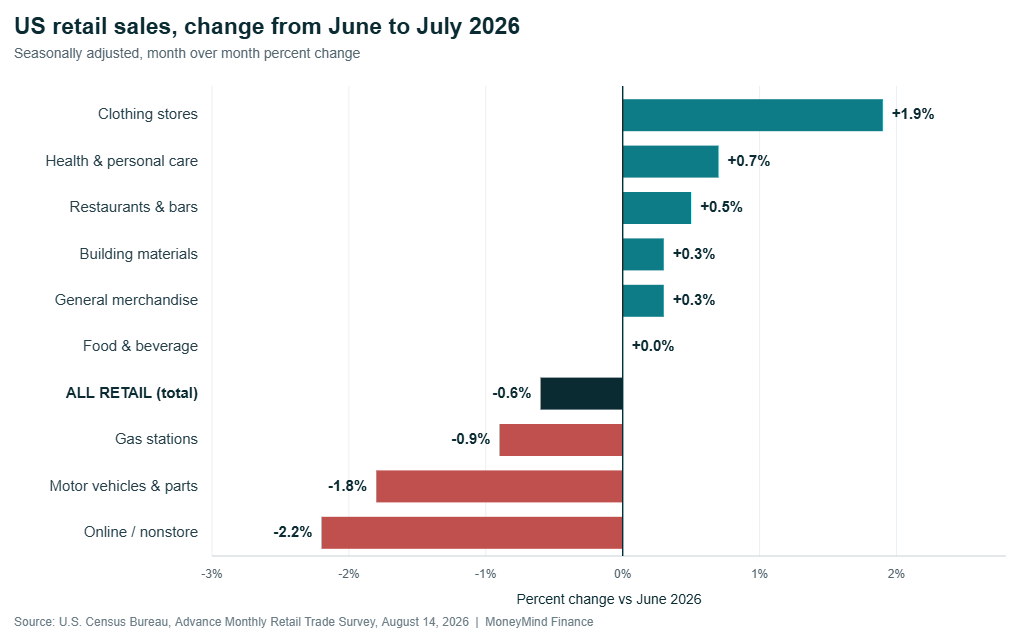
Car dealers (down 1.8%) and online retailers (down 2.2%) did most of the damage, and gasoline stations fell 0.9% partly because pump prices eased during the month. Meanwhile clothing stores rose 1.9%, restaurants and bars rose 0.5%, and grocery spending was essentially flat. Strip out cars and gas and the decline shrinks to just 0.2%.
That is the puzzle the retailers get to answer this week: was July a genuine pullback, or a pause after a strong stretch?
Why inflation and the Fed sit behind every result
Inflation is the rate at which prices rise. Consumer prices were up 3.4% over the year to July, and 0.1% on the month, the Bureau of Labor Statistics reported. Strip out food and energy, the volatile bits, known as core inflation and the annual rate was 2.5%. The sting is still in energy: gasoline was up 24.6% over the year.
When fuel and groceries eat a bigger share of a paycheck, something else gets cut. That is exactly what retail executives get asked about on their conference calls, and it is why their guidance often moves markets more than the results themselves. If you want the fuller picture, Read: CPI Report Week: What Beginners Should Watch.
Then there is the Fed, the Federal Reserve, America's central bank, which sets a key short-term interest rate. In July it held rates steady in a 3.50% to 3.75% range, with three officials dissenting in favor of a hike. Wednesday's minutes are the written record of that argument, and investors will comb them for how close the Fed came to raising rates. Chair Kevin Warsh speaks at the Jackson Hole symposium on August 27 to 29, which is the next big set-piece after this week.
Read: What Happens When the Fed Raises Rates? A Beginner's Guide.
The Counter-Argument
The optimistic case is easy to tell: retail sales are still up 5.0% from a year ago, restaurants grew, and one weak month after a run of gains is normal noise.
The bearish case deserves a real hearing, though. Because the retail sales report is not adjusted for inflation, a 5% annual rise sitting on top of 3.4% inflation means the volume of goods actually bought grew far less than the headline suggests. And the categories that fell are the ones people can most easily postpone, a new car, an online splurge. That is what a squeezed household looks like: still buying groceries, quietly delaying the big-ticket item. Add three Fed officials pushing for higher rates, and borrowing may get more expensive for shoppers and retailers alike.
Home Depot reported first, and its results showed exactly that split: fewer visits, bigger baskets. Read: Home Depot Stock: What Beginners Should Watch Now for what the numbers actually said.
The honest middle ground: one month cannot settle it, which is why this week's company-level results carry weight. Executives see daily transaction data across thousands of stores. If they describe shoppers trading down to cheaper brands, the soft July figure looks like a trend. If they report steady traffic and raise their outlook, it looks like noise.
The One Number to Watch
If you follow only one figure this week, make it U.S. comparable sales growth at Walmart on Thursday.
It is the cleanest measure of whether the same stores are selling more than a year ago, and Walmart's scale means it reflects a real cross-section of American households. Pair it with the split between traffic (how many people came in) and ticket (how much each spent). Growth driven by more visits is healthy. Growth driven only by higher prices per basket, with traffic flat or falling, is inflation doing the work, a much weaker signal.
And remember: none of this requires you to trade anything. For a long-term investor, weeks like this are best used as free education about how the economy actually works.
Update: the interest rate backdrop behind those consumer numbers moved again the following week. Read: Jackson Hole Preview: 3 Fed Votes Say Hike, Not Cut.
FAQ
Why do retailers report earnings later than tech companies?
Many retailers use a fiscal year that ends in late January rather than December, so their quarters finish about a month later than most companies'. That is why their results land in mid-August while big tech reported in late July.
Does a bad retail sales month mean a recession is coming?
No. A recession is a broad, sustained decline in economic activity, and it is judged on many measures over months, jobs, income, production, spending. A single 0.6% monthly dip, which may yet be revised, is one input among many.
What are FOMC minutes?
The FOMC is the Fed committee that sets interest rates. The minutes, published about three weeks after each meeting, summarize the discussion. They show how divided officials were and what would change their minds, context the short rate announcement leaves out.
Should a beginner do anything during a week like this?
Most long-term investors do nothing, and that is a legitimate choice. Company results move share prices over days; a diversified plan is measured in years. Use the week to learn how a business you already shop at actually earns its money.
Disclaimer: Content on this site is for informational and educational purposes only and does not constitute financial, investment, or trading advice. I am not a licensed financial advisor. Always conduct your own research and consult a licensed professional before making investment decisions.