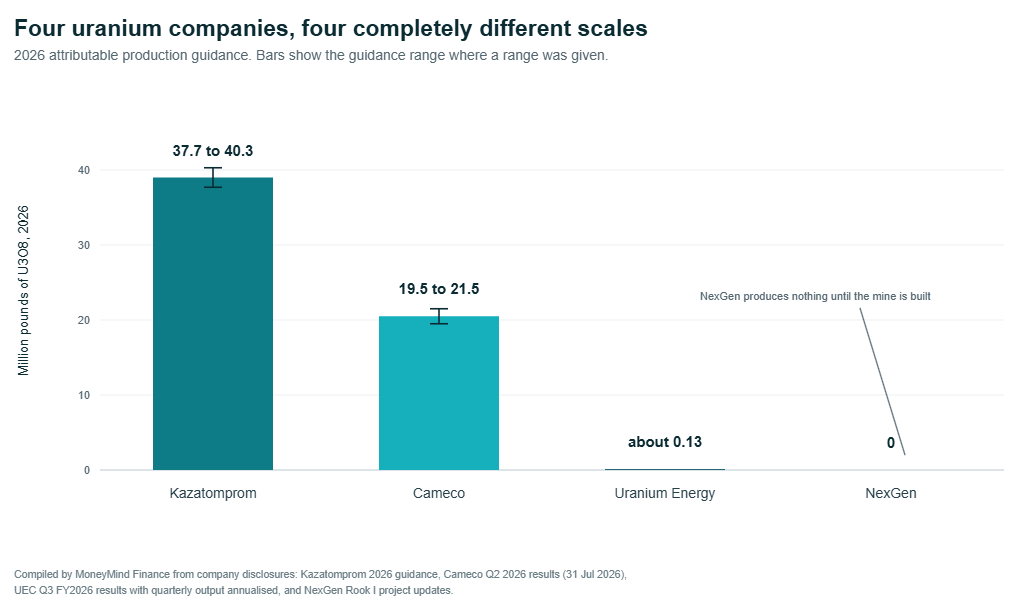
Most beginner guides treat uranium stocks as one trade, but they are not. The four companies often mentioned together have very different production profiles: one is set to produce roughly 40 million pounds this year, another about 20 million, a third produced 32,195 pounds last quarter, and the fourth is not expected to produce until around 2030. Same sector, same headlines, wildly different businesses. This guide clarifies what each one actually does, scores them against the same six criteria, and gives you the spreadsheet so you can change our figures and see what happens.
What these companies actually do
Nuclear power plants rely on uranium as their main fuel source. It is dug up, processed into a powder called U3O8 (say "U-three-O-eight", the industry shorthand for uranium concentrate), and sold mostly to electricity utilities under long contracts. Unlike oil, there is no busy public exchange: a small number of buyers and sellers agree prices privately, and a reported "spot price" signals the smaller market for uranium delivered soon.
Cameco (NYSE: CCJ) is the largest Western producer, mining in northern Saskatchewan, and it also owns a stake in Westinghouse, which services and builds reactors. Kazatomprom (LSE: KAP) is the world's biggest uranium miner, based in Kazakhstan, and its decisions move the whole market. NexGen Energy (NYSE: NXE) owns no operating mine at all: it is building one. Uranium Energy Corp (NYSE: UEC) is a small US producer that has only recently started pulling uranium out of the ground in volume.
That last distinction matters more than anything else in this article, and the chart below is the clearest way to see it.
Why uranium stocks are getting attention now
Two things are happening at once. Demand expectations are rising, as governments extend the lives of existing reactors and technology companies sign deals for nuclear power to run AI data centres. And supply is being deliberately held back: Kazatomprom, the largest producer, has cut its nominal 2026 output from 32,777 tonnes of uranium to 29,697, and its guidance still depends on getting enough sulphuric acid, a mundane but essential mining input.
The spot price sat at US$86.48 a pound on 8 August 2026, according to the CarbonCredits.com uranium price tracker. Cameco's own commentary points at something more durable than the spot market, noting that the long-term contract price strengthened further in the first half of the year as utilities focused on security of supply.
Revenue and earnings, in plain language
Cameco is the only one of the four with financial statements that are relatively easy for a beginner to follow, and its latest quarter shows why headline profit can be misleading. For the quarter to 30 June 2026 it reported net earnings of C$25 million but adjusted net earnings of C$77 million and adjusted EBITDA of C$391 million, according to Cameco's own results release of 31 July 2026.
Three terms worth knowing. Net earnings is profit after every cost, including accounting charges. Adjusted figures strip out items management considers one-off, which is useful but chosen by the company. EBITDA is earnings before interest, tax, depreciation and amortisation, a rough proxy for cash the operations throw off.
The gap between C$25 million and C$391 million is not a trick. Most of the year-on-year fall came from Westinghouse, where a large Czech reactor contract had flattered the 2025 comparison, and from Cameco deliberately selling fewer pounds this year under its contracting discipline. Cameco delivered 7.1 million pounds in the quarter and held 8.7 million pounds of inventory at an average cost of C$58.05 a pound.
The others cannot be read this way. NexGen has no revenue. UEC has revenue measured in tens of thousands of pounds. Applying a price-to-earnings ratio to a company with no earnings tells you nothing, which is exactly why we score them on six things instead of one.
The MoneyMind Uranium Stock Watch Score
We score every company we cover on the same six criteria, one to five, so they can be compared side by side. These are our judgements, not facts, and the underlying figures are listed in the spreadsheet so you can disagree with us precisely rather than vaguely.
| Criterion | Cameco | Kazatomprom | NexGen | UEC |
|---|---|---|---|---|
| Revenue momentum | 3 | 3 | 1 | 3 |
| Profit quality | 3 | 3 | 1 | 2 |
| Balance sheet | 5 | 3 | 4 | 3 |
| Customer concentration | 4 | 3 | 3 | 3 |
| Valuation vs growth | 2 | 4 | 2 | 2 |
| Catalyst clarity | 4 | 3 | 5 | 4 |
| Total out of 30 | 21 | 19 | 16 | 17 |
Cameco scores highest on the strength of its balance sheet: C$1.1 billion of cash against C$1.0 billion of debt and an undrawn C$1.0 billion credit facility. NexGen scores lowest overall and highest on catalyst clarity, which is the honest picture of a company with no revenue but a licensed construction project running to a stated CAD 2.2 billion budget.
Download the full spreadsheet: Uranium Stock Watch Score (CSV, opens in Excel or Google Sheets). It contains the scoring table with live formulas, every source figure used with its date and origin, and a cost-versus-spot calculator where you can change the uranium price and watch the margins move.
What could drive growth
The strongest driver is contracted demand rather than hope. Cameco has commitments for average annual deliveries of more than 28 million pounds a year over the next five years. Utilities do not buy uranium speculatively; they buy it because reactors must be fuelled years ahead.
Second, supply discipline. When the largest producer cuts nominal output, every other producer's pound becomes more valuable. Third, new demand from data centres, which need round-the-clock power that wind and solar alone struggle to supply. Read: Nuclear AI Power Stocks to Watch in 2026.
What could go wrong
Uranium bulls have been early before, and painfully so. After Fukushima in 2011 the price spent a decade in the basement and investors who bought the recovery waited years.
More specifically: mining is physically hard. Cameco had production disrupted this year by flooded supply roads in northern Saskatchewan and further operational problems at Cigar Lake after quarter-end. Guidance held, but the reminder stands. Higher prices also invite idled mines to restart, and Kazatomprom could simply reverse its cuts. And for NexGen, a four-year construction programme is four years of spending with no revenue, during which costs can rise and timelines slip.
Finally, higher uranium prices do not automatically translate into higher profits. Cameco sells much of its output under contracts agreed years earlier, so today's spot price flows through slowly, if at all.
Valuation explained for beginners
A valuation multiple is just a way of asking how much you pay today for what a business earns. The most common, the price-to-earnings or P/E ratio, divides the share price by earnings per share. A high multiple means investors are paying now for profits they expect later.
The catch in this sector is that P/E barely functions. NexGen has no earnings, so its ratio is meaningless. UEC's earnings are tiny relative to its size. Cameco's reported earnings swing on Westinghouse accounting. So investors lean on other measures: the value of proven reserves in the ground, the cost to produce a pound against the price it sells for, and the number of pounds already committed under contract.
That cost-versus-price gap is the most useful beginner lens, and it is the calculator in the spreadsheet. UEC reported a total cost of US$54.61 a pound in its latest quarter against a spot price near US$86.48. The gap is real, but it only matters multiplied by volume, and UEC's volume is currently very small.
A realistic five-year scenario
To be explicit: these are scenarios for the businesses, not forecasts for the share prices. We do not publish price targets.
If the tight market persists. Kazatomprom holds output below its old nominal level, contracted prices keep climbing, and Cameco's realised price rises as old contracts roll off. NexGen finishes Rook I near budget around 2030 and becomes a significant Western producer. UEC ramps Burke Hollow and Christensen Ranch into meaningful volume.
If supply responds. High prices bring idled capacity back, Kazatomprom reverses its cuts, and NexGen's new pounds arrive into a better-supplied market around 2030. Producers still earn more than they did in 2020, but the scarcity premium fades.
If demand disappoints. Reactor projects slip, as nuclear projects historically do, and data-centre power deals turn out smaller than announced. The developer with four years of spending and no income is the most exposed in this case, not the incumbent with a billion dollars of cash.
Who these may or may not suit
This is general information, not advice about your situation. But the shape of each business does imply a different time horizon.
A producer with contracted revenue and a strong balance sheet behaves differently from a pre-revenue developer whose value depends on finishing a mine four years from now. Anyone who might need the money before then is holding something whose payoff sits beyond their horizon. Uranium is also a single commodity in a single industry, so a position here is concentrated by definition. Read: Index Funds Explained: A Beginner's Guide.
We apply the same Stock Watch Score to other critical commodities, using identical criteria so the totals can be compared side by side. Read: Copper Stocks: Freeport Up 65% as Grasberg Doubles Output
What to watch going forward
If you follow one number, make it the long-term contract price rather than the spot price everyone quotes. Spot covers a thin slice of the market; the long-term price is what utilities actually agree to pay for pounds delivered over years, and it is what flows into producer revenue.
Alongside it, three dated signposts: whether Cameco holds its 19.5 to 21.5 million pound guidance after the Cigar Lake disruption, whether Kazatomprom's next update keeps output below the old nominal level, and whether NexGen's construction milestones stay on the CAD 2.2 billion estimate. Each is checkable, and each will tell you more than a week of price movement.
FAQ
What are the best uranium stocks for 2026?
We do not rank stocks as best or worst, because that depends on your circumstances. What we can say is that they are not interchangeable: Cameco and Kazatomprom produce at scale today, UEC has just begun producing, and NexGen produces nothing until its mine is built. Our scoring table above sets out how each compares on six measures.
Why is the uranium price not one single number?
Because there are two markets. The spot price covers uranium for near-term delivery and is widely quoted. The long-term contract price covers multi-year utility agreements and is where most volume actually trades. They can move in different directions for months.
Is it better to own a producer or a developer?
They are different propositions rather than better or worse. A producer earns money now and is exposed to operating problems. A developer earns nothing now and is exposed to construction risk and funding, with more room to grow if the build succeeds.
Can I follow uranium without picking a company?
Yes. The Sprott Physical Uranium Trust simply holds physical uranium in storage, so it tracks the metal rather than any one company's mining performance. There are also funds holding baskets of miners. Both spread single-company risk while still moving with the sector.
What is in the downloadable spreadsheet?
The scoring table with live formulas so you can change any score, a cost-versus-spot calculator where you set the uranium price and see the margin per pound, and a source list giving every figure with its date and origin.
Read: the four defense primes and their record $761 billion backlog, scored on the same six criteria used above.
Disclaimer: Content on this site is for informational and educational purposes only and does not constitute financial, investment, or trading advice. I am not a licensed financial advisor. Always conduct your own research and consult a licensed professional before making investment decisions.