
JPMorgan Stock to Watch: $15.3B Profit, Buffer at 13.9%
JPMorgan Stock to Watch: $15.3B Profit, Buffer at 13.9%
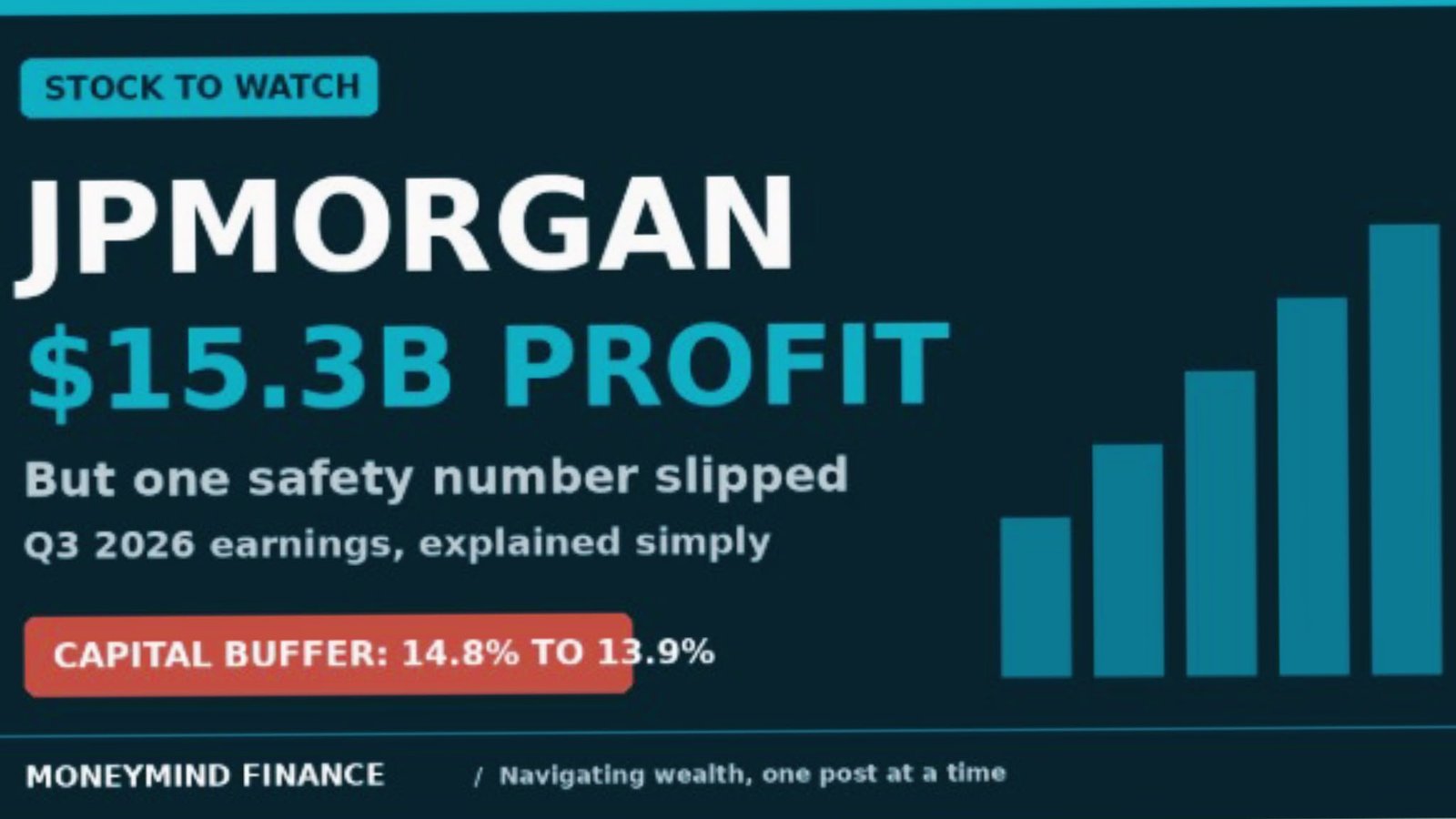
JPMorgan stock to watch: America's biggest bank has just reported a $15.3 billion profit for the third quarter of 2026, bit one important safety number in the report got worse.
If you have never read a bank's financial report before, do not worry. This guide explains each term as we go. We are here to learn and not to tell anyone to buy or sell JPMorgan stock.
What JPMorgan Chase Does
Think of JPMorgan Chase as a huge shopping centre with three main businesses under one roof. The first store is Consumer and Community Banking: it offers everyday banking, credit cards, home loans and car loans to millions of people. The second is the Commercial and Investment Bank: it helps companies raise money, advises them on business deals and buys and sells stock and bonds for clients. The third is Asset and Wealth Management: it manages money for wealthy families, retirees and large organizations.
Having three stores matters. When one slows down, another often picks up the slack. In the latest quarter, the investment bank earned about $8.2 billion, the consumer bank about $5.7 billion and wealth management about $1.8 billion, according to the company's Q3 2026 Form 8-K filing summary. (A Form 8-K is a report US companies must file with the government when something important happens, such as quarterly results.)
JPMorgan Stock to Watch: Why It Matters Right Now
JPMorgan reported on Tuesday, 13 October 2026, kicking off bank earnings season. Banks are useful to watch because they sit in the middle of the economy. Their results show whether people are borrowing, spending and paying loans back.
Here is the headline. Net income (the profit left after all costs and taxes) was $15.3 billion, up 6% from $14.4 billion a year earlier. Earnings per share, which is profit divided by the number of shares, was $5.57, up 10%. Total revenue was about $50.9 billion, up 8%.
There is a catch for anyone comparing quarters. Profit was down 28% from the second quarter, but that is because the second quarter included a one-time $4.6 billion gain on Visa shares the bank owned. Strip that out and the third quarter looks steady, not weak.
The interest rate backdrop also matters. The Federal Reserve raised its target range to 3.75% to 4.00% in September, which changes how banks earn money. If you want that background, Read: PCE Inflation Report: Fed Just Hiked to 4%.
Revenue and Earnings Explained Simply
A bank makes money in two main ways. The first is net interest income, often shortened to NII. It is the gap between the interest the bank earns on loans and the interest it pays out on deposits. If you pay 2% on savings and charge 8% on a loan, the 6% gap is the bank's cut. JPMorgan's NII was $27.0 billion, up 13% from a year ago.
The second is fees and trading: advising on deals, handling payments, managing wealth and trading for clients. Equities trading revenue (buying and selling company shares for clients) jumped 49% from a year earlier, and investment banking fees rose 14%, led by advice on mergers.
Now the costs. JPMorgan spent $27.3 billion running the bank, up 12%. Costs grew faster than revenue (12% versus 8%), so the share of each revenue dollar eaten by expenses (called the overhead ratio) rose from 52% to 54%. That is not a disaster, but it is the kind of detail that separates a good quarter from a perfect one.
Two more terms. Provision for credit losses is money the bank sets aside in case borrowers do not repay. It was $2.7 billion, including $2.2 billion of loans actually written off (called net charge-offs) and a $539 million top-up to the safety cushion. And ROTCE, return on tangible common equity, tells you how much profit the bank earns for each dollar of shareholder money. JPMorgan's was 20%, which is high for a bank. CEO Jamie Dimon said on the earnings call that conditions are "exceptionally favorable" compared with the 17% the bank aims for across a full economic cycle, according to the Q3 2026 earnings call transcript.
Growth Drivers to Know
1. Lending is growing. Total loans rose 10% to about $1.58 trillion, led by a 16% jump in loans to companies. Total deposits (money customers keep at the bank) rose 9% to about $2.78 trillion. More loans funded by more deposits is the basic engine of a bank.
2. Higher interest rates help the interest gap, for now. Management expects NII excluding its trading business to reach about $107 billion in 2027, according to the call. Roughly a quarter of the expected increase comes from the shape of the yield curve (the pattern of interest rates over different time periods), including rate hikes already priced in.
3. Capital markets are busy. Strong equities trading and deal advice gave the investment bank a 14% revenue gain to $22.7 billion.
4. Everyday spending is healthy. The company said debit and credit card spending grew 10% from a year earlier, and finance chief Jeremy Barnum called the consumer "very healthy" on the call.
What Could Go Wrong
No company is risk free. Here are the main things worth understanding, with the mechanism behind each.
The safety buffer shrank. Banks must hold a minimum amount of high-quality capital to absorb losses. A common measure is the CET1 ratio (Common Equity Tier 1), which compares a bank's strongest capital to its risky assets. JPMorgan's fell to 13.9% from 14.8% a year ago and 14.2% last quarter. The causes: the bank's risky assets grew by about $52 billion in one quarter, it paid out dividends and share buybacks, and paper losses on bonds it holds reduced capital. A lower buffer is not a crisis, but it leaves less room if something breaks.
Costs are rising faster than sales. If that gap continues, profit growth slows even when revenue is strong. Management guided to about $27.5 billion of expenses in the fourth quarter.
Trading can cool quickly. Barnum said "evolving market conditions have recently slowed activity a bit." Trading revenue is lumpy, and Dimon described the deal pipeline as "like an accordion" that can open and close fast.
Higher rates can backfire. Barnum warned that a long, aggressive rate cycle would likely lift unemployment and hurt consumer credit. Rising rates also give savers a reason to move money into higher-paying products such as certificates of deposit, which can make deposits more expensive for the bank.
Loose lending standards elsewhere. Dimon said some credit terms in the market "have got a little bit loose," pointing to weak lender protections. If those loans sour, banks feel it.
Securities losses. The bank booked $658 million of losses on investment securities in the quarter, compared with a $105 million gain a year earlier. Losses like these usually appear when interest rates rise, because older bonds lose value.
The counter-argument (and why it is serious). Some investors argue a record-level profit at the top of the cycle is exactly when to be careful, because 20% returns are above the bank's own 17% long-run goal. Dimon himself said "I would never take it off the table" about the chance of market or economic stress, though he stressed that is not a prediction. The serious part: bank profits are cyclical, meaning they rise and fall with the economy, and the best quarters often come just before conditions change.
Valuation for Beginners
Valuation asks a simple question: how much are you paying for each dollar of what the company earns or owns?
As of the close on 13 October 2026, JPMorgan shares were $331.43 according to the Yahoo Finance quote page, giving a market value of about $881 billion. The shares sit about 10% below their 52-week high of $366.50 and about 19% above the low of $279.10.
The price-to-earnings ratio (P/E) divides the share price by a year of profit per share. JPMorgan's trailing P/E is about 13.9, meaning investors pay about $13.90 for each $1 of yearly profit. Banks usually trade at lower P/E ratios than fast-growing tech firms because their profits are more cyclical.
Banks are also judged against tangible book value: roughly what shareholders would own if you subtracted intangible items such as brand value and acquisition goodwill. JPMorgan's is $112.64 per share, so the stock trades at about 2.9 times that (and about 2.5 times regular book value of $132.30). A bank earning 20% on tangible equity can deserve a premium to book value, but if returns fall back to 17% or lower, that premium can shrink.
The bank also paid a dividend of $1.65 per share, which works out to about 1.97% a year at the current price. That is a modest payout, and Dimon said the bank holds roughly $30 billion of extra capital it would rather keep available for investments and "dry powder" than spend on buying back shares at current prices. Share buybacks fell sharply to about $1.1 billion this quarter from about $8.3 billion a year earlier.
A Five-Year Scenario for the Business (Not the Share Price)
This section looks at the business, not the stock price. We never predict share prices. We start with a simple run rate: the third quarter's $50.9 billion of revenue multiplied by four, about $204 billion a year. We then apply three labelled, made-up growth paths. These are teaching examples, not forecasts.
| Scenario | Assumptions | Revenue in year 5 | Net income in year 5 |
|---|---|---|---|
| Cautious | Revenue grows 2% a year (a slow economy); profit margin slips to 24% | about $225 billion | about $54 billion |
| Middle | Revenue grows 4% a year; profit margin settles at 28% | about $248 billion | about $69 billion |
| Strong | Revenue grows 6% a year (busy markets, steady lending); margin holds at 30% | about $273 billion | about $82 billion |
For reference, this quarter's profit margin (net income divided by revenue) was about 30%. So the strong case simply assumes today's very good conditions last. You can change the assumptions yourself in the spreadsheet below.
Download the full spreadsheet: [OWNER: upload the spreadsheet and link it here]
The MoneyMind Stock Watch Score
Here is MoneyMind Finance's own scorecard. Each criterion is scored from 1 (weak) to 5 (strong). It is our judgement, based on public numbers, and it is not a recommendation.
| Criterion | Score | One-line reason |
|---|---|---|
| Revenue momentum | 4 | Revenue up 8% and net interest income up 13% from a year ago. |
| Profit quality | 3 | EPS up 10%, but costs rose 12% and securities losses hit $658 million. |
| Balance sheet | 4 | Capital ratio 13.9%, down from 14.8%, but deposits grew 9%. |
| Customer concentration | 5 | Three large businesses and millions of customers, so no single dependency. |
| Valuation vs growth | 3 | About 13.9 times earnings and 2.9 times tangible book: fair, not clearly cheap. |
| Catalyst clarity | 4 | Q4 guidance is out and the next report is due in January. |
| Total | 23 / 30 | Strong business, with valuation and rising costs holding the score back. |
Scores are MoneyMind Finance's own judgement for education only, not a buy or sell signal.
Who This May and May Not Suit
In general terms, large diversified banks like JPMorgan tend to appeal to people who want exposure to the whole economy rather than one product, who can accept that bank profits rise and fall with the economic cycle, and who value dividends alongside growth.
They may suit less well anyone who needs steady returns every single year, who is uncomfortable when the whole financial sector falls together, or who wants a fast-growing company. A bank's value also depends on rate decisions made by the Fed, which no company controls. This is general education only. Your own goals, timeline and comfort with risk matter more than any scorecard.
What to Watch Next and the One Number
Here is a short watch list. First, JPMorgan's next quarterly report in January, which will show whether trading and deal activity held up. Second, the Fed: the next policy meetings could change borrowing costs (Read: Fed Minutes Wednesday: Hike Odds Fall to 22% After 29K Jobs). Third, other banks reporting this week, such as Goldman Sachs, Citigroup and Morgan Stanley, which show whether JPMorgan's results are special or typical. Fourth, the card loss rate, which management continues to expect at about 3.2%.
The One Number to Watch: 13.9%. That is the CET1 capital ratio. It fell from 14.8% a year ago. If it keeps drifting down while costs climb, the bank has less room to keep paying out dividends and buying back shares. If it stabilises, that is a sign of comfort.
FAQ
Q: Is JPMorgan stock a buy right now?
A: This site does not tell readers to buy or sell anything. Our job is to explain what the numbers mean so you can judge for yourself. Check the valuation, risks and your own plan before any decision.
Q: Why did profit fall from the last quarter?
A: The second quarter included a one-time $4.6 billion gain on Visa shares. Compared with a year ago, third quarter profit actually rose 6%.
Q: What does CET1 mean in simple words?
A: It is a bank's thickest cushion against losses, measured as a share of its risky assets. A higher number means a bigger cushion. JPMorgan's is 13.9%.
Q: Do higher interest rates help or hurt banks?
A: Both. They can widen the gap between what banks earn on loans and pay on deposits, but they can also slow borrowing and cause more loan defaults if they go too far.
Q: Does JPMorgan pay a dividend?
A: Yes. The board declared $1.65 per share on 15 September 2026, which is about 1.97% a year at the 13 October share price. Dividends can be changed by the company at any time.
Disclaimer: Content on this site is for informational and educational purposes only and does not constitute financial, investment, or trading advice. I am not a licensed financial advisor. Always conduct your own research and consult a licensed professional before making investment decisions.
All Categories
Recent Posts
JPMorgan Stock to Watch: $15.3B Profit, Buffer at 13.9%

Delta Stock to Watch: Fuel Up 75%, Profit Still Held
Fed Minutes Wednesday: Hike Odds Fall to 22% After 29K Jobs
Tags

Navigating wealth, One post at a time