The Fed minutes will be published this Wednesday, Oct 7, and they land right after a jobs report that had everyone surprised. The "minutes" are the Federal Reserve's written record of what its officials said at their September 15 to 16 meeting, released three weeks later. Think of them as the meeting notes that the public gets to read.
In simple terms: the Fed raised interest rates in September, then the economy added only 29,000 jobs. This week the market wants to know whether the Fed is still leaning toward another hike.
What the Fed Minutes Are, and Why Markets Care
At its September meeting, the Fed voted 12 to 0 to raise its key rate by 0.25 points, to a range of 3.75% to 4.00%. That was its first increase since July 2023. Chair Kevin Warsh said inflation "is too high and has been for too long," but he would not promise a path for future moves.
That refusal to promise is exactly why the minutes matter. The press conference gives you the chair's view. The minutes actually show how many of the other officials leaned toward more hikes, and how strongly. The Fed's own forecasts in September pointed to one more increase in 2026 and another one in 2027, and the minutes can also show how firm that view actually is. The Fed's official calendar lists the release for Oct 7.
The Jobs Report That Changed the Mood
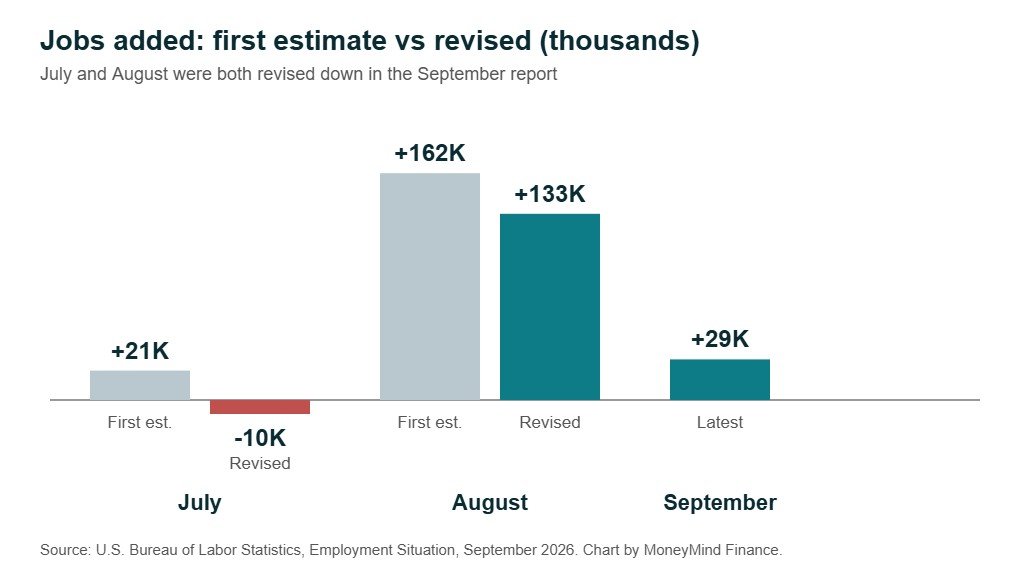
On Friday, the Bureau of Labor Statistics reported that employments increased by just 29,000 jobs in September, and the unemployment rate rose to 4.2%. Payrolls simply means the number of jobs added across the economy in a month.
The revisions hurt too. July was cut from +21,000 to a loss of 10,000 jobs, and August was trimmed from +162,000 to +133,000. Wage growth cooled as well, with average hourly pay up 0.1% for the month and 3.0% over 12 months.
Why would a hiring slowdown matter to rate hikes? The Fed raises rates to cool an economy that is running hot. Weak hiring suggests the economy may already be cooling, which gives officials less reason to push rates higher. According to Benzinga, via Yahoo Finance, the chance of an October hike dropped to 22% on Friday from 64% a week earlier. Those odds come from futures traders, so treat them as a mood reading, not a promise.
Stocks liked the news. The S&P 500 closed Friday at 7,722.72, up 0.73%, and the Nasdaq rose 1.19%.
Three Phrases to Listen For in the Minutes
You do not need to read every line. Scan the coverage for these three ideas:
- "Some participants" or "many participants": Fed minutes use these words to show how widely a view is shared. "Many" is a bigger group than "some."
- "Additional firming": This is Fed language for more rate hikes. If it appears often, the hawks (officials who favour higher rates) are still in charge.
- "Data dependent": This means the Fed will decide meeting by meeting. Expect it to come up, because the jobs data arrived after the September meeting.
One catch: the minutes describe a meeting held before the weak jobs report. They are a look backward, so a hawkish tone may already be out of date.
The Counter-Argument (And Why It's Serious)
The case against reading too much into one weak report is strong. Monthly jobs numbers get revised, and the two prior months were just cut. A single soft month could be noise, and the Fed has said inflation remains too high. Our earlier look at the PCE inflation report showed core inflation still above the Fed's 2% target.
That is a fair warning. The measured rebuttal is that the Fed does not need one report to change course, but two of the last three months were soft, which starts to look like a trend rather than a blip. If inflation data soften too, the case for another hike gets thinner. If it doesn't, the Fed can still hike even with slower hiring. Neither side has won yet.
Read: how rate hike odds climbed above 60% in early September, which shows how quickly this mood can swing.
Also on the Calendar This Week
Earnings are light. According to Kiplinger's earnings calendar, PepsiCo reports Thursday, Oct 8, and Delta Air Lines reports Friday, Oct 9. Delta is a handy read on travel demand, and PepsiCo shows how everyday shoppers are coping with prices. The Fed's next rate decision comes Oct 27 to 28.
The One Number to Watch
22%. That is the market's reported chance of an October hike, down from 64% a week earlier. If the minutes sound more hawkish than that number implies, expect it to jump back up. If they sound cautious, the number may keep sliding.
FAQ
What time are the Fed minutes released?
The Fed releases minutes on a set schedule, three weeks after each meeting. The September minutes are due Wednesday, Oct 7. Check the Fed's website for the exact release time.
Do the minutes change interest rates?
No. Rates only change at Fed meetings. The minutes simply reveal how officials were thinking, which can move markets.
Why did weak jobs lower the odds of a rate hike?
The Fed hikes rates to slow an overheated economy. Slower hiring points to a cooler economy, so traders see less need for more hikes.
What is a hawk at the Fed?
A hawk is an official who favours higher rates to fight inflation. The opposite is a dove, who favours lower rates to support growth and jobs.
Disclaimer: Content on this site is for informational and educational purposes only and does not constitute financial, investment, or trading advice. I am not a licensed financial advisor. Always conduct your own research and consult a licensed professional before making investment decisions.