An HSA for beginners guide might seam unnecessary at first, until you see the new figures: the IRS has raised the 2027 contribution limit to $4,500 for self-only health coverage and $9,000 for family coverage, both increases from 2026. If you have never opened an HSA, or you have one through work that mostly sits untouched through your job, This change is a good reason to learn how the account works before open enrollment this fall.
A Health Savings Account, or HSA, is a savings account you can open only if you are enrolled in a High Deductible Health Plan (HDHP): a health insurance plan that costs less each month but requires you to pay more out of pocket before coverage kicks in. Money you put into an HSA can be spent, tax free, on qualified medical costs like doctor visits, prescriptions and dental care.
What Makes an HSA Different From Every Other Account You Own
Most savings accounts give you one tax break. An HSA is unusual because it can actually give you three, which is why financial writers often call it a "triple tax advantage." Contributions reduce your taxable income the year you make them. The balance grows without being taxed while it sits in the account. And withdrawals are tax free too, as long as you spend them on qualified medical expenses.
Unlike a Flexible Spending Account (FSA), which usually resets to zero at the end of the year under a rule often called "use it or lose it," an HSA balance is yours to keep. It rolls over every year with no expiration, and the account stays with you if you change jobs or health plans, because you, not your employer, own it. NerdWallet's breakdown of employer HSA and FSA plans covers this ownership difference in more detail, and it is the most important reason financial planners treat an HSA as a long term account rather than a spending account.
The HSA for Beginners Cheat Sheet: What Changed for 2027
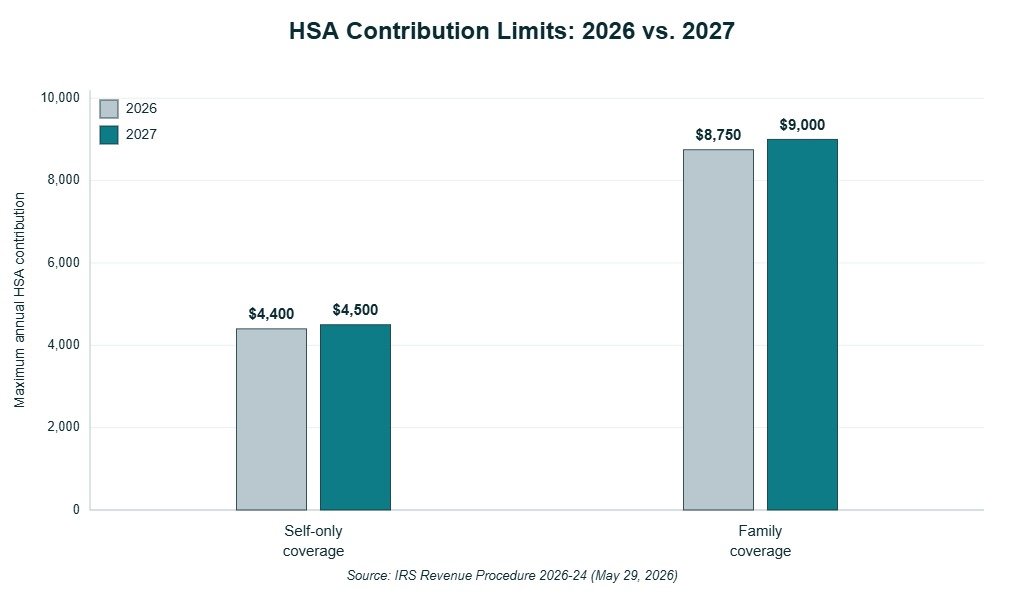
The IRS published the new figures in Revenue Procedure 2026-24 on May 29, 2026. Here is what changes for calendar year 2027:
- Self-only coverage: contribution limit rises to $4,500, up $100 from $4,400 in 2026.
- Family coverage: contribution limit rises to $9,000, up $250 from $8,750 in 2026.
- Catch-up contribution for people 55 and older: stays at $1,000, unchanged, and it does not adjust for inflation the way the base limit does.
- To qualify, your HDHP's minimum deductible must be at least $1,750 for self-only coverage or $3,500 for family coverage, and your plan's maximum out-of-pocket cost cannot exceed $8,700 (self-only) or $17,400 (family), according to HealthCare.gov's explanation of HDHP-eligible plans.
These limits apply to combined contributions from you and your employer, so if your company adds money to your HSA, that amount counts toward your annual cap.
HSA vs. FSA: Why the Difference Actually Matters
It helps to see the two side by side, since employers often present both during open enrollment.
An FSA does not require a High Deductible Health Plan, but the money is usually "use it or lose it": whatever you have not spent by the end of the plan year, or a short grace period if your employer offers one, disappears. An HSA works the opposite way. There is no deadline, so a $500 balance today can still be there when you retire.
An FSA also belongs to your employer's plan. If you leave your job, the unspent balance generally stays behind. An HSA is titled in your own name at a bank or investment provider you choose, so it travels with you through job changes, career breaks and retirement.
The tradeoff is the higher deductible that comes with an HDHP. For some households, especially those who rarely need care beyond routine checkups, that tradeoff pays for itself through the tax savings alone.
Who Should Actually Open One Before Open Enrollment
An HSA tends to make the most sense for people who are relatively healthy, have some savings cushion, and could comfortably cover a higher deductible if a bill arrived. It is a weaker fit for someone likely to hit that deductible every year without the cash flow to get there.
Many HSA providers also let you invest the balance once it passes a minimum threshold, similar to a 401(k) or IRA, which is why some people treat their HSA as a second retirement account earmarked for future medical bills. After age 65, you can withdraw HSA money for any reason without the usual penalty, though non medical withdrawals are then taxed as regular income, the same as a traditional IRA.
The Counter-Argument (And Why It's Serious)
The strongest case against an HSA is simple: not everyone can afford the higher deductible that comes with an HDHP. If a $1,750 deductible would force you to put a medical bill on a credit card, the tax savings on your HSA contribution do not make up for the cash flow strain of an unexpected diagnosis or accident. Lower deductible plans exist for a reason, and for some households, particularly those managing an ongoing condition with predictable annual costs, a traditional plan with a lower deductible and steadier copays is the safer, cheaper choice overall.
The reasonable middle ground is to run the numbers for your own situation before switching plans. Add up what you paid in premiums and deductible costs under your current plan last year, compare it to what an HDHP plus HSA would have cost, and only switch if the math and your emergency savings both support it.
The One Number to Watch
The number worth watching is not the $4,500 contribution limit itself. It is your plan's maximum out-of-pocket cost: $8,700 for self-only coverage or $17,400 for family coverage in 2027. That is the true worst case your HSA balance needs to be able to cover in a bad year, and it is usually far higher than what people expect when they first see a lower monthly premium advertised. Before open enrollment, check whether your HSA balance, plus what you could reasonably save between now and January, gets you close to that number.
Read: if tax-advantaged accounts are new to you, our Roth IRA Basics: A Beginner's Guide for 2026 covers the retirement account most people set up first.
Read: pair any HSA contribution increase with a full plan for your paycheck using our 50/30/20 Budget: A Simple Guide for Beginners.
Frequently Asked Questions
Do I lose my HSA money if I do not use it this year?
No. Unlike an FSA, an HSA has no "use it or lose it" rule. Your full balance carries over every year with no expiration date.
What happens to my HSA if I switch jobs?
It stays yours. An HSA is owned by you personally, not your employer, so you keep the account, the balance and any investments inside it when you leave.
Can I use HSA money for anything after I turn 65?
Yes, but with a catch. After 65 you can withdraw for non medical expenses without the usual 20 percent penalty, though that withdrawal is then taxed as regular income, similar to a traditional IRA.
Is an HSA better than an FSA?
It actually depends on your health plan. An HSA requires a High Deductible Health Plan and gives more flexibility and portability. An FSA does not require an HDHP but usually expires unspent funds every year. Most people are only eligible for one or the other at the same time, not both.
Disclaimer: Content on this site is for informational and educational purposes only and does not constitute financial, investment, or trading advice. I am not a licensed financial advisor. Always conduct your own research and consult a licensed professional before making investment decisions.