
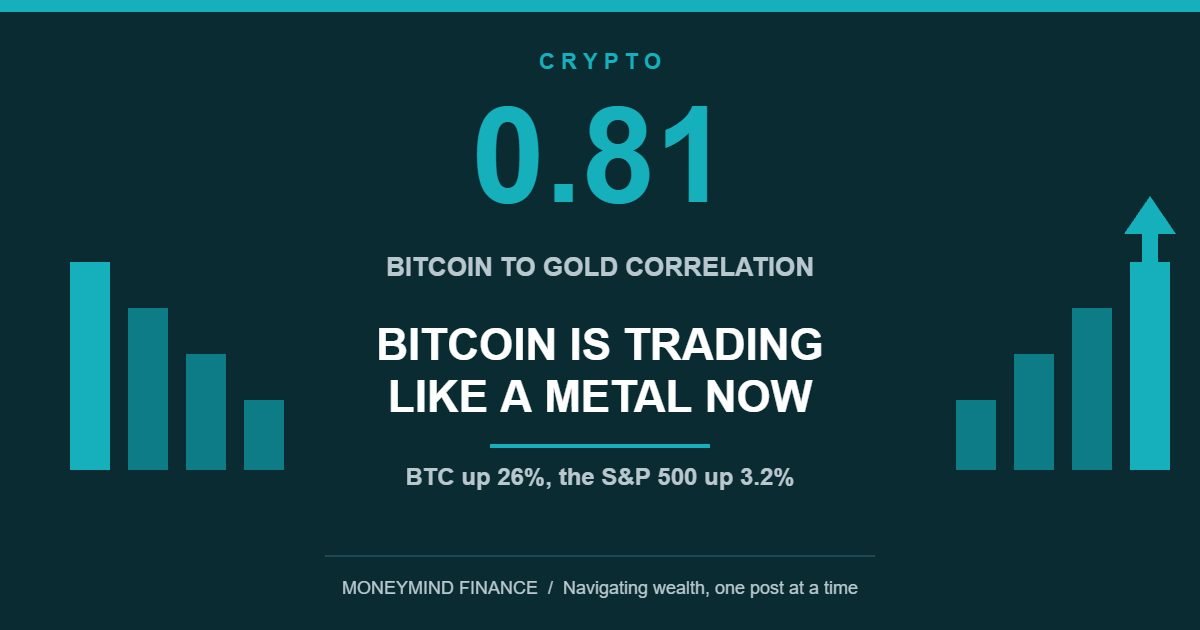
The bitcoin gold correlation hit +0.81 over the 30 days ending August 28 2026, that one figure tells the story of the past month better than any price headline. Bitcoin and gold rarely get discussed in the same discussion, have spent August moving almost as a pair. Meanwhile the stock market, which bitcoin was expected to track, has been left behind.
Here's what the number means, what drove the move, and why it may not be wise to read too much into it.
What the Bitcoin Gold Correlation Actually Measures
Correlation measures how closely two assets move together. It ranges from +1, to -1, with +1 meaning they move in perfect lockstep. A reading of 0 means knowing what one did tells you nothing about the other. A 30-day correlation only looks at the last 30 days of daily moves, so it is a snapshot rather than a permanent trait.
So a bitcoin gold correlation of +0.81 is high. On most days last month, when gold rose, bitcoin rose too, usually by more. According to CoinDesk's reading of TradingView data on 28 August, bitcoin's link to the US Dollar Index sat at -0.86 over the same window, and its relationship with the Nasdaq, historically the index it tracked most closely, has weakened.
Put plainly: the market has been trading bitcoin less like a tech stock and more like a hard asset.
Why Bitcoin and Gold Moved Together in August
The trigger was the bond market, not anything that happened inside crypto.
The 30-year Treasury yield is the interest rate the US government pays to borrow for 30 years. It matters to everyone because it sets the tone for mortgage rates, corporate borrowing and how investors value long-term assets. Through August it hovered at its highest level since 2007, a problem for both the government's interest bill and stock valuations.
On 19 August, Treasury Secretary Scott Bessent said the government would at least double its buybacks of longer-dated Treasury notes, lifting each operation from $2 billion to at least $4 billion, running from 9 September to 4 November. A buyback is simply the Treasury purchasing back bonds it previously issued. Buying pushes bond prices up, and bond prices moving up means yields move down.
Markets read that as an official effort to hold long-term borrowing costs down, then made a leap: if $4 billion is not enough, the Federal Reserve might have to step in and buy bonds itself, printing money to do it. That idea has a name, yield curve control, and it historically makes people want to own assets that cannot be printed.
Gold and bitcoin both qualify. Both rallied. Bitcoin went from roughly $64,000 to roughly $80,000 inside a week, as CoinDesk reported ahead of the Jackson Hole symposium. That is the whole mechanism. Bond worry, then hard asset rally, then a correlation reading of +0.81.
Read: Jackson Hole Preview: 3 Fed Votes Say Hike, Not Cut
How Bitcoin's 26% Month Compares With Stocks
The gap between the hard assets and the stock market in August was not subtle.
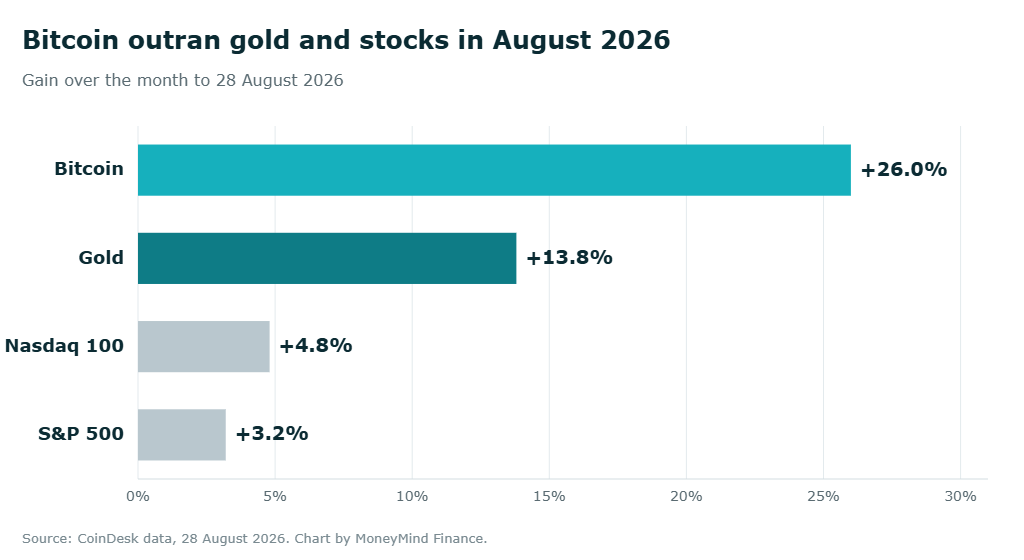
Bitcoin gained about 26% across the month. Gold added 13.8%. The Nasdaq 100 managed 4.8% and the S&P 500 just 3.2%. Yahoo Finance's own tracking put bitcoin's one-month change at 26% as well, so the headline figure holds up across two independent sources.
Note that stocks were not weak in August. They sat near record highs. Bitcoin and gold simply ran harder, which is what makes the month unusual.
Context still matters. Over the year to 28 August 2026, bitcoin was down 27.8% and ether down 44.2%, according to Yahoo Finance data, and bitcoin's all-time high remains $126,198.07 from 6 October 2025. A very good month does not undo a very bad year.
The Counter-Argument (And Why It's Serious)
The bullish reading is that bitcoin has matured into digital gold, a store of value that protects you when governments overspend. There are three solid objections.
First, 30 days is a very short window. A one-month correlation can be produced by a single shared driver, here the bond buyback news, rather than any lasting relationship. Bitcoin has previously tracked the Nasdaq closely, and before that almost nothing. Correlations drift, and they reverse quickly.
Second, correlation cuts both ways. If bitcoin moves with gold, it falls with gold too. That is not a hedge, it is a second position in the same trade. Anyone holding both and feeling diversified in August was, on these numbers, holding one bet twice.
Third, the thesis got tested almost immediately and did not pass cleanly. Federal Reserve Chair Kevin Warsh delivered his first Jackson Hole keynote on 28 August. He came out hawkish, saying in his prepared remarks published by the Federal Reserve that "the responsibility for 65 months of sustained, elevated inflation sits squarely with the central bank" and that on inflation "we have work to do." That is close to the opposite of a Fed signalling willingness to print money to cap yields. Bitcoin dipped to about $78,700 on the remarks, and odds of a September rate hike rose to 42% from 35% the day before, according to CME FedWatch data cited by CoinDesk.
The scenario that built the rally, a Fed willing to accommodate the Treasury, is the one the Fed Chair declined to endorse. The rally has held so far, but the reason for it looks less secure than it did a week earlier.
Read: Crypto Bear Market: What Beginners Should Know
The One Number to Watch
Watch the 30-day bitcoin gold correlation itself, and specifically whether it holds above +0.50 into October.
That number tells you whether the "digital gold" behaviour is a genuine change or just a by-product of one busy month of bond news. If it stays high through the Fed's 16 September meeting and the buyback window that runs to 4 November, the argument gets considerably stronger. If it drifts back toward zero once the buyback story goes quiet, August was a coincidence with good timing.
Read: CLARITY Act Vote: 60 Needed, Republicans Hold 53, the other September date that could move crypto.
You can check it free on TradingView: add a correlation coefficient indicator to a bitcoin chart and set the comparison symbol to gold. It takes a minute, and it is a more useful habit than refreshing the price.
Frequently Asked Questions
Does a high correlation mean bitcoin is now as safe as gold?
No. Correlation describes direction, not size. Bitcoin rose roughly twice as much as gold in August, and it can fall roughly twice as hard. Two assets can move together while one is far more volatile.
What does a negative correlation with the dollar mean?
The US Dollar Index measures the dollar against a basket of major currencies. A reading of -0.86 means bitcoin generally rose on days the dollar fell, and fell on days it rose. That is a sign traders have been treating bitcoin as an alternative to holding dollars.
Is yield curve control actually happening?
Not at present. What exists is a Treasury buyback of at least $4 billion per operation, small next to roughly $40 trillion of federal debt, and buybacks do not create new money. Yield curve control would need the Fed to participate, and Warsh gave no indication at Jackson Hole that it intends to.
Should a beginner buy bitcoin because it is acting like gold?
A one-month correlation reading is not a reason to buy anything. Bitcoin is still down 27.8% over the past year and well below its October 2025 high. Anyone considering crypto should be comfortable with losing a large share of the money involved, and should speak to a licensed professional about their own circumstances.
Disclaimer: Content on this site is for informational and educational purposes only and does not constitute financial, investment, or trading advice. I am not a licensed financial advisor. Always conduct your own research and consult a licensed professional before making investment decisions.