If you follow the stock market even casually, you have probably heard Tesla mentioned this month. On July 2, 2026, the company reported that it delivered a record 480,126 vehicles in the three months from April to June, up about 25% from the same period a year earlier, according to Tesla’s own delivery report. That is the strongest second quarter in the company’s history, and it snapped two years of falling numbers. Yet the stock’s reaction was oddly mixed, and the real drama is still ahead. This is why Tesla is a fascinating stock to watch right now, not a stock to rush into, but one worth understanding as a case study in how markets weigh the present against the future.
What Actually Happened in Tesla’s Q2
Let’s start with a quick definition. When a car company reports “deliveries,” it means the number of vehicles actually handed over to customers in a period not just built, but sold and driven off the lot. For a company like Tesla, deliveries are the closest thing to a real-time sales scoreboard, which is why investors watch them so closely.
The 480,126 figure beat what most Wall Street analysts had expected (many forecasts sat closer to 406,000, per Electrek). A “beat” simply means the real number came in better than the average guess. The chart below shows how Tesla’s quarterly deliveries have moved over the past year and a half so you can see the recovery in context.
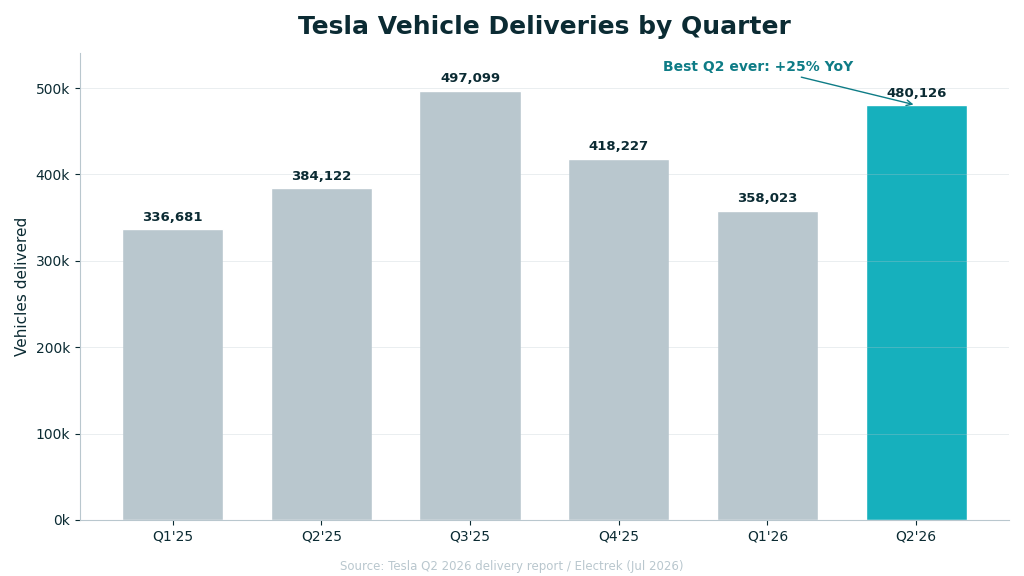
Notice that Q2 2026 is the tallest of the recent second quarters, but not the single biggest quarter ever (Q3 2025 was slightly higher). That nuance matters: the story here is a rebound, not a brand-new all-time peak. Strong deliveries helped push Tesla’s stock up roughly 6% right after the report, a reminder that markets reward good news relative to expectations.
Why Tesla Is Really an “AI and Robotaxi” Story Now
Here is the twist that makes Tesla so interesting to watch. Even with record deliveries, a chunk of investors seem more focused on something that barely shows up in today’s sales numbers: robotaxis. A robotaxi is a self-driving car that picks up paying passengers with no human driver think of it as an Uber where the software is the driver. Tesla has launched an early robotaxi service in Miami and is expanding testing in Austin, Texas.
This connects to a term you’ll hear a lot: FSD, or “Full Self-Driving,” Tesla’s driver-assistance software. The bet from bulls (investors who are optimistic) is that if Tesla perfects this technology, it could earn money from software and rides, not just from selling cars once. That is a very different, potentially higher-margin business. The catch, in CEO Elon Musk’s own words, is that meaningful robotaxi revenue is unlikely before 2027. So investors are being asked to look past today and imagine tomorrow, which is exactly where risk lives. If you are new to this idea of paying today for future growth, our guide to AI and tech stocks for beginners is a helpful primer.
The Catalysts and Risks to Keep an Eye On
A catalyst is simply an upcoming event that could move a stock meaningfully. For Tesla, the big one is its Q2 earnings report on July 22, 2026. Deliveries tell you how many cars were sold; the earnings report tells you how profitable those sales were. Two terms worth knowing here: gross margin is the slice of each sale left over after the direct cost of making the product a higher margin means Tesla keeps more from every car. EPS (earnings per share) is the company’s profit divided by its number of shares, a common way to size up profitability per unit of ownership.
The signposts a beginner can watch: Did Tesla have to cut prices or offer incentives to hit those record deliveries, and did that squeeze margins? What did management say about the robotaxi rollout timeline and the coming lower-cost “Cybercab” vehicle? And how is demand holding up in a competitive market where rivals keep launching new electric vehicles (EVs)? None of these are reasons to buy or sell, they are simply the dials that tell you whether the story is strengthening or weakening. If you want to see how a single earnings report can hide a more complicated picture, our breakdown of Nike’s recent earnings is a good example.
The Counter-Argument (And Why It’s Serious)
It would be easy to get swept up in the record-delivery headline, so it’s worth taking the strongest opposing case seriously. The bearish (pessimistic) argument goes like this: Tesla’s stock price already assumes the robotaxi dream comes true. By many measures, Tesla trades at a very high valuation compared with traditional carmakers, meaning investors are paying a premium today for profits that may not arrive for years, if ever. Self-driving technology is genuinely hard, tightly regulated, and Tesla’s Austin fleet is reportedly still small, with some early riders reporting long waits and software glitches. If robotaxis take longer than hoped, or a rival wins the race, a lot of that optimism could unwind quickly.
That is a real risk, and dismissing it would be a mistake. The measured rebuttal is not that the bears are wrong, but that Tesla has repeatedly shown it can scale manufacturing and surprise skeptics, the Q2 rebound is a fresh example. The honest takeaway for a beginner is that Tesla is a stock where the range of possible outcomes is unusually wide. That is precisely why it belongs on a watchlist you follow closely rather than a “set it and forget it” position.
There is a quieter side to the electric vehicle story. An electric car uses far more copper than a petrol one, in the motor and the wiring, so EV demand lands on the metals market long before it lands on a showroom floor. Read: Copper Stocks: Freeport Up 65% as Grasberg Doubles Output
The One Number to Watch
If you only track one thing on July 22, make it Tesla’s automotive gross margin excluding regulatory credits. In plain English: how much profit Tesla squeezes out of the cars themselves, stripping out the money it earns selling environmental credits to other automakers. Why this number? Because it tells you whether those record deliveries came from healthy demand or from heavy discounting. A stable or rising margin suggests the core car business is strong enough to fund the expensive robotaxi ambitions. A sliding margin would be a warning that the growth is being “bought” with price cuts. One clean number, and it cuts right to the heart of the debate.
Frequently Asked Questions
What does “deliveries” mean for a car company?
It’s the number of vehicles actually handed over to customers in a period. It works like a sales scoreboard, so investors use it as an early read on demand before the full financial results come out.
Why did Tesla stock have a mixed reaction to record deliveries?
Because markets look forward, not just backward. Strong deliveries were good news, but many investors are focused on the uncertain robotaxi timeline and on profit margins, which the delivery number alone doesn’t reveal.
What is a robotaxi, in simple terms?
A self-driving car that carries paying passengers with no human behind the wheel. Tesla hopes this could one day become a large, software-driven business, though management says meaningful revenue is unlikely before 2027.
Should a beginner buy Tesla stock?
This article isn’t a recommendation to buy or sell. Tesla is presented as a stock to watch because it clearly illustrates how markets weigh today’s results against tomorrow’s promises. Always do your own research and consider speaking with a licensed professional.
Disclaimer: Content on this site is for informational and educational purposes only and does not constitute financial, investment, or trading advice. I am not a licensed financial advisor. Always conduct your own research and consult a licensed professional before making investment decisions.