
A little-known Chinese company is about to raise $4.3 billion by selling shares to the public, and it could reshape one of the most important corners of the technology world: the chips that give your phone, laptop, and every AI data center their memory. On July 9, 2026, ChangXin Memory Technologies, better known as CXMT, cleared the way for what is set to be the largest stock-market debut of the year in mainland China. You cannot easily buy this stock as a beginner in the U.S., so why should you care? Because this single event is a window into the memory-chip boom and it changes the story for companies you can watch, like Micron.
What Is CXMT, and Why Is This IPO a Big Deal?
Let's unpack the jargon first. An IPO (initial public offering) is the moment a private company sells shares to the public for the first time, raising cash to grow. CXMT is doing its IPO on the STAR Market, think of it as China's answer to the tech-heavy Nasdaq, created in 2019 to fund strategic industries. Because it lists in China, its shares are A-shares (stocks of mainland Chinese companies, mostly traded by domestic investors), which is a big reason they are hard for everyday foreign investors to access.
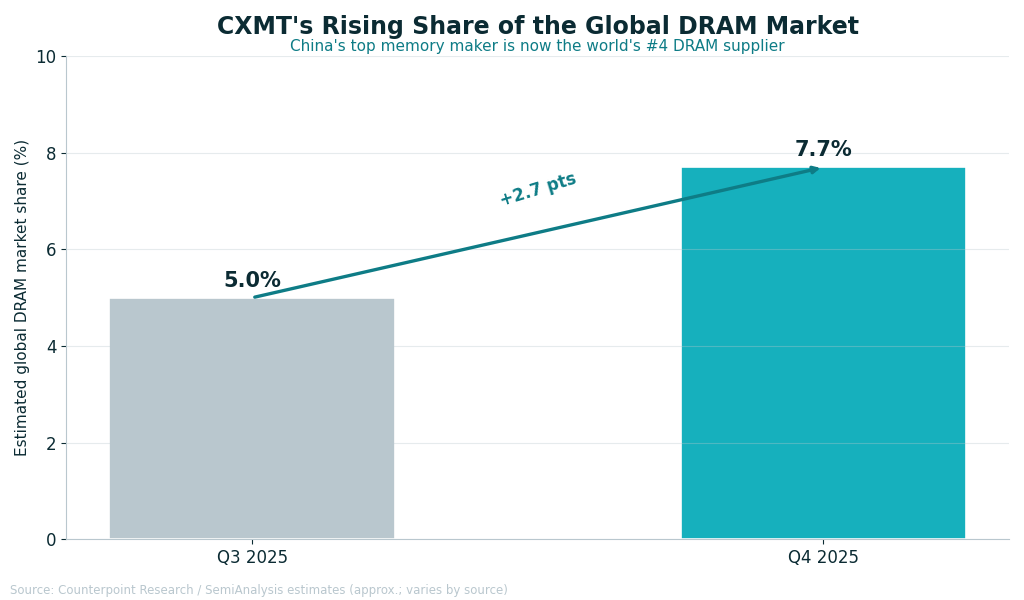
CXMT makes DRAM short for dynamic random-access memory. This is the fast, temporary memory a computer uses to juggle whatever it is working on right now (very different from the storage that keeps your files when the power is off). Every server training an AI model needs enormous amounts of it. Founded in 2016 with Chinese government backing, CXMT has grown into the world's fourth-largest DRAM maker and China's main challenger to the three giants that dominate the field: Samsung, SK Hynix, and Micron. The IPO aims to raise about 29.5 billion yuan (roughly $4.3 billion) to expand production and develop HBM (high-bandwidth memory), the premium, stacked memory that sits right next to AI chips and commands the highest prices.
Why the Timing Could Not Be Better
CXMT is going public in the middle of a memory shortage. The AI boom has data centers scrambling for chips, and when demand outruns supply, prices climb, exactly what has been happening to memory. That upcycle turned CXMT's finances around fast: the South China Morning Post reports its revenue jumped about 719% year over year in the first quarter, flipping the company from a loss to a profit. Its selling prices are now estimated to be within 5–10% of the global leaders, according to research firm SemiAnalysis, a striking catch-up for a company barely a decade old.
There are real customers behind the hype, too. In late June 2026, CXMT signed a server-memory supply deal with Tencent reportedly worth more than 20 billion yuan (around $3 billion), and its chips are used by ByteDance, Alibaba Cloud, Lenovo, Xiaomi, and others. Even Apple has reportedly begun evaluating CXMT memory for devices sold in China. When a company's product is being designed into the supply chains of the biggest names in tech, that is a signal worth noting, whether or not you can own the shares.
What It Means for the Stocks You Can Actually Watch
Here is the practical takeaway for a beginner. Since CXMT's A-shares are hard to buy from outside China, the smarter move is to treat this news as a read on the industry and watch the memory-chip stocks that trade on U.S. exchanges above all Micron Technology (MU), the only major American DRAM and HBM maker. The same shortage lifting CXMT's numbers is lifting Micron's, and CXMT's aggressive expansion tells you how the competitive landscape may shift over the next few years. To be clear, this is about monitoring, not a suggestion to buy: the goal is to understand the catalysts and risks so you can follow the story with open eyes. For the background on why memory became the hottest part of the AI trade, Read: Micron's HBM Supercycle Could Redefine AI Growth.
The signposts to keep an eye on are straightforward: memory prices (are they still rising?), HBM progress (can CXMT crack the premium tier the leaders dominate?), and how much new supply China adds. More supply down the road could eventually cool prices, good for buyers of memory, tougher for the sellers whose profits depend on those prices staying high.
The Counter-Argument (And Why It's Serious)
The bullish story has a serious rebuttal. First, memory is one of the most cyclical industries on earth, meaning it swings between boom and bust as prices soar, everyone builds more factories, supply floods in, and prices crash. CXMT is IPO-ing at the top of a very good cycle, and today's windfall profits are exactly the kind that can evaporate when the cycle turns. Second, there is a political overhang: the U.S. has restricted the export of advanced chipmaking tools to China, and tighter controls could hamper CXMT's ability to reach the cutting edge or sell abroad. Third, a state-backed national champion may be built partly for strategic reasons rather than pure profit, which is not the same thing as a stock built to reward outside shareholders.
So how should a beginner weigh that? Fairly, and on both sides. The cyclical risk is real, but the AI-driven demand for memory looks structural rather than a one-off fad, which could make this upcycle longer than past ones. Export controls are a genuine threat, yet they have also pushed China to pour money into exactly the kind of self-reliance CXMT represents, which is part of why the IPO is so large. The honest conclusion is that CXMT is a powerful signal of where the industry is heading, not a guaranteed winner. For a recent reminder of how quickly chip enthusiasm can wobble, Read: Chip Stock Selloff: Why Micron, AMD and Intel Slid.
The One Number to Watch
If you track just one thing from this story, make it DRAM contract prices, the prices big buyers pay for memory in bulk, reported monthly by research firms and widely quoted in chip coverage. Memory is a commodity, so its price is the single clearest gauge of the whole cycle: rising prices mean the boom is intact and companies like Micron and CXMT are minting money; falling prices are the early warning that the cycle is rolling over. You do not need to own a single chip stock to follow that number, and once you understand it, a lot of confusing memory headlines suddenly make sense.
Frequently Asked Questions
Can I buy CXMT stock as a U.S. investor?
Generally no, not easily. CXMT is listing as A-shares on Shanghai's STAR Market, which is primarily open to domestic Chinese investors and select qualified institutions. Most retail investors abroad cannot buy it directly, which is why watching U.S.-listed peers like Micron is the more practical way to follow the theme.
What is DRAM?
DRAM is a computer's short-term working memory, the space it uses to hold whatever it is actively doing. It is not where your files are permanently stored; it is the fast scratchpad that lets a device (or an AI server) juggle many tasks at once. AI has made it far more valuable.
Why does a Chinese IPO matter for American chip stocks?
Because memory is a global, interconnected market. CXMT's growth signals both strong demand today and more competition tomorrow. Rising demand supports prices now (good for all memory makers), while China's expanding supply could pressure prices later, so the news cuts both ways for companies like Micron.
Is now a risky time to be interested in memory stocks?
Memory is famously cyclical, and prices are currently high, so the sector carries real boom-and-bust risk. That is a reason to watch and learn rather than chase headlines. Focus on understanding the cycle, especially contract prices before making any decisions.
Disclaimer: Content on this site is for informational and educational purposes only and does not constitute financial, investment, or trading advice. I am not a licensed financial advisor. Always conduct your own research and consult a licensed professional before making investment decisions.