U.S Defense stocks are entering a period defined by unusually large order backlogs. Four major American defense contractors reported a combined $761 billion in contracted work at the end of June 2026 quarter. That figure highlights the huge demand for military equipment, including missiles, aircraft, ships and other defense systems. But then, there's another part of the story which investors need to understand: government funding. Much of the U.S. defense industry actually relies on federal spending to sustain these programs. The current temporary funding measure is set to expire on December 11, 2026, making the date an important one for investors who are monitoring defense stocks and federal spending.
What Defense Stocks Actually Sell
These four are prime contractors. A prime is the main builder on a military program, just the way a general contractor is the main builder on a house: the government signs with the prime, which then hires hundreds of smaller suppliers underneath it. That matters, because a prime books the whole value of a program even though a huge part of the cash flows straight out to subcontractors.
- RTX is the odd one out: roughly half its business is civil aviation, through Pratt and Whitney engines and Collins Aerospace cabin systems. Its defense arm, Raytheon, builds Patriot, Standard Missile and AMRAAM.
- Lockheed Martin builds the F-35 fighter, the PAC-3 and THAAD interceptors and Sikorsky helicopters.
- Northrop Grumman builds the B-21 bomber, the Sentinel missile replacement and a large national security space business.
- General Dynamics builds nuclear submarines and combat vehicles, and owns Gulfstream, the business jet maker.
Two terms recur. Backlog is the value of signed contracts not yet delivered: future work, not money in the bank. Book to bill is new orders divided by sales, so above 1.0 the order book grew and below 1.0 the company delivered more than it sold.
Why Defense Stocks Are Getting Attention Now
Three dated events stacked up. Between July 21 and July 29 all four primes reported June quarter results, and every one announced a record backlog and raised full year guidance. In April the White House asked Congress for $1.5 trillion in total defense budgetary resources for fiscal 2027, which the fact sheet describes as a $445 billion or 42 percent increase on the 2026 level. And on September 2 the President signed a stopgap funding bill that keeps the government open only until December 11.
That last item is the one most coverage skips. A stopgap, formally a continuing resolution, freezes spending at last year's levels. The U.S. Government Accountability Office has documented what that does to defense programs: continuing resolutions bar new program starts and block production rate increases, and new multi year contracts cannot be signed while one is in force. So the primes have booked the largest order book in their history, and the mechanism that pays to accelerate it is switched off until at least December 11.
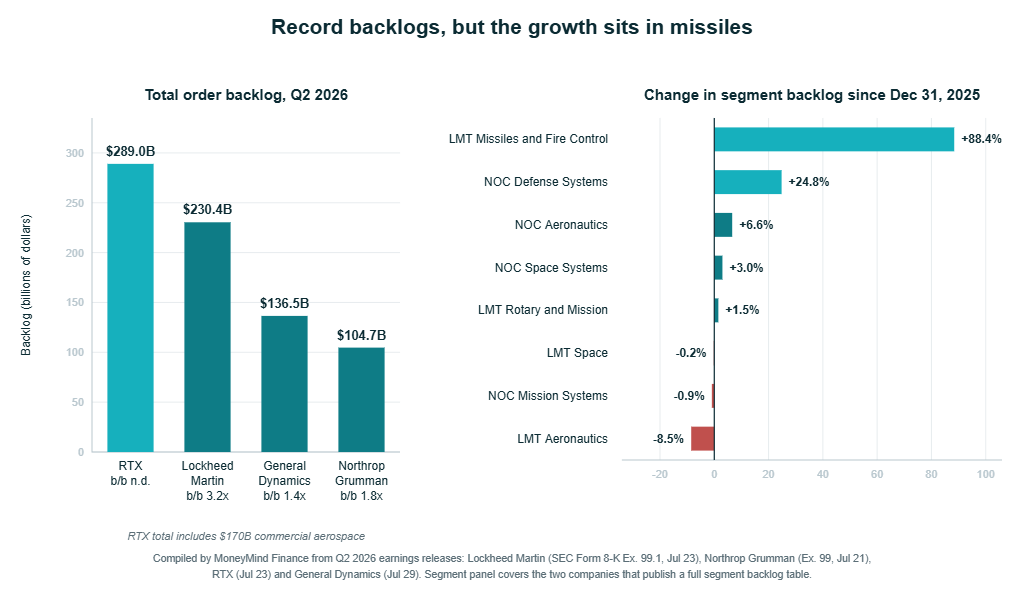
The right hand panel is the part worth staring at, because backlog did not grow consistently. Lockheed's Missiles and Fire Control segment nearly doubled its order book in six months, from $46.7 billion to $87.9 billion, largely on the $35 billion multi year THAAD contract. Over the same period Lockheed's Aeronautics segment, home of the F-35, saw backlog fall 8.5 percent. Both sit in the backlog table near the end of Lockheed Martin's second quarter earnings release. Northrop shows the same tilt: Defense Systems grew 25 percent while Mission Systems slipped 1 percent.
The money is moving out of airframes and into things that get fired. That is a different story from the one most defense coverage tells, and it is visible only in the segment tables.
Revenue and Earnings, Explained Simply
Definitions first. Operating margin is operating profit divided by revenue: how many cents of each sales dollar survive the cost of the work. EPS is profit divided by share count. Free cash flow is the cash left after paying for equipment and buildings, usually the honest number. Guidance is the company's own forecast for the year.
- RTX: sales of $24.7 billion, up 14 percent, adjusted EPS up 21 percent, free cash flow of $2.9 billion. Full year sales guidance raised to $95.0 billion to $96.0 billion.
- Lockheed Martin: sales of $20.1 billion, up 11 percent, EPS of $7.94, free cash flow of $2.9 billion, and $65 billion of new orders in a single quarter, a book to bill near 3.2.
- Northrop Grumman: sales of $10.9 billion, up 5 percent, but EPS of $7.68 was down 6 percent. Net awards of $20.0 billion gave a book to bill near 1.8.
- General Dynamics: revenue of $14.1 billion, up 8.1 percent, EPS of $4.24, up 13.4 percent, operating margin up 40 basis points to 10.4 percent, book to bill of 1.4.
The growth rates and the order rates do not line up. Lockheed grew sales 11 percent but booked orders worth more than three times its sales; Northrop grew 5 percent and its earnings per share went backwards. Backlog is a promise about the future, the income statement a report on the present, and the two are telling different stories.
The MoneyMind Stock Watch Score
We score every company we cover on the same six criteria, 1 to 5, for a total out of 30, so a defense prime can be compared against a miner we covered months ago. These scores are MoneyMind Finance's own judgement, not fact, and reasonable people will disagree with several.
| Criterion | RTX | Lockheed | Northrop | General Dynamics |
|---|---|---|---|---|
| Revenue momentum | 5 | 4 | 3 | 4 |
| Profit quality | 4 | 3 | 2 | 5 |
| Balance sheet | 4 | 2 | 3 | 5 |
| Customer concentration | 5 | 2 | 2 | 4 |
| Valuation vs growth | 2 | 4 | 3 | 3 |
| Catalyst clarity | 5 | 5 | 4 | 4 |
| Total out of 30 | 25 | 20 | 17 | 25 |
- RTX, 25. Fastest growth, least dependent on one customer, since $170 billion of its $289 billion backlog is commercial aerospace. Marked down purely on price.
- General Dynamics, 25. The quiet one: best margin trend, and $7.5 billion of total debt against $4.3 billion of cash and $26.8 billion of equity.
- Lockheed Martin, 20. Clearest catalyst and cheapest multiple, dragged down by a thin balance sheet and reliance on a single customer.
- Northrop Grumman, 17. Record backlog, but margins went the wrong way and EPS fell. The order book is strong; execution is the question.
Download the full spreadsheet: the MoneyMind Finance defense stocks watch sheet holds the scoring table with live SUM formulas, a forward price to earnings calculator whose inputs you can change, the segment backlog data behind the chart, and every figure in this article with its date and source. It opens in Excel, Numbers or Google Sheets.
Read: Uranium Stocks 2026: What the Big Four Actually Produce, the same scoring method applied to a very different industry.
What Could Drive Growth From Here
- Munitions multi year contracts. Lockheed's $35 billion THAAD award is the template: multi year deals let a contractor buy materials in bulk and hire ahead of demand, which is why they appear as step changes in backlog.
- Sentinel and the nuclear rebuild. Northrop booked $7.6 billion for Sentinel in one quarter. Replacing the land based leg of the nuclear deterrent runs for decades and is very hard to cancel once started.
- Allied demand and local build. RTX's Raytheon segment grew sales 18 percent on Patriot, Standard Missile and AMRAAM volume, much of it from allied governments. Lockheed has agreed to co-produce ATACMS in Europe with Rheinmetall, because European buyers increasingly insist weapons be built locally.
- Submarines and Gulfstream. General Dynamics lifted its Marine revenue outlook by almost $1.3 billion, and its Aerospace segment ran a book to bill of 1.5, a genuinely separate engine from the defense budget.
What Could Go Wrong
The bull case is easy to write, so here is the serious version of the other side.
- Backlog is not revenue, and conversion is slow. A submarine takes years. If orders arrive faster than delivery capacity, backlog grows while sales crawl, which is what Northrop's 5 percent growth against a 1.8 book to bill already shows.
- Funding can stall even when demand does not. Under the current stopgap, new starts and rate increases are blocked. If Congress extends rather than replaces it in December, some promised capacity expansion cannot be funded on schedule.
- Margins are already cracking in places. Northrop's segment operating margin fell 120 basis points to 10.6 percent, and Defense Systems dropped from 12.7 percent to 7.5 percent after a $68 million unfavourable adjustment on one missile program. Its Space segment took a $91 million hit on another. Both appear in Northrop Grumman's second quarter earnings release.
- Fixed price development contracts are where the money dies. In 2025 Lockheed booked $1.6 billion of losses across a classified program and two helicopter programs. On a fixed price contract the contractor eats any overrun.
- One customer, one set of politics. Lockheed and Northrop depend almost entirely on the US government, and Lockheed carries $20.5 billion of long term debt against just $8.8 billion of equity. It also delivered 19 F-35s in the June quarter against 50 a year earlier.
What the Valuations Actually Mean
The forward price to earnings ratio is the share price divided by the profit per share the company expects this year. A ratio of 20 means paying $20 for each $1 of expected annual profit. It gauges how much optimism is already in the price, not whether a business is good.
Using each company's own guidance and share prices on September 16, 2026, RTX trades near 27 times expected earnings, General Dynamics near 21, and Northrop and Lockheed both near 18. Prices move daily, so recalculate before relying on these. The downloadable sheet does the arithmetic.
The spread is informative. RTX is dearest partly because half of it is commercial aerospace, which investors have historically paid more for. Lockheed is cheapest despite the clearest catalyst, which tells you the market is worried: the F-35 delivery slump, the thin equity base, the memory of 2025's fixed price losses. A low multiple is rarely a bargain. It is usually a list of concerns expressed as a number.
A Realistic Five-Year Scenario
This projects the business, not the share price. Nobody can forecast a stock price five years out. Combined 2026 sales guidance for the four is about $276 billion; here is where combined sales could sit in 2031 under three labelled scenarios, with the assumptions stated.
- Slow lane, about $320 billion. Roughly 3 percent annual growth: repeated stopgaps, the fiscal 2027 request cut back substantially, rate increases slipping. Margins stay near today's 10 to 11 percent.
- Middle path, about $370 billion. Roughly 6 percent annual growth: a meaningful part of the fiscal 2027 increase enacted, munitions multi year contracts close to schedule, allied orders building. Margins drift toward 11 to 12 percent as volume covers fixed costs.
- Fast lane, about $425 billion. Roughly 9 percent annual growth: the topline increase largely enacted, industrial base expansion funded, European rearmament continuing. Margins exceed 12 percent.
That is arithmetic, not prediction. The gap between the slow and fast lanes is about $105 billion of annual revenue, and the variable deciding it is congressional appropriations rather than anything the companies control.
Who This May or May Not Suit
Speaking generally rather than about anyone's situation: this is a slow moving, politically driven industry. Contracts are long, the customer is a government, and catalysts arrive on a legislative calendar rather than a product cycle. A multi year horizon and a tolerance for budget news are close to prerequisites here.
It suits an impatient investor poorly: backlog converts over years, and a company can post record orders and a falling share price in the same quarter. Anyone uncomfortable with that dependency on one government customer, or with holding defense companies for ethical reasons, has a straightforward reason to pass.
Read: How to Research a Stock Before Buying: A Beginner's 7-Step Checklist, which covers the groundwork worth doing before any of this becomes actionable.
What to Watch Going Forward
- December 11. Whether Congress passes full year appropriations or extends the stopgap. An extension keeps new starts and rate increases frozen.
- Third quarter results in late October. Whether Northrop's margin pressure spreads, and whether Lockheed's F-35 deliveries recover.
- The fiscal 2027 topline as enacted. The $1.5 trillion request is an opening position. What Congress appropriates is what matters, and the shift from airframes to munitions will show up in the segment tables first.
The One Number to Watch
Book to bill. In the October results, check whether each company's orders still exceed its sales. Comfortably above 1.0 means the order book is still growing. A reading below 1.0, especially at two or more of the four, would be the first hard evidence that the ordering surge has peaked, and it would appear there long before it appeared in revenue.
Defense Stocks FAQ
Is a record backlog the same as guaranteed future revenue?
No. Backlog is signed work, far more solid than a forecast, but US government contracts can be reduced or terminated for convenience and schedules slip routinely. Treat it as a strong indicator of demand, not a promise of profit.
What happens to defense companies during a government shutdown?
A shutdown differs from a stopgap. Under the current stopgap the government is open and paying, but frozen at last year's levels. In a real shutdown, awards and payments can be delayed, hitting cash flow rather than backlog. Northrop states plainly that its guidance does not assume a prolonged shutdown.
Why did Northrop's earnings per share fall when its backlog hit a record?
They measure different things. Backlog records orders won, earnings record work delivered. Northrop took unfavourable cost adjustments on two programs, cutting current profit, while booking $20 billion of orders for future years.
Are defense stocks a safe place to hide when markets fall?
They are often described that way, and their revenue is genuinely less tied to consumer spending than most industries. But they are still equities, they still fall in broad selloffs, and a shift in budget priorities can reprice the whole group quickly.
Disclaimer: Content on this site is for informational and educational purposes only and does not constitute financial, investment, or trading advice. I am not a licensed financial advisor. Always conduct your own research and consult a licensed professional before making investment decisions.