It’s very easy to feel overwhelmed by daily stock market news as a newbie in the investment space. The complex charts showing price movements, debates and reviews from analysts, and the financial earning releases may likely not make sense at first
However, the learning curve progresses as you continually study and research about latest financial news. A good example is that of Bank of America, which recently reported stronger-than-expected earnings. In addition to this, other corporate organizations like Morgan Stanley, Robinhood, and Broadcom also made notable moves.
Instead of viewing these reports as just any other financial news, let’s analyze it in a way that actually helps you understand how to evaluate a stock, and whether companies like Bank of America hold any prospect for a beginner investor’s portfolio.
What Bank of America Actually Does
At its core, Bank of America is a massive financial institution that makes money in several ways
- Consumer banking: Checking accounts, credit cards, mortgages
- Business banking: Loans and services for companies
- Investment banking: Helping corporations raise money and manage deals
- Trading: Buying and selling stocks, bonds, and other assets
Think of it as a financial supermarket. Whether individuals or large corporations need money services, Bank of America is often involved, and it earns fees, interest, or trading profits from those activities.
You May Also Want to Read: 3 Top AI Semiconductor Stocks to Watch in 2026
This diversification is important. It means the bank isn’t relying on just one income stream, which can make it more stable over time.
Why This Recent News Matters

Bank of America reported:
- Earnings per share (EPS): $1.11 (vs. $1.01 expected)
- Revenue: $30.43 billion (vs. $29.93 billion expected)
At first glance, the difference between expected and actual earnings may look small, but in the stock market even slight “beats” matter because prices are built on expectations, not just raw performance. Analysts create forecasts based on economic data, past results, and industry trends, so when a company delivers better numbers than predicted, it signals that the business is performing more strongly than the market had priced in. This often leads to a modest boost in investor confidence, which is why the stock saw a small rise even after a relatively simple earnings beat.
What makes this more interesting is the source of the strength: Bank of America’s equity sales and trading division performed well, meaning the bank benefited from increased market activity where clients were actively buying and selling financial assets. This kind of revenue is not purely “steady banking income,” but instead depends on how active and volatile the markets are, which can create both opportunity during busy periods and weakness when trading slows down.
A Simple Financial Breakdown
Let’s unpack what these numbers mean in a beginner-friendly way.
You May Also Want to Read: Meta, Spotify & Citigroup: Top Stocks for Beginner Investors
Revenue
Revenue of $30.43 billion shows the scale of Bank of America’s operations. For comparison, that’s larger than the entire GDP of some small countries.
Even though the gap between expected and actual earnings looks small on the surface, it matters a lot in the stock market because share prices are largely driven by expectations rather than absolute results. Analysts build forecasts using economic trends, past performance, and industry data, so when a company slightly outperforms those estimates, it signals that the business is doing better than what the market had already priced in. That surprise factor is often enough to lift investor sentiment, even if only modestly, which helps explain why the stock moved higher despite a relatively small earnings beat.
Earnings per share (EPS) of $1.11 means:
After covering its costs, the company still produced strong profits, and it performed better than analysts had expected, which usually signals that management is running the business efficiently and making good operational decisions. For beginners, earnings per share (EPS) is a helpful way to understand profitability because it shows how much profit is effectively attributed to each individual share of the company. In this case, a major reason for the stronger results was the performance of its equity sales and trading business, where revenue increases when clients are actively buying and selling financial assets, allowing the bank to earn fees and spreads on those transactions. This part of banking is cyclical, meaning it tends to do well when markets are active or volatile, but it can slow down when trading activity declines.
Why Investors Might Be Optimistic

There are several reasons why someone might feel positive about Bank of America long term.
1. Strong Position in the Financial System
Bank of America’s massive scale gives it a built-in advantage: millions of customers and long-standing business relationships create steady, recurring revenue across different economic conditions. Because it serves individuals, small businesses, and large corporations, it isn’t overly dependent on any single source of income. This size and diversification also help it stay more resilient during downturns, as losses in one area can often be offset by strength in another.
2. Benefiting From Higher Interest Rates
When interest rates go up, banks can immediately charge borrowers more on loans such as mortgages, car loans, and credit cards. However, they usually do not raise the interest they pay on savings accounts at the same speed or by the same amount. This difference creates a wider profit spread, meaning the bank earns more money on each loan it makes compared to what it pays out to savers.
3. Diversified Revenue Streams
Bank of America earns money from several different areas, not just traditional lending, which makes its business more balanced compared to smaller banks that rely heavily on loans and interest income. Alongside consumer and business banking, it generates revenue from trading activities, investment banking services, and wealth management, where it helps clients manage and grow their assets. Because these income sources perform differently depending on market conditions, this mix helps reduce overall risk while also giving the bank multiple ways to grow its earnings over time.
4. Consistent Earnings Performance
Beating expectations, even slightly, signals reliability. Over time, consistency is one of the most valuable traits in a stock.
You May Also Want to Read: Nvidia Stock Forecast 2026: Buy NVDA Now?
What Could Go Wrong
1. Trading Revenue Is Unpredictable
Beating expectations, even by a small margin, is important because it signals that a company is consistently managing its business well and performing slightly better than what the market anticipated. Over time, this kind of consistency becomes valuable for investors because it builds trust in the company’s ability to deliver stable results across different conditions. However, one area where this stability can break down is trading revenue, which contributed to the recent strength but is far less predictable than core banking income.
2. Regulatory Pressure
Banks operate under strict government regulation, which means they must follow detailed rules on how much risk they can take, how much money they must keep in reserve, and how they report their financial activities. When regulations change, they can directly impact profitability by limiting certain types of high-return activities, while also increasing compliance costs because banks need larger legal, reporting, and risk-management systems to meet new requirements.
3. Competition From Fintech
Companies like Robinhood and Webull are reshaping how younger investors interact with financial services. Recent news about easing day-trading restrictions for retail investors could benefit these platforms more than traditional banks.
A Simple 5-Year Scenario Analysis

Over the next five years, Bank of America’s performance will largely depend on the direction of the economy and interest rates. In a steady growth scenario, where the economy expands at a moderate pace and rates remain stable, the bank would likely deliver consistent earnings growth. This would usually translate into gradual stock appreciation and steady dividend income, which appeals to investors looking for reliability rather than rapid gains.
In a stronger economic environment, the picture becomes more optimistic. Higher interest rates, active lending, and strong market activity would boost both loan income and trading revenues. In this case, earnings could grow faster than usual, and the stock may outperform the broader market as investor confidence improves.
On the other hand, a downturn or recession would create pressure on the business. Loan demand would weaken, defaults could rise, and trading activity would slow, all of which would reduce earnings. The stock could decline or move sideways during this period, although large banks like Bank of America have historically recovered over time as conditions improve.
The key takeaway for beginners is that banks move with the economy, they are cyclical, but large institutions tend to be resilient over the long run.
Who Should Consider This Stock?
Beginner Investors Who Want Stability. Bank of America may suit beginners who prefer a more stable, established company instead of fast-moving growth stocks. Its size and diversification make it relatively predictable, and it also reflects broader economic trends, which can help new investors understand how markets behave.
Long-Term Investors
This stock is better suited for long-term holding rather than short-term trading. Investors can benefit from steady dividends and gradual growth, with returns building over time through compounding rather than quick price jumps.
Balanced Portfolios
Bank of America can also help balance a portfolio that includes higher-growth stocks like Broadcom or software-focused companies like GitLab. While those stocks may grow faster, banks provide stability and exposure to the financial system, helping smooth overall portfolio risk.
Update — Mid-2026: Where BAC Stands Now
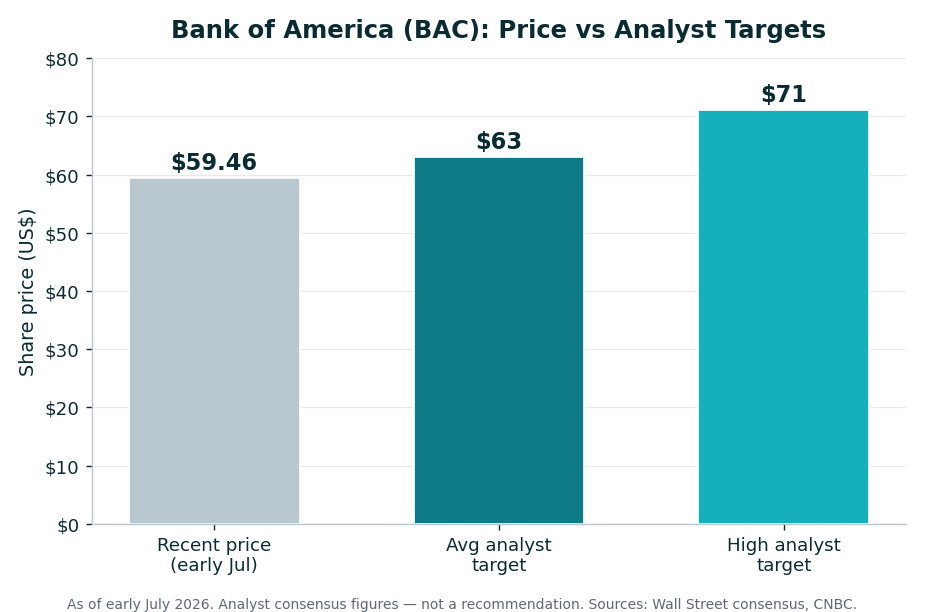
This article was written around Bank of America’s Q1 2026 results. A few things have moved since. Through early July 2026, the stock traded around $59–$60. Importantly, Bank of America passed the 2026 Federal Reserve “stress test" an annual health check that models how a bank would hold up in a severe recession, which clears the way for the dividend increases and share buybacks banks typically announce in July. Wall Street analysts sit at a “Moderate Buy” consensus, with average price targets around $62–$64 (some as high as $71). The stock trades near a 14.5–14.8x trailing P/E, the price-to-earnings ratio, a common yardstick for how expensive a stock is relative to its profits — and pays a dividend yielding about 1.9%.
The next signpost to watch is close: Q2 2026 results are due July 14. Using the lens this article built, the numbers worth watching are net interest income (the loan-versus-deposit spread), whether trading revenue stayed strong, and any dividend or buyback news following the stress-test clearance. None of this is a recommendation, it’s a checklist for reading the next report like an investor rather than a headline.
Frequently Asked Questions
1. Is Bank of America a safe stock for beginners?
It’s generally considered more stable than smaller or speculative companies, but it still carries risk, especially during economic downturns.
2. Why do bank stocks move with interest rates?
Because banks earn money from the difference between what they charge on loans and what they pay on deposits. Higher rates often increase that gap.
3. What does earnings beat actually mean?
It means the company performed better than analysts expected. This often boosts investor confidence.
4. Is trading revenue reliable?
Not really. It can be strong in active markets but weak when markets are quiet. It’s one of the more unpredictable parts of banking.
5. Should beginners focus on bank stocks?
They can be a good part of a diversified portfolio, but it’s important not to rely on just one sector.
Final Thoughts: What This Teaches You as a Beginner Investor
The most valuable lesson here isn’t just about Bank of America, it’s about how to think about stocks.
A single earnings report tells you:
- How a company performs under current conditions
- Which parts of the business are strong
- Whether expectations were realistic
But long-term investing is about patterns, not one-off events. Bank of America’s recent performance shows:
- Stability matters
- Diversification inside a business is powerful
- Beating expectations builds confidence, but doesn’t guarantee future growth
For beginners, this kind of stock can act as a foundation, something steady while you explore higher-growth opportunities elsewhere. The goal isn’t to chase every headline. It’s to understand what’s underneath them.
Disclaimer
This article is for educational purposes only and should not be considered financial advice. Always do your own research or consult a qualified financial professional before making investment decisions.