
The Ethereum Foundation is making post-quantum security a top priority, signaling a shift from long-term research to real engineering work. As timelines around quantum computing shorten, Ethereum’s core contributors say the network needs to prepare now, well before the threat becomes urgent.
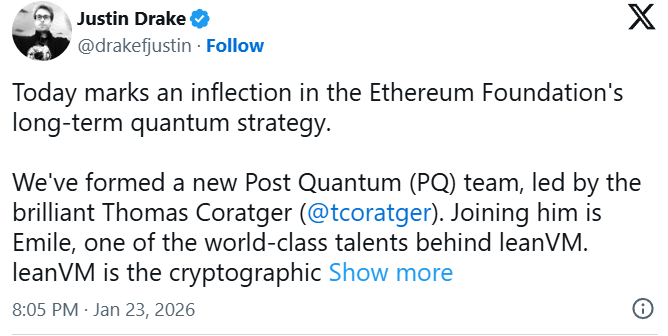
According to Ethereum Foundation (EF) researcher Justin Drake, a newly formed Post-Quantum (PQ) team will focus on upgrading wallet safety, testing quantum-resistant systems, and funding new cryptography research.
Ethereum Moves From Research to Action
For years, post-quantum security lived mostly in the background at Ethereum. That’s changing.
Drake says the foundation is now treating quantum resistance as a strategic issue that needs active development, not just academic discussion. The new Post-Quantum team will be led by Thomas Coratger, with support from Emile, a cryptographer known for work on leanVM.
LeanVM is becoming a key part of Ethereum’s long-term security strategy. Drake argues that while quantum computers capable of breaking today’s encryption don’t exist yet, the time it takes to safely upgrade a global blockchain is long enough that waiting would be risky.
Quantum computers use entirely different types of processors than today’s machines. In theory, they could eventually crack the cryptography that protects blockchain wallets and private keys.
For Ethereum and other large networks, the biggest risk isn’t a sudden quantum breakthrough. It’s the transition period, updating wallets, moving users to new cryptographic standards, and doing it all without disrupting daily activity.
That kind of upgrade takes years, not months.
Developer Sessions and Test Networks Are Already Live
Ethereum’s response is already underway.
Drake outlined several near-term steps, starting with biweekly developer sessions focused on post-quantum transactions. These sessions are expected to begin next month and will be led by Antonio Sanso.
The work will focus on:
- User-facing wallet protections
- New cryptographic tools built directly into the protocol
- Account abstraction paths
- Long-term plans to aggregate transaction signatures using leanVM
On the engineering side, multi-client post-quantum consensus test networks are already running. Multiple teams are involved, and weekly coordination calls are helping ensure different clients can work together smoothly.
Ethereum Backs Research With $2 Million in Prizes

The Ethereum Foundation is also putting real money behind post-quantum cryptography.
Drake confirmed two major research initiatives:
- The $1 million Poseidon Prize, aimed at strengthening the Poseidon hash function
- The $1 million Proximity Prize, focused on advancing post-quantum cryptographic techniques
These prizes are designed to attract top researchers and speed up innovation in an area that will affect the entire blockchain industry.
Community Education and Events Are Coming
Beyond engineering, Ethereum is investing in education and outreach.
The EF plans to host:
- A Post-Quantum event in October
- A dedicated Post-Quantum Day in late March, ahead of EthCC
These efforts will be supported by educational content, including a video series and enterprise-focused materials, aimed at helping developers and organizations understand what’s coming and how to prepare.
Why Ethereum Is Acting Earlier Than Traditional Finance
Some investors believe blockchains may actually have an advantage here.
Pantera Capital’s Franklin Bi noted that traditional financial systems often take many years to upgrade core infrastructure. Blockchains, by contrast, can coordinate full-stack software changes more quickly, if they start early enough.
Ethereum’s move suggests it wants to stay ahead of that curve.
The Bigger Picture
Quantum threats may still be years away, but Ethereum’s leadership appears convinced that preparation can’t wait. By turning research into real-world engineering, funding cryptography, and involving the community early, the network is betting that proactive security will matter more than last-minute fixes.
For a system that secures hundreds of billions of dollars, that mindset may prove essential.
Read: Should You Buy XRP While It’s Under $3? another major network beginners often weigh alongside Ethereum.
Update — Mid-2026: Where the Roadmap Stands
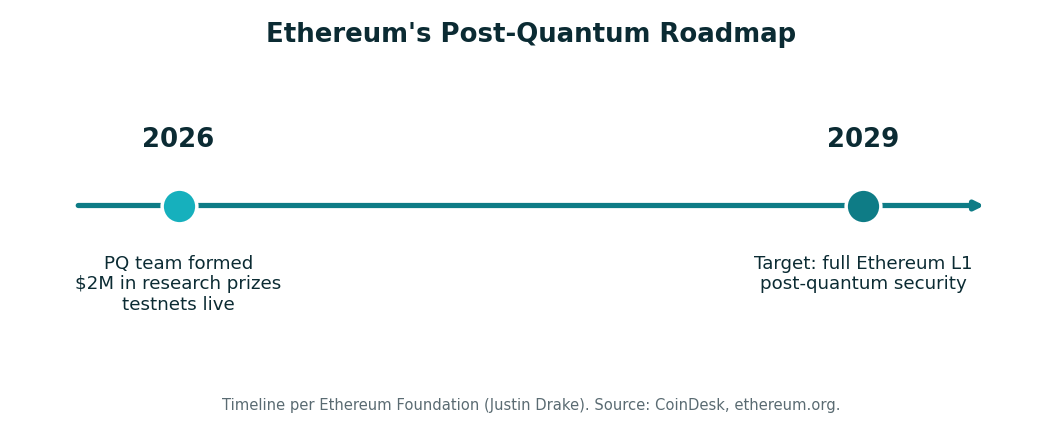
Since this announcement in January 2026, Ethereum’s post-quantum push has moved from plan to public roadmap. Justin Drake has put a concrete target on it: making Ethereum’s base layer (“Layer 1,” the core network) fully post-quantum secure by around 2029, delivered through a series of scheduled network upgrades. The Foundation also launched a public dashboard at pq.ethereum.org so anyone can follow the progress.
On the technical side, the headline work is leanXMSS, a quantum-safe way to handle the digital signatures validators use to confirm transactions, paired with the lightweight leanVM that bundles those signatures together and shrinks the data by roughly 250 times. In plain terms: swap out the cryptography quantum computers could one day break, without bloating the network. The urgency drew fresh attention in spring 2026 after a widely discussed Google research paper (which Drake co-authored) reexamined how close quantum machines are to threatening today’s crypto. Drake has since reframed the whole effort as an “opportunity” for Ethereum to become the first major post-quantum-secure blockchain.
Disclaimer
This article is for informational purposes only and does not constitute financial, investment, or legal advice. Cryptocurrency and blockchain technologies involve risk, and readers should conduct their own research or consult qualified professionals before making decisions.