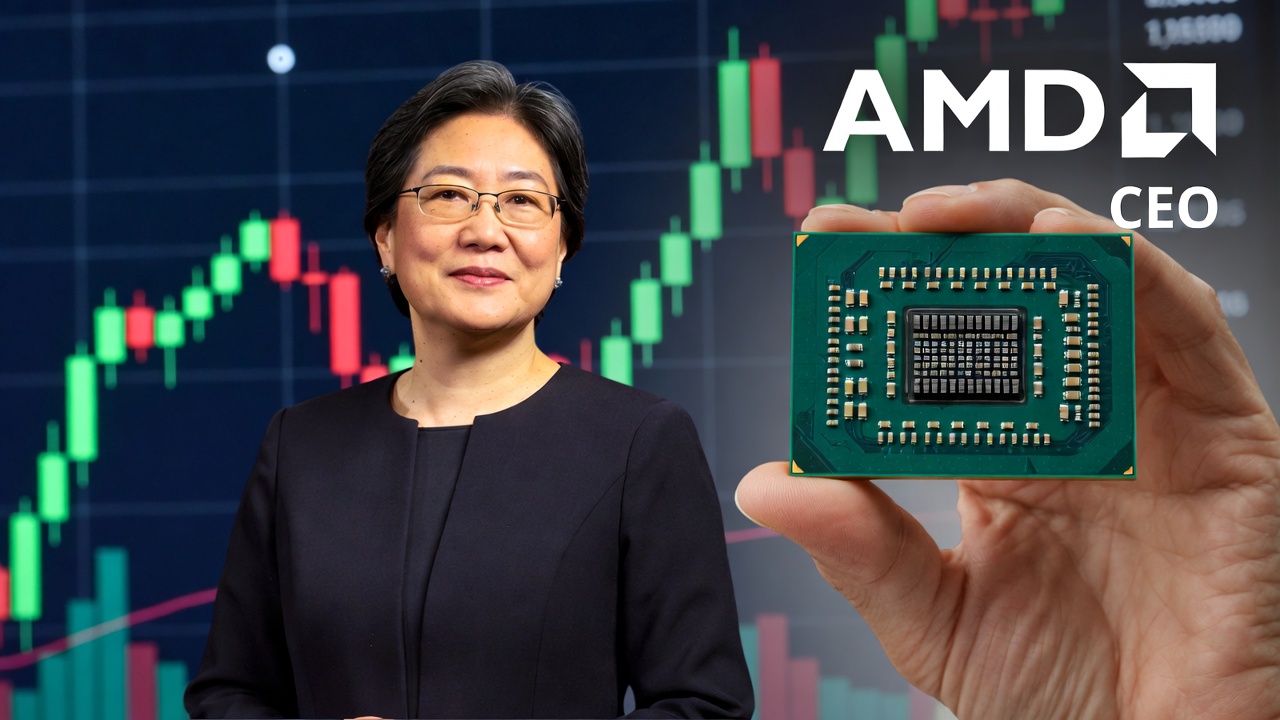
Advanced Micro Devices better known as AMD just delivered an earnings report that, at first glance, looked like exactly what investors usually want to see. Revenue climbed sharply. Profits surged. Demand tied to artificial intelligence remained strong.
And yet, despite beating expectations across the board, AMD’s stock slid more than 6% in after-hours trading.
In this breakdown, we’ll walk through what AMD actually reported, where the company clearly outperformed expectations, why forward guidance became the sticking point, and what this episode says about market psychology in an environment where optimism is already running hot.
No hype. No predictions. Just a clear look at what the company said and why the reaction unfolded the way it did.
AMD’s fourth-quarter earnings comfortably exceeded Wall Street expectations, both on revenue and profitability. For the quarter that ended in December, the company reported:
- Earnings per share: $1.53
Analysts had expected $1.32 - Revenue: $10.27 billion
Analysts had expected $9.67 billion
That’s a clean beat on both the top line and the bottom line.
Revenue rose 34% year over year, an impressive growth rate for a company of AMD’s scale. Even more striking was the jump in profitability. Net income climbed to $1.51 billion, or 92 cents per share, compared with $482 million, or 29 cents per share, during the same quarter a year earlier.
This wasn’t marginal improvement, profit nearly tripled.
From a pure execution standpoint, this was a strong quarter. The kind that, historically, often leads to positive stock reactions.
So why didn’t it this time?

Earnings season isn’t only a report card on what already happened. It’s also a window into what companies believe comes next. And that’s where AMD’s results became more complicated.
While the fourth-quarter performance exceeded expectations, AMD’s outlook for the current quarter didn’t rise quite as far as some investors had hoped, especially given the intense focus on artificial intelligence infrastructure spending across the tech sector.
For the first quarter, AMD said it expects:
- Revenue of $9.8 billion, plus or minus $300 million
That guidance actually sits above the broader analyst consensus of roughly $9.38 billion. On paper, it’s not weak.
But context matters. Expectations around AI-related growth particularly for companies positioned anywhere near data center hardware, have been elevated for months. Some investors were looking for guidance that clearly signaled even faster acceleration ahead.
When that didn’t materialize, the stock came under pressure.
This reaction wasn’t about AMD missing targets. It was about expectations running ahead of what the company was prepared to promise.
AMD shares have more than doubled over the past year. That kind of run tends to raise the bar significantly.
In situations like this, markets often demand not just solid results, but unmistakable forward momentum. Guidance that’s merely “good” can feel underwhelming when optimism is already priced in.
That doesn’t point to a weakening business. It reflects how optimistic investors had become going into the report particularly around AI spending.
To understand why those expectations were so high, it helps to look at AMD’s role in artificial intelligence hardware.
In the market for large-scale graphics processors used to train and run advanced AI models, there are effectively two major players:
- Nvidia, which dominates the space
- AMD, which has emerged as the primary alternative supplier
While AMD’s market share remains much smaller than Nvidia’s, it has attracted growing attention as customers look to diversify suppliers and secure more computing capacity.
Over the past year, AMD has announced several notable AI-related customers, including:
- OpenAI, the company behind ChatGPT
- Oracle, which is expanding its cloud infrastructure
These announcements helped fuel expectations that AMD could steadily increase its role in AI computing, even as Nvidia maintains its lead.

Much of that AI-related activity shows up in AMD’s data center business and this segment delivered one of the strongest performances in the quarter
In the fourth quarter, AMD’s data center revenue reached $5.4 billion, representing 39% growth year over year.
According to the company, this growth came from two areas:
- Its traditional server CPU business
- Its AI-focused GPU offerings
That distinction matters. It suggests that AI demand isn’t limited to graphics processors alone. It’s also driving broader investment in high-performance server CPUs that support AI workloads across data centers.
On the earnings call, CEO Lisa Su highlighted this dynamic directly. She emphasized that the AI build-out is boosting demand not only for GPUs, but also for the server CPUs that work alongside them.
Large cloud providers often referred to as hyperscalers are expanding infrastructure to support AI-driven services. At the same time, enterprise customers are upgrading data centers to handle new AI workflows.
In practical terms, AI is reshaping how computing systems are built, and AMD is participating across multiple layers of that transformation.
Another area drawing close investor attention is AMD’s next wave of AI hardware.
The company plans to begin shipping a new integrated, server-scale AI system called Helios later this year. Unlike selling individual chips, Helios is designed as a complete system optimized for large AI workloads.
This approach can appeal to customers looking for ready-to-deploy solutions rather than assembling complex systems themselves.
Lisa Su said AMD is currently engaged in active discussions with customers about additional Helios sales. While no specific revenue figures were attached to those conversations, the comments signal that AMD views Helios as a meaningful part of its longer-term AI strategy.
More broadly, it reflects AMD’s effort to move beyond components and toward offering more complete platforms.
Outside of data centers, AMD also reported solid momentum in its client and gaming segment.
Revenue here reached $3.9 billion, up 37% year over year. The company attributed much of that growth to demand for Ryzen processors used in laptops and personal computers.
AMD also noted continued market share gains relative to Intel, particularly in PCs.
This is noteworthy because the PC market has been working through a prolonged slowdown following the pandemic surge. Growth in this segment suggests stabilization and potentially early signs of recovery in both consumer and enterprise demand.
While AI captures the headlines, PCs and gaming still represent an important piece of AMD’s overall business.
AMD’s embedded segment which includes chips used in industrial, automotive, and specialized applications posted more modest growth.
Revenue in this segment came in at $950 million, up 3% year over year.
Compared with data centers and PCs, this business was relatively flat. That likely reflects broader industrial demand trends, which have been mixed across the global economy.
For large semiconductor companies, it’s common to see different segments move at very different speeds depending on end-market conditions.
One of the more closely watched issues surrounding AMD has been its exposure to China amid U.S. export restrictions on advanced AI hardware.
In this earnings report, AMD provided additional clarity.
The company said it recorded $390 million in China revenue during the fourth quarter from sales of its Instinct MI308 chips. For the current quarter, AMD expects approximately $100 million in China-related revenue tied to these products.
These figures suggest that, while export controls remain a constraint, AMD is still generating meaningful revenue in China under current regulations.
At the same time, the expected decline in the current quarter highlights how sensitive this revenue stream remains to policy and regulatory changes.
So what’s the broader takeaway?
First, AMD delivered a strong operational quarter. Revenue accelerated, profitability improved sharply, data center demand remained robust, and AI supported multiple parts of the business.
Second, the stock’s decline reflects expectations, not operational weakness. With AI spending front and center and AMD shares already having doubled over the past year, some investors were looking for guidance that clearly signaled faster growth ahead. When that didn’t happen, the stock pulled back.
This is a reminder that markets don’t react to numbers in isolation. They react to how results compare with what investors already expect.
AMD’s earnings highlight a company deeply embedded in some of today’s most important technology trends, particularly artificial intelligence and data center expansion. At the same time, they show how difficult it can be to exceed expectations when optimism runs high.
Strong performance doesn’t always translate into a positive stock reaction especially when forward guidance becomes the focal point.
Disclaimer
This article is for informational and educational purposes only and does not constitute financial, investment, or trading advice. The information presented reflects publicly available data and company statements at the time of reporting. Readers should conduct their own research or consult a qualified financial professional before making any investment decisions.