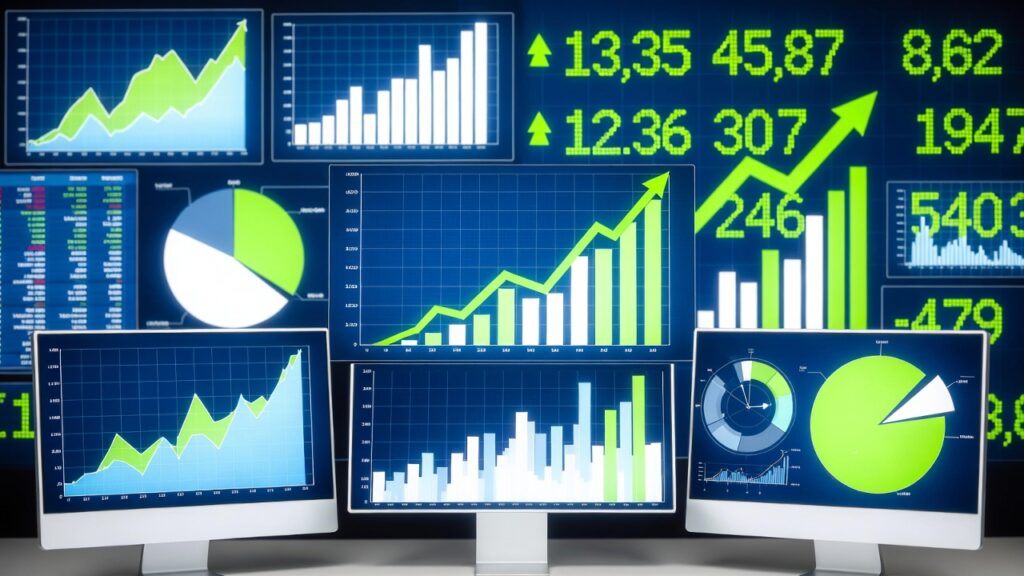
The U.S. stock market has enjoyed a strong run, but recent signals suggest that 2026 may not be as smooth for investors. While the S&P 500 delivered impressive gains in 2025, a combination of trade tariffs, economic pressure, and stretched market valuations is raising concern.
History shows that when these factors come together, stock returns often weaken in the years that follow.
A Strong Market Run Meets Growing Risks
The S&P 500 rose about 16% in 2025, marking its third straight year of double-digit gains. While this performance reflects strong momentum, markets rarely rise indefinitely without pauses or corrections.
Two major issues now stand out:
- The economic impact of President Donald Trump’s trade tariffs
- The very high valuation of U.S. stocks compared with historical norms
Together, these factors are making investors more cautious about what lies ahead in 2026.
How Trump’s Tariffs Are Affecting the U.S. Economy
In 2025, the U.S. sharply increased tariffs on imported goods. According to the Budget Lab at Yale, the average tax on U.S. imports reached 16.8%, the highest level since 1935.
While tariffs were promoted as a way to strengthen the economy, several economic indicators suggest unintended consequences.
Who Is Really Paying the Tariffs?
Although tariffs are charged on foreign goods, research shows the cost largely falls on Americans:
- 82% of tariff costs were paid by U.S. businesses and consumers as of October 2025 (Goldman Sachs)
- By July 2026, consumers alone are expected to carry 67% of the burden
This means higher prices for everyday goods, which can reduce household spending.
Manufacturing, Jobs, and Consumer Confidence Are Weakening
Several key economic indicators have moved in the wrong direction:
Manufacturing Activity
The Institute for Supply Management reports that U.S. manufacturing has been in contraction for nine straight months, largely due to uncertainty created by trade policy.
Employment Trends
- U.S. unemployment is now at a four-year high
- Hiring slowed more in 2025 than any year since the 2009 Great Recession, excluding the pandemic period
Consumer Sentiment
Consumer confidence fell sharply in 2025, recording its lowest annual average since 1960, based on University of Michigan data.
When consumers feel uncertain, spending typically slows, adding pressure to economic growth.
Why GDP Growth May Be Misleading
U.S. GDP grew at an annual rate of 4.3% in the third quarter, the fastest pace in two years. While this looks positive, economists note a distortion.
Imports fell sharply because companies stockpiled goods earlier in the year ahead of tariffs. Since imports are subtracted from GDP calculations, this temporarily boosted growth figures.
Research from the Federal Reserve Bank of San Francisco, based on 150 years of data, shows that tariffs historically lead to:
- Higher unemployment
- Slower long-term economic growth
That combination rarely supports strong stock market performance.
A Valuation Signal Not Seen Since 2000
One of the strongest warning signs comes from market valuation data.
Economist Robert Shiller, a Nobel Prize winner, developed the Cyclically Adjusted Price-to-Earnings (CAPE) ratio to measure whether markets are overvalued. Unlike standard P/E ratios, CAPE uses 10 years of inflation-adjusted earnings, making it more reliable during economic cycles.
As of December, the S&P 500’s CAPE ratio stood at 39.4, its highest level since the dot-com bubble in 2000.
Historically, this level has been extremely rare.
What History Shows After CAPE Exceeds 39
When the S&P 500’s CAPE ratio has moved above 39 in the past, returns have often struggled:
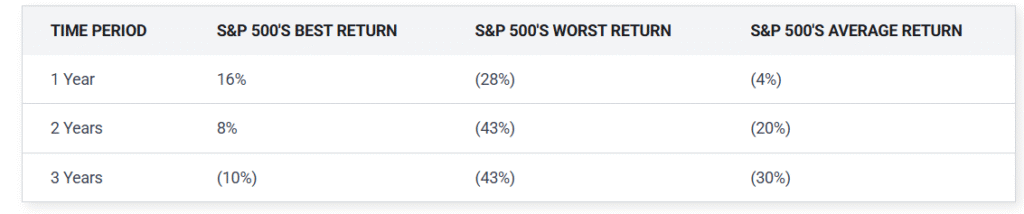
Notably, the market has never produced a positive three-year return after reaching this valuation level.
This does not guarantee an immediate crash, but it does suggest lower long-term returns and higher volatility.
What This Means for Investors in 2026
The message from history is not panic—it is caution.
High valuations combined with economic headwinds have often led to weaker performance over time. Investors may consider:
- Reviewing stocks they no longer strongly believe in
- Gradually increasing cash reserves
- Focusing on quality businesses with strong balance sheets
Markets move in cycles, and managing risk becomes more important when warning signs appear.
Final Thoughts
The S&P 500 enters 2026 at a challenging crossroads. Strong past gains, rising tariffs, economic uncertainty, and historically high valuations create conditions that investors should not ignore.
While no one can predict markets with certainty, history provides valuable context and right now, it suggests caution rather than complacency.
Disclaimer
This article is for informational and educational purposes only and does not constitute financial, investment, or legal advice. Stock market investments involve risk, and past performance does not guarantee future results. Always conduct your own research or consult a qualified financial professional before making investment decisions.